



Ship Rudder: 7 Types, How They Work, and Efficiency
A ship rudder is the primary steering mechanism on marine vessels, generating hydrodynamic force to control direction. When angled against water flow, the rudder blade creates pressure differences on each face, pushing the stern sideways and rotating the ship around its center of gravity, using the same Bernoulli lift principle as an aircraft wing.
Understanding how different ship rudder types compare explains why a supertanker steers differently from a racing yacht, and why modern shipping continues to invest in new designs for better fuel efficiency. This guide covers the 7 main types of ship rudders, their efficiency characteristics, and the factors that determine how well any rudder performs.
How a Ship Rudder Works
The fundamental principle is hydrodynamics. The side force a rudder generates follows:
F = ½ × ρ × V² × A × C_L × sin(δ)
Where ρ is water density, V is vessel speed, A is rudder area, C_L is the lift coefficient, and δ is the deflection angle. This means rudder force grows with the square of vessel speed: a ship moving at 15 knots has roughly 4× more rudder authority than the same ship at 7.5 knots.
Rudder efficiency depends on several key factors:
- Aspect ratio (AR): The ratio of rudder height to width. Higher AR (4–6 is typical) reduces induced drag by 20–30%, improving the lift-to-drag ratio, similar to the difference between long and short aircraft wings.
- Rudder area: Optimal range is 1.5–3% of waterplane area. A 40 m² rudder on a 150 m tanker boosts turning moment by approximately 25%.
- Position relative to propeller: Rudders placed directly in propeller wash receive accelerated water flow, significantly improving low-speed control.
- Hull–rudder integration: Well-matched hull and rudder geometry can improve efficiency by 5–15% versus a poorly matched design.
7 Types of Ship Rudders
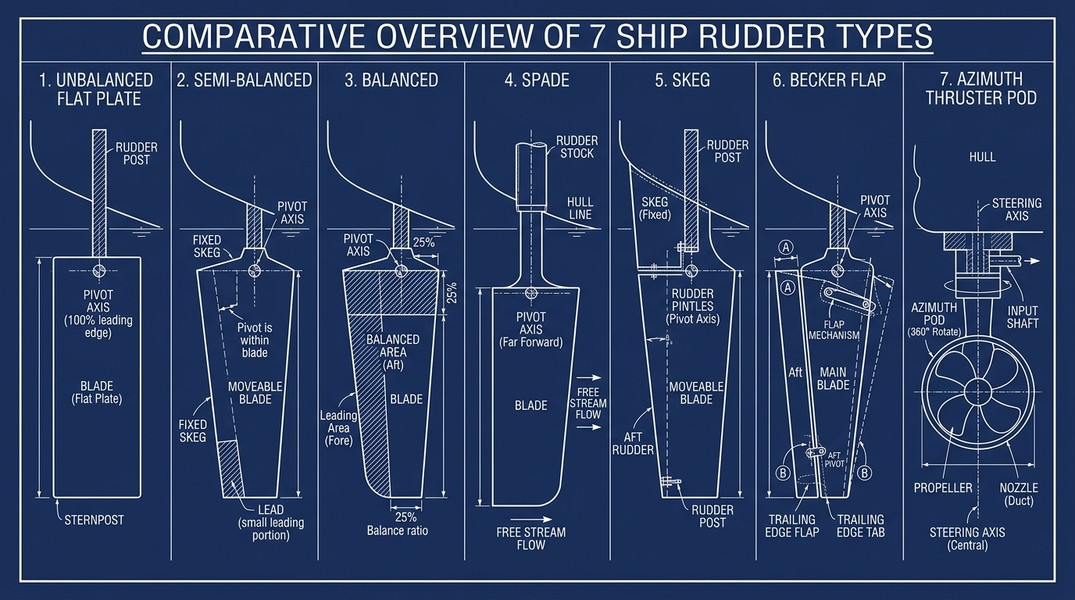
1. Unbalanced Rudder
The oldest and simplest design: the entire blade sits aft of the rudder stock (pivot axis). Every square meter of the blade is behind the pivot, which means all hydrodynamic force works against the steering gear.
Efficiency: This requires high torque to turn; the steering gear must overcome the full lift force. Not suitable for larger vessels where torque requirements become prohibitive. Unbalanced rudders remain common on smaller fishing vessels, river barges, and ice-class ships where mechanical simplicity and robustness matter more than hydrodynamic efficiency.
2. Semi-balanced Rudder
A portion of the blade (roughly 20–30%) extends forward of the pivot axis. This forward area generates lift in the opposite direction to the aft section, partially canceling the torque load on the steering gear.
Efficiency: Reduces steering torque by 30–50% compared to unbalanced designs, improving propulsive efficiency by 2–4%. The semi-balanced configuration is the most common design on modern merchant ships: it offers a practical balance between steering performance, torque requirements, and structural integrity. Most bulk carriers, tankers, and general cargo vessels use this type.
3. Balanced Rudder
The balanced rudder places roughly half the blade area forward of the pivot, nearly eliminating net torque at typical operating angles. The steering gear handles minimal load, allowing faster, more precise course corrections.
Efficiency: Reduces required steering torque by 50–60% versus unbalanced designs and improves propulsive efficiency by 3–5%. Requires careful engineering: too much area forward of the pivot can cause the rudder to self-rotate uncontrollably ("hunting"). Well-designed balanced rudders deliver excellent responsiveness on large ships where steering precision is critical.
4. Spade Rudder
The spade rudder is attached to the hull only at the top via the rudder stock, with the blade hanging free below, unsupported at the bottom. This free-hanging design allows the rudder to rotate through a wide angle with minimal drag.
Efficiency: Excellent maneuverability at speed, with lift coefficients of 1.5–1.8 and propulsive efficiency gains of 4–6%. The dominant design for sailing yachts, performance powerboats, and racing vessels. The key vulnerability is structural: spade rudders are exposed to damage from underwater obstacles, and the cantilever loads require a robust stock.
5. Skeg Rudder
The skeg rudder mounts the blade on a fixed structural extension (skeg) that protrudes from the hull, with the pivot stock running through the skeg. The hull provides direct structural support to the lower rudder.
Efficiency: Reduces propulsive efficiency gains slightly (2–3%) versus spade designs, but the skeg provides significant structural protection and enhances directional stability. Preferred on vessels that frequently operate in shallow water, ice, or areas with debris risk. The skeg also reduces propeller-induced vibration transmitted through the rudder, lowering fatigue loads on the steering gear.
6. Becker/Flap Rudder
The Becker rudder adds a trailing-edge flap that constitutes 10–20% of total chord length. The flap deflects independently (up to 100°) while the main blade moves to a maximum of 35–45°. This coordinated movement produces a compound hydrofoil profile with greatly amplified lift.
Efficiency: The flap raises the maximum lift coefficient from 1.2 (standard rudder) to 2.5, boosting turning force by 15–20% and improving propulsive efficiency by 5–10%. Becker rudders deliver 7–12% fuel savings on bulk carriers versus unbalanced designs, making them the commercial efficiency benchmark. Around 80% of new LNG carriers delivered by Korean yards now incorporate Becker-type rudders. The trade-off is higher manufacturing cost and additional hydraulic maintenance for the flap actuator.
7. Azimuth Thruster (Azipod)
The azimuth thruster eliminates the traditional rudder entirely. Instead, a pod-mounted propulsion unit rotates up to 360°, simultaneously providing propulsive thrust and directional control. Some configurations include a small fixed fin for hydrodynamic efficiency.
Efficiency: Propulsive efficiency gains of 8–15% overall, with turning diameters as low as 0.5 ship lengths in unrestricted water. Azipods excel in dynamic positioning applications, holding position within 1 meter in 99% of conditions, making them standard on cruise ships, offshore support vessels, and specialized research or icebreaker ships. The Azipod XO generation (2026) delivers up to 25 MW per unit and is optimized for Arctic operations.
Efficiency Comparison at a Glance
| Rudder Type | Max Lift Coeff. | Torque Reduction | Propulsive Efficiency Gain | Typical Vessels |
|---|---|---|---|---|
| Unbalanced | 1.0–1.2 | baseline | N/A | Fishing boats, river barges |
| Semi-balanced | 1.2–1.4 | 30–40% | +2–4% | Bulk carriers, general cargo |
| Balanced | 1.3–1.5 | 50–60% | +3–5% | Large cargo ships |
| Spade | 1.5–1.8 | 40–50% | +4–6% | Yachts, fast vessels |
| Skeg | 1.1–1.3 | 20–30% | +2–3% | Tankers, shallow-water vessels |
| Becker/Flap | 1.8–2.5 | 50–70% | +5–10% | LNG carriers, bulk carriers |
| Azimuth thruster | N/A (360°) | N/A | +8–15% | Cruise ships, icebreakers |
Factors That Affect Rudder Efficiency in Practice
Beyond rudder type, several operational factors determine real-world performance:
Vessel speed: Rudder force scales with speed squared, so a ship at 15 knots has 4× more rudder authority than at 7.5 knots. Most rudders become significantly less effective below a minimum threshold speed.
Water depth: Shallow water increases turbulence and degrades performance. Deep-water operation produces the best efficiency for any given design.
Material: Traditional cast iron and bronze (density 7.8–8.8 g/cm³) are being replaced by corrosion-resistant nickel-aluminium bronze (service life 20+ years in saltwater) and carbon-fiber composites (1.6 g/cm³, 40% lighter). Ice-class vessels require steel with yield strength above 500 MPa.
Cavitation: At high speeds, local water pressure can drop below vapour pressure, forming destructive vapour bubbles. Foil-profile rudders (spade, Becker) reduce cavitation risk and are preferred on fast ferries and container ships.
Recent Innovations (2024–2026)
As IMO emissions regulations tighten, rudder design has seen renewed engineering focus:
- Smart rudders with IoT sensors (2025): Strain gauges and AI algorithms predict stall with 95% accuracy and auto-adjust flaps in real time, reducing cavitation erosion by up to 30%. Kongsberg and Rolls-Royce have both deployed commercial systems.
- Twisted trailing-edge Becker rudders (2024): Hybrid designs combining twisted edges with active flaps improve efficiency by an additional 15% and reduce NOx emissions by 10% through optimized propeller–rudder interaction. Now standard on new LNG carrier builds.
- Biofouling-resistant coatings (2025): Silicon-infused composite coatings reduce drag by 8% over five years versus uncoated rudders. Laser-ablative anti-fouling systems, which ablate biogrowth at 50 W/m², are in commercial trials.
- Electrically actuated flaps (2026 pilots): Zero-leak electric servos for fully autonomous vessels, with response times below 0.5 seconds. Rolls-Royce and Wärtsilä are both running commercial pilot programs.
Korea holds approximately 40% of the global market for advanced LNG and ultra-large container ship rudders by 2026, driven by tightening IMO Carbon Intensity Indicator (CII) targets.
Choosing the Right Rudder Type
The appropriate rudder design depends on the vessel's primary use case:
| Vessel Type | Recommended Rudder |
|---|---|
| Fishing boats, river barges | Unbalanced or semi-balanced |
| Racing yachts, sailboats | Spade |
| Bulk carriers, general cargo | Semi-balanced or Becker/flap |
| Tankers | Balanced or skeg |
| High-speed ferries, container ships | Becker/flap |
| Cruise ships, offshore support | Azimuth thruster |
| Icebreakers | Skeg or reinforced unbalanced |
For more on how modern ships are built and categorized, see our guide to types of ships and the key parts of a ship explained. To see these vessel types in action on live AIS data, the Primo Nautic ship tracker shows real-time positions for every vessel class mentioned in this guide.
Most Recent Posts
Discover more articles from our blog.