



What Is AIS? How the Automatic Identification System Works
AIS (Automatic Identification System) is a VHF radio-based tracking system that automatically broadcasts a vessel's position, identity, speed, and navigational data to other ships and coastal authorities. Every commercial vessel over 300 gross tonnes is required to carry an AIS transponder under SOLAS Regulation V/19.2.4, which means you can locate almost any cargo ship, cruise liner, or tanker on a live map from your phone.
Understanding AIS is simpler than it sounds. This guide explains how the system works from signal to screen, what Class A and B transponders actually do, what data gets transmitted, where coverage ends, and how AI-powered apps are building on those foundations.
What Is AIS?
AIS stands for Automatic Identification System. The International Maritime Organization mandated it under SOLAS Regulation V/19.2.4, with full implementation required across the commercial fleet by 2004. The rule covers vessels over 300 gross tonnes on international voyages, those over 500 gross tonnes on domestic routes, and all passenger ships regardless of size.
At its core, AIS is a two-way VHF radio system. Ships broadcast their own position and receive transmissions from nearby vessels. That mutual exchange was designed to prevent collisions, particularly in busy shipping lanes, fog, and low visibility. Coast guards and port authorities adopted it quickly for traffic management.
What changed the system's reach is access. A global network of ground stations and satellites now aggregates AIS signals and publishes them online, turning a collision-avoidance tool into a live tracking platform that anyone can use.
How AIS Works Technically
AIS transmits on two dedicated VHF radio frequencies: 161.975 MHz (Channel 87B) and 162.025 MHz (Channel 88B), using a protocol called STDMA (Self-Organizing Time Division Multiple Access). STDMA divides each frequency into 2,250 time slots that repeat every 60 seconds, allowing individual stations to continuously synchronize and avoid overlapping transmissions — even in ports where hundreds of ships are broadcasting simultaneously.
The hardware on each vessel consists of one VHF transmitter, two VHF TDMA receivers, one VHF DSC receiver, and a standard marine data link to the ship's display system. Position and timing data comes from an integrated or external GPS receiver.
There are two main coverage types, and most tracking platforms combine both.
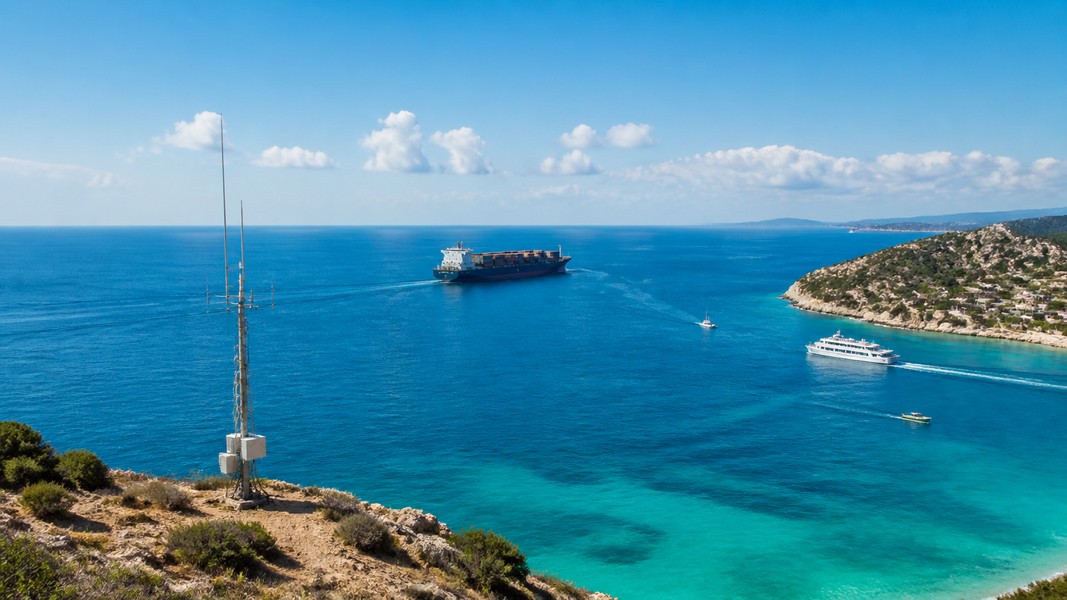
Terrestrial AIS (T-AIS) relies on a network of coastal and port-based ground stations. Each station has a reception range of approximately 40 nautical miles (74 km). T-AIS gives the most frequent and reliable data near coastlines, ports, and major shipping lanes, but its coverage ends where the horizon does.
Satellite AIS (S-AIS) extends coverage globally. Organizations like Global Fishing Watch use S-AIS to monitor vessel activity across entire ocean basins. It works well in remote waters but can struggle in extremely congested areas where hundreds of nearby vessels transmit simultaneously and signals overlap.
AIS Range: How Far Does the System Reach?
The VHF frequencies that AIS operates on limit its line-of-sight range to approximately 40 nautical miles under normal conditions from a shore station, and up to 20–30 nautical miles between two vessels at sea level.
This constraint means terrestrial AIS coverage is restricted to coastal waters and areas within radio transmission range of shore stations. Deep ocean transit routes — particularly in the South Atlantic and parts of the Pacific — have historically thin T-AIS coverage, meaning vessels crossing those waters may appear intermittently.
Satellite AIS fills this gap in theory. Over 100 billion AIS messages have been processed from satellite receivers, generating global route density data spanning more than a decade. However, satellite receivers in high-traffic areas can receive overlapping signals from thousands of vessels simultaneously, causing message collisions that reduce data reliability. Long Range Identification and Tracking (LRIT) is a separate satellite system distinct from AIS — it operates globally but requires vessels to transmit on demand rather than continuously.
Position data refreshes every 2 to 10 seconds for vessels moving above 14 knots in high-density areas. For slower vessels in open ocean, updates can come as infrequently as every 3 minutes.
Class A vs Class B AIS Transponders
Not all vessels transmit at the same level. The two transponder classes differ significantly in power, update frequency, and regulatory requirements.
Class A transponders are required on all large commercial ships — any vessel over 300 GT on international voyages, cargo vessels over 500 GT on domestic routes, and all passenger ships. Class A units broadcast at 12.5 watts, update dynamic position data every 2–10 seconds depending on speed, and transmit static vessel information every 6 minutes. They include the full AIS data set: static, dynamic, and voyage information.
Class B transponders are designed for smaller, non-SOLAS vessels — private yachts, coastal fishing boats, and recreational craft. They transmit at 2 watts, update position roughly every 30 seconds, and broadcast a more limited range of information. Class B is optional for most small craft but widely adopted by safety-conscious boaters.
| Feature | Class A | Class B |
|---|---|---|
| Required by SOLAS | Yes (300 GT+ international, all passenger) | No |
| Transmit power | 12.5 watts | 2 watts |
| Position update rate | 2–10 seconds (underway) | ~30 seconds |
| Static data interval | Every 6 minutes | Every 6 minutes |
| Typical users | Commercial cargo, tankers, cruise ships | Yachts, recreational, small commercial |
The practical consequence for tracking: a large cruise ship or container vessel is almost always visible on AIS platforms. A small private yacht may or may not appear, depending on whether it carries a transponder and whether it is switched on.
What Data AIS Captures
AIS transmissions carry three distinct categories of information.
Static data identifies the vessel itself: ship name, MMSI number (a unique 9-digit identifier assigned for the vessel's lifetime), IMO number, call sign, vessel type such as cargo, passenger, or tanker, and physical dimensions including length and beam. Static data is programmed into the transponder and rarely changes.
Dynamic data is what makes AIS useful in real time. Each broadcast includes latitude and longitude derived from GPS, speed over ground (SOG), course over ground (COG), true heading, and navigation status. Navigation status codes describe whether the vessel is underway, anchored, moored, restricted in maneuverability, or not under command — codes that often explain what looks like unusual behavior on the map.
Voyage data fills in the journey context. The captain manually enters the destination port, expected time of arrival, and the vessel's current draught (how deeply it sits in the water, indicating cargo load). This data should be updated when plans change, though in practice it often isn't, which creates a gap between the displayed ETA and reality.
For understanding how to use AIS data to follow a specific ship, the guide on tracking a cruise ship in real time covers the practical process step by step.
AIS Tracking Limitations
AIS is reliable for most commercial vessels in most conditions, but several real gaps affect its accuracy.
The "dark ship" problem is the most significant. AIS transponders can be switched off. Under SOLAS guidelines, the master of any vessel has discretion to turn off the AIS unit if its continual operation might compromise the vessel's safety or security. When a vessel goes dark, it disappears from the map without warning.
Geographic blind spots persist even with satellite coverage. Deep ocean transit routes, particularly in the South Atlantic and parts of the Pacific, have historically thin T-AIS coverage. The 40-nautical-mile shore station range means vessels crossing those waters may appear intermittently.
AIS spoofing is a documented and growing concern. Vessels in restricted regions have been found broadcasting false GPS coordinates to disguise their actual location. Security researchers have tracked cases in the Eastern Mediterranean, around North Korea, and in Persian Gulf routes where ships manipulate their transmitted position to avoid regulatory attention.
Data accuracy from crowdsourced receivers is another limitation. Publicly available AIS websites sometimes use non-certified base stations that may not provide accurate data. The IMO does not support the display of AIS on public websites for this reason — crowdsourced receivers may lack certification standards.
In congested ports, signal interference is common. When hundreds of vessels transmit from the same area simultaneously, receivers struggle to decode individual signals cleanly. The result can be brief gaps in position data that resolve once the vessel clears the port.
Finally, voyage data is only as reliable as the person who entered it. Captain-reported ETAs are frequently optimistic and rarely updated mid-voyage.
How AI Transforms AIS Data
Raw AIS data tells you where a ship is. AI helps you understand what that means for your specific situation.
Machine learning models can analyze a vessel's actual speed, historical routes, seasonal patterns, and current weather conditions to produce a more realistic arrival estimate than the captain's manually entered number.
Primo Nautic addresses this with a dual ETA system that compares the captain's reported arrival time against an AI-calculated prediction. When the two diverge significantly, the app flags the discrepancy — more useful than raw AIS data alone for anyone planning to meet a ship or coordinate around a cargo delivery.
Beyond ETA prediction, AI enables personalization that basic AIS viewers cannot offer. A parent following a child on a voyage wants reassurance and plain-language updates, not a stream of bearing coordinates. A logistics coordinator wants delay probability and port clearance windows. Primo Nautic adapts its updates based on the reason you select for tracking.
Weather integration adds another dimension. Overlaying real-time meteorological data at the vessel's exact AIS-reported coordinates shows not just where the ship is, but what sea state it is currently sailing through.
Getting Started with AIS Vessel Tracking
No specialist equipment is needed to start tracking vessels. A smartphone or desktop browser is sufficient.
The most reliable way to find a specific ship is to search by MMSI number. This 9-digit identifier is unique to the vessel and eliminates ambiguity when searching for a common ship name. Cruise lines list MMSI numbers on their websites under fleet information pages.
For anyone wanting more than a dot on a map, the available vessel tracking apps vary considerably in what they offer beyond raw AIS data. Free tools show live position and basic fields. More capable apps add notifications for arrivals and departures, delay alerts, AI-generated summaries, and dual ETA tools that go beyond what the captain entered into the transponder.
You can also compare the leading tracking platforms directly in the VesselFinder vs MarineTraffic comparison to find which suits your tracking needs.
AIS as a Foundation, Not the Full Picture
AIS vessel tracking gives you access to globally distributed position data on millions of ships. The system works because SOLAS Regulation V/19.2.4 requires commercial vessels to broadcast it, and because a worldwide infrastructure of receivers and satellites collects those signals.
Understanding what AIS can and cannot do helps you read the map accurately. A ship that disappears may have a technical explanation or a deliberate one. A captain-reported ETA may have no relationship to when the vessel actually arrives. Signal gaps in open ocean are normal.
AI layers on top of AIS to address those limitations: generating arrival estimates when transponder data is stale, personalizing updates for different tracking purposes, and translating coordinates into language that matches why you are tracking a ship in the first place. The underlying technology has been at sea for decades. What has changed is how much of it is now accessible, and how much smarter the tools built on top of it have become.
Most Recent Posts
Discover more articles from our blog.