A roll-on roll-off ship, commonly called a ro-ro ship, is a vessel built specifically for wheeled cargo that drives on and off via built-in ramps. There are no cranes involved: vehicles roll aboard under their own power or with a tug, are secured on multi-level decks, and roll off again at the destination port. Ro-ro ships are the reason a car manufactured in Japan can end up in a showroom in Germany without a scratch.
Ro-ro vessels form a critical but often invisible part of global trade. If you have ever watched a large ship unload hundreds of vehicles at a port, you have seen a roll-on roll-off ship at work. This article covers how they work, the different types, the cargo they carry, and the major operators that keep the global automotive supply chain moving.
How a Roll-On Roll-Off Ship Works
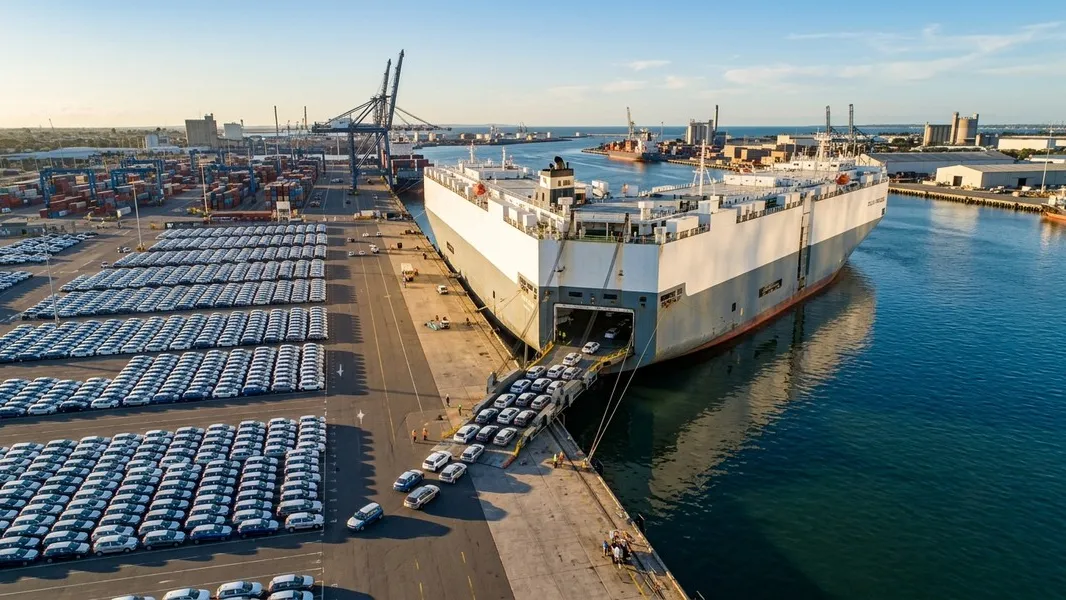
The defining feature of every ro-ro ship is its ramp system. Most vessels use a stern ramp: a hinged platform at the rear of the ship that lowers to connect the main deck with the dock surface. Some ships also have bow ramps, quarter ramps on the sides, or internal elevators to shift vehicles between decks. Once a vehicle reaches the correct level, crew members position it on a designated lane and lash it down with chains and straps attached to reinforced deck fittings.
Capacity is measured in Car-Equivalent Units (CEU), a standard that converts every type of cargo to its equivalent car-sized footprint. A compact passenger car counts as one CEU. A large truck might count as four. This metric lets operators compare different vessel sizes and plan cargo manifests precisely.
Modern PCTCs, the largest category of ro-ro ship, carry 6,000 to 8,500 CEU on a single voyage. The decks are adjustable: hoistable car-deck panels can be raised or lowered to accommodate taller vehicles such as trucks, buses, or farm equipment. Loading a fully loaded PCTC typically takes 12 to 24 hours at a busy auto terminal.
Types of Roll-On Roll-Off Vessels
Not all ro-ro ships are identical. The category covers several distinct sub-types, each optimized for a different cargo mix.
Pure Car Carrier (PCC)
The PCC is built solely for passenger vehicles, with decks close together to pack in the maximum number of cars. Capacities range from around 1,000 CEU on older vessels to 5,000 CEU on newer builds. PCCs move the bulk of finished-vehicle exports from manufacturing countries.
Pure Car and Truck Carrier (PCTC)
The PCTC is the dominant vessel type in the global automotive trade. It handles cars, trucks, buses, construction equipment, and agricultural machinery on reinforced decks capable of supporting loads up to 100 to 120 tonnes per unit. The adjustable decks allow one voyage to carry a mix of sedans and heavy tractors in the same hold.
ConRo
A ConRo combines roll-on roll-off capability with container stacking. The lower decks accommodate wheeled cargo that rolls aboard, while the upper decks or hatches carry stacked containers. This hybrid design makes ConRo vessels useful on trade lanes where cargo volumes are mixed and no single cargo type justifies a dedicated ship.
RoPax
RoPax ferries integrate a vehicle deck with passenger accommodations. You see them on short-sea ferry routes, where they carry trucks and cars alongside hundreds of foot passengers. The Baltic and Mediterranean are dense with RoPax traffic, as is the English Channel and routes connecting Scandinavian countries.
Heavy-Lift Ro-Ro
Some ro-ro vessels are designed specifically for project cargo: wind turbine components, large industrial machinery, military vehicles, and locomotives. These ships have extra deck reinforcement and specialized loading arrangements for outsize items that cannot fit a standard car deck.
What Cargo Do Ro-Ro Ships Carry
The primary cargo of ro-ro ships is the automobile. Japanese and South Korean manufacturers export millions of finished vehicles annually, and the majority move by ro-ro rather than container. The reason is straightforward: loading a car into a container requires special frames or disassembly, adds cost, and risks damage. On a ro-ro, a car rolls aboard in the same state it left the factory floor.
Beyond passenger cars, ro-ro ships routinely carry trucks, buses, and vans. Agricultural and construction equipment such as tractors, bulldozers, and cranes are a growing segment, as are military vehicles shipped under defense contracts. Railway rolling stock, including locomotives and wagons, can also move by ro-ro on vessels configured for the extra weight and height.
Electric vehicles have introduced new handling requirements. EV batteries require pre-voyage inspection surveys, and some operators enforce charging restrictions during the voyage to manage fire risk. Some ro-ro vessels are being retrofitted with battery monitoring systems to accommodate the growing share of EVs in global vehicle trade.
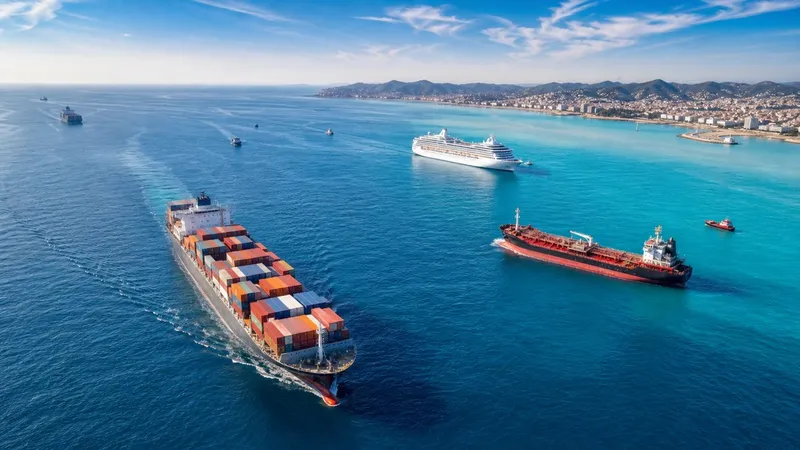
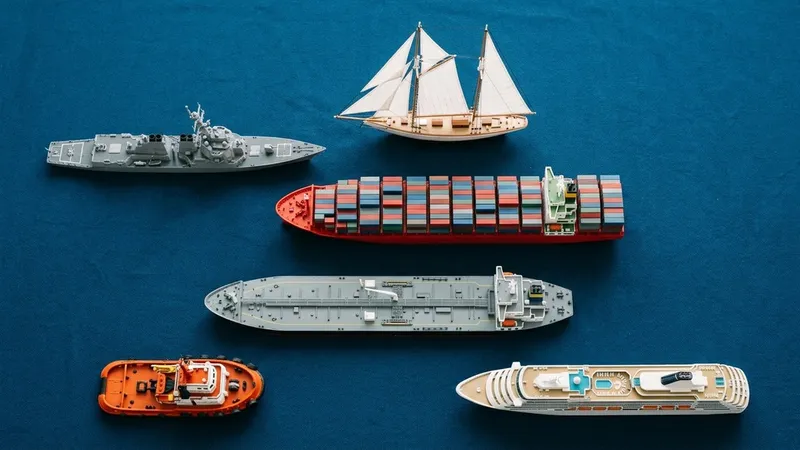
Anything on wheels that can be driven or towed onto a ramp is a candidate for ro-ro transport. That flexibility is its core advantage. For cargo that cannot fit standard containers, ro-ro is often the most practical option available. You can see how ro-ro vessels fit into the broader picture of vessel types at sea, from bulk carriers and tankers to container ships.
Major Ro-Ro Operators and Routes
A small number of specialized shipping companies control most of the global ro-ro fleet. Wallenius Wilhelmsen, a Norwegian-Swedish company, is one of the largest pure car and truck carrier operators in the world, with a fleet spanning transoceanic trade routes between Asia, Europe, and North America. Höegh Autoliners, also Norwegian, operates a similar network and has committed to ordering zero-emission vessels for future fleet renewal.
Japanese companies are major players too. K Line, NYK Line, and Mitsui O.S.K. Lines (MOL) each operate large PCTC fleets connecting Japanese and South Korean automotive factories to markets across Europe, North America, Australia, and the Middle East. The Asia-Europe and Asia-North America lanes are the highest-volume corridors in the automotive trade.
The global ro-ro fleet includes over 750 active vessels. Analysts project the automotive transportation market to grow from around USD 468 million in 2026 to over USD 800 million by 2033, driven in part by rising vehicle exports from new manufacturing centers in Southeast Asia and Mexico.
Ro-ro vessels are fully trackable by AIS, which means you can follow any PCTC or car carrier in real time. Primo Nautic displays live position, speed, heading, and estimated arrival time for ro-ro ships on any active trade route. Cargo monitors waiting on a vehicle shipment can follow the vessel's progress and receive delay alerts without needing access to carrier logistics portals.
Ro-Ro vs Lo-Lo: Key Differences
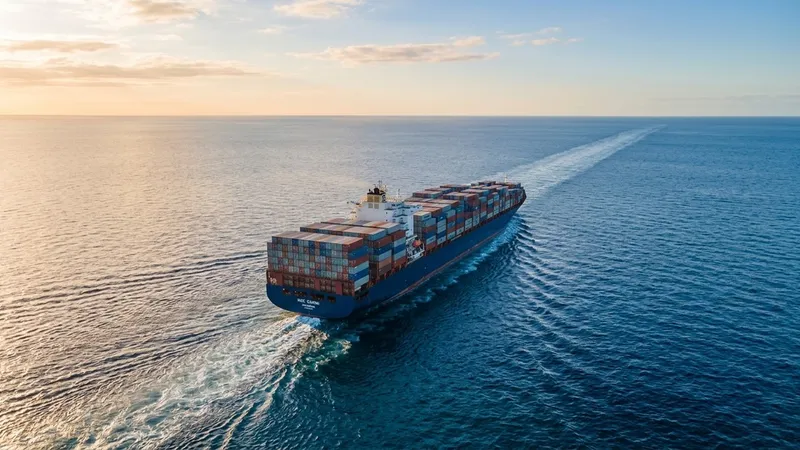
The alternative to ro-ro loading is Lo-Lo, which stands for lift-on lift-off. In a Lo-Lo operation, shore-based cranes or ship-mounted cranes lift cargo on and off the vessel. The standard container ship is a Lo-Lo vessel: containers are lifted one by one and stacked in holds.
Ro-ro has several advantages over Lo-Lo for wheeled cargo. Loading is faster because vehicles move under their own power rather than waiting for crane cycles. There is less risk of cargo damage because nothing is lifted off the ground. And ro-ro ships can operate at ports with minimal crane infrastructure, as long as there is a berth with enough draft and a flat ramp connection.
Lo-Lo wins for cargo that does not have wheels, is already containerized, or needs the weather protection of a sealed metal box. According to the World Shipping Council, container ships carry roughly 90 percent of non-bulk manufactured goods globally, so the two systems handle fundamentally different niches. Containerization standardized global trade around the 20-foot equivalent unit (TEU); ro-ro standardized vehicle shipping around the CEU.
For very large or very heavy project cargo that cannot roll, float-on float-off (Fo-Fo) ships offer a third method, where cargo floats onto a partially submerged deck. For anything on wheels, though, the roll-on roll-off method remains the most efficient and cost-effective approach.
How Ro-Ro Ships Operate in Port
A ro-ro call at port follows a predictable sequence. The vessel berths stern-in where possible so the main ramp gives direct access to the terminal yard. Yard tractors, also called tugmasters, collect each vehicle from the ship and drive it to a staging area for inspection and processing. At auto export terminals, the process runs in reverse: vehicles arrive by rail or road transporter and queue for drive-on loading.
The lashing process is critical to safe transport. Each vehicle is secured to the deck using at least four lashing points, with chains rated for the vehicle's weight. Lashing crews work methodically through each deck before the ramp closes. Improper lashing is a leading cause of cargo shift at sea, which can damage vehicles and in severe cases affect the ship's stability.
Port turnaround time for a large PCTC handling 6,000 vehicles can be as short as 24 hours at an efficient terminal. Primo Nautic users tracking a ro-ro vessel can observe these short port windows directly in the vessel's voyage history: the app logs departure just hours after arrival, reflecting how tightly operated these cargo calls are. Compare that with oil tankers, which often spend several days in port for loading and discharge.
Conclusion
Roll-on roll-off ships are a specialized but indispensable part of global shipping. They move the world's vehicles, from mass-market cars to military equipment, using a simple and efficient principle: if it has wheels and fits on a ramp, it can travel by ro-ro. The main types, PCC, PCTC, ConRo, RoPax, and heavy-lift ro-ro, each fill a different role depending on cargo mix and route requirements. A handful of major operators, including Wallenius Wilhelmsen, Höegh, K Line, NYK, and MOL, dominate the transoceanic lanes that connect manufacturing regions to consumer markets. The fleet is growing, driven by rising vehicle trade volumes and the ongoing transition to electric vehicles, which are reshaping how ro-ro operators handle and monitor their cargo.