Boat navigation lights are the color-coded signal system every vessel uses to show its position, heading, and status to other mariners at night and in restricted visibility. Red, green, and white lights placed at precise positions tell surrounding vessels which way you are heading and what type of vessel you are, making collision avoidance possible even when sight lines are zero. Under the COLREGS framework, displaying correct boat navigation lights is a legal requirement from sunset to sunrise and during any period of reduced visibility.
This guide covers every rule you need: the exact colors and what they signal, arc coverage in degrees, visibility distance requirements by vessel size, and the correct light configuration for each vessel type.
The 3 Navigation Light Colors and What They Signal
The color of a navigation light tells nearby mariners which side of your vessel they are looking at. By reading both sides together, they can determine your heading and relative position in seconds.
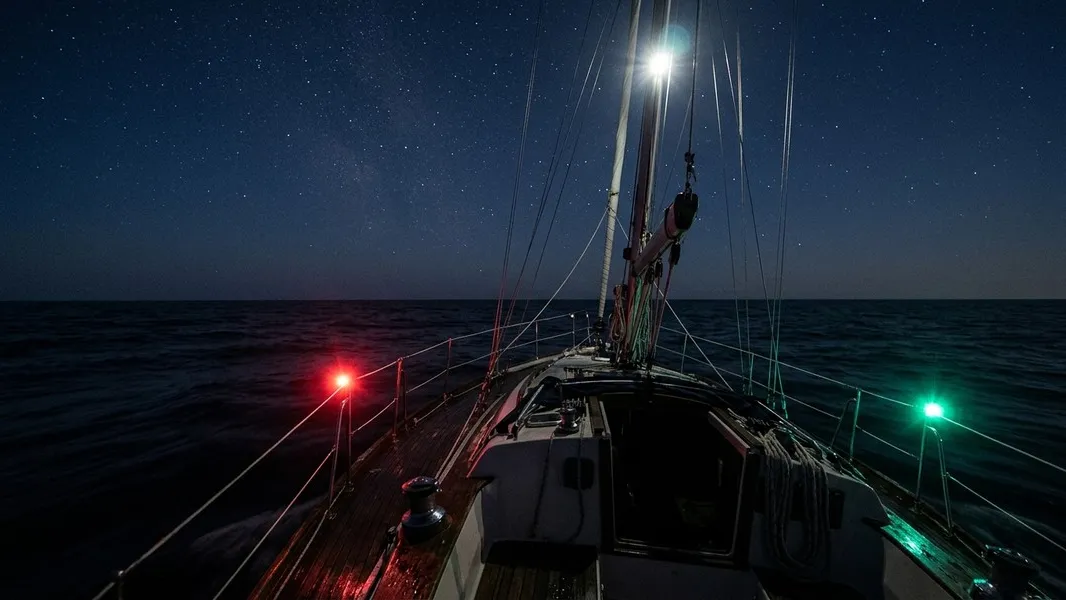
Red marks the port (left) side. When another mariner sees your red light, they are viewing your left side. If they see both a red and green light ahead simultaneously, a head-on or crossing situation is forming and right-of-way rules apply. Red on port is easy to remember: both "port" and "red" are shorter, four-letter words.
Green marks the starboard (right) side. Seeing your green light means the observer is on your right side. In a crossing situation, a vessel seeing the red sidelight of another must give way; the vessel showing green holds course and speed.
White serves two functions. The masthead light shines forward to confirm your vessel is underway under engine power. The stern light shines aft to show your direction to any vessel astern. At anchor, a single white all-round light indicates you are stationary. Understanding port and starboard is the foundation for reading these signals correctly in any situation.
Navigation Light Positions and Arc Coverage
Each navigation light on a vessel covers a specific arc of visibility measured in degrees. Getting the position right is not optional: a light mounted in the wrong place changes what surrounding mariners see and can lead to misread headings.
The masthead light is a white light mounted forward on the centerline. It covers 225 degrees, from dead ahead to 22.5 degrees past each beam. The stern light, also white, mounts at the rear and covers the remaining 135 degrees from dead astern back to 67.5 degrees forward of the beam on each side. Masthead and stern together cover the full 360-degree circle.
Sidelights cover 112.5 degrees each. The red port sidelight shines from dead ahead to 22.5 degrees abaft the port beam. The green starboard sidelight does the same on the other side. All-round lights cover a full 360 degrees and are used for vessels at anchor, fishing vessels, and vessels with special status. The towing light, a yellow light, covers 135 degrees and mounts directly above the stern light.
Sidelights must be mounted on their respective sides of the vessel at a position that produces the correct arc. Mounting them too far forward or aft distorts coverage and creates blind spots that violate COLREGS rules.
COLREGS Visibility Requirements by Vessel Size
COLREGS Rule 22 sets minimum visibility distances for each navigation light based on vessel length. These are not suggestions: operating with lights that fail to meet the specified range is a violation regardless of whether a collision occurs.
Vessels over 50 meters must show a masthead light visible at 6 nautical miles. Sidelights, stern lights, towing lights, and all-round lights on these larger vessels must be visible at 3 nautical miles.
Vessels between 12 and 50 meters need a masthead visible at 5 nautical miles, or 3 nautical miles for vessels under 20 meters. All other lights on vessels in this size range require a 2-nautical-mile range.
Vessels under 12 meters must show primary lights visible at 2 nautical miles, with sidelights at a minimum of 1 nautical mile. These distance thresholds explain why cheap non-certified LEDs can result in a violation even when the light is technically on.
COLREGS Rule 20 requires all navigation lights from sunset to sunrise and during any period of restricted visibility, including fog, heavy rain, and haze, regardless of time of day. No other lights that impair or could be confused with navigation lights are permitted.
Navigation Lights by Vessel Type
The configuration required depends on your vessel type and length. The table below covers the most common categories:
| Vessel | Configuration Required |
|---|---|
| Powerboat under 7m | Sidelights plus stern, or all-round white plus sidelights |
| Powerboat 7-12m | White masthead (225°) + sidelights (112.5°) + stern (135°) |
| Powerboat over 12m | As 7-12m; vessels over 50m add a second masthead light aft |
| Sailboat under sail | Sidelights plus stern, or tricolor masthead light on vessels under 20m |
| Sailboat under engine | Same as powerboat of equivalent size |
| Vessel at anchor | White all-round at highest accessible point |
| Vessel under tow | Yellow towing light above stern light; towed vessel shows sidelights plus stern |
| Vessel restricted in maneuvering | White, red, and green all-round lights plus underway lights |
Small powerboats under 7 meters have a simplified option: a single all-round white light combined with sidelights, rather than the full masthead-plus-stern setup. This is the standard configuration on dinghies, tenders, and small runabouts. The all-round white allows surrounding vessels to see the boat from any direction, though it provides less directional information than a masthead-plus-stern combination.
Sailboats underway under engine power are treated as power-driven vessels under COLREGS and must display the same lights as a motorboat of equivalent size. Under sail alone, they switch to sidelights plus a stern light, or a single tricolor light at the masthead if the vessel is under 20 meters. The tricolor combines red, green, and white into a single unit and is only permitted when sailing, not motoring.
Fishing vessels, vessels not under command, and vessels restricted in their ability to maneuver carry additional lights and shapes beyond the base configurations. If your vessel falls into any of these categories, consult the full USCG navigation rules for your specific setup.
When You Must Show Navigation Lights
The requirement is simpler than many boaters assume. Display navigation lights between sunset and sunrise, and any time visibility is restricted, not just when it is fully dark.
A fog bank at noon, a rain squall in the afternoon, and a sudden drop in visibility from blowing spray all trigger the same requirement as full darkness. This is one of the most frequently violated aspects of Rule 20 because recreational boaters associate lights with nighttime rather than visibility conditions.
Anchored vessels also have a light obligation. If you are swinging on a hook overnight, you must display a white all-round light so underway vessels can identify you as a stationary hazard. Vessels under 7 meters anchored away from a fairway or anchorage are exempt from this rule in practice, but the default is to show the light.
7 Common Navigation Light Mistakes
- Wrong configuration for your vessel size. A 14-foot powerboat has different requirements than a 40-foot cruiser. Check your length bracket against COLREGS Rule 23 before fitting any lights.
- Sidelights mounted off-centerline. Sidelights must be on their respective sides at a position producing the correct 112.5-degree arc. Off-center mounting distorts the arc and gives other mariners a false picture of your heading.
- Skipping lights in restricted daytime visibility. COLREGS Rule 20 requires lights any time visibility is restricted, not only after dark. Fog, heavy rain, and thick haze all trigger the requirement.
- Using all-round white instead of a tricolor on a sailboat. A single all-round white light does not communicate that you are a sailing vessel or which direction you are heading. Other mariners cannot determine your course from it.
- Gear, sails, or passengers blocking light arcs. A fender bag over a sidelight or a stacked headsail in front of the masthead light creates a blind sector. Verify clear arcs before every night passage.
- Using non-certified aftermarket lights. Not all marine lights sold as "navigation lights" meet COLREGS visibility and arc specifications. Use only ABYC-certified or USCG-compliant fixtures to ensure your lights actually meet the required ranges.
- Failing to test batteries before departure. LED navigation lights draw minimal current, which can mask a degrading battery until it fails completely. Test your lights before every night passage and carry spares for fuse-protected circuits.
How AIS Complements Navigation Lights
Navigation lights give visual signals to vessels within line of sight. AIS vessel tracking adds a digital layer: every AIS-equipped vessel broadcasts its identity, position, speed, and heading via VHF radio, which any receiver or compatible app can display on a chart in real time.
Both systems serve the same goal: situational awareness and collision avoidance. They work differently, though. Navigation lights are passive: they require no equipment on the receiving vessel beyond functioning eyesight at range. AIS is active: it requires a transponder on the broadcasting vessel and a receiver or mobile app on the observing side.
In dense traffic or poor visibility, lights alone can create confusion when multiple vessels overlap on the water. AIS resolves that by identifying each vessel individually and showing its course and speed. Primo Nautic uses live AIS data to show real-time vessel positions, movement, and conditions, so you can monitor vessels of interest whether you are following a cruise ship, tracking a cargo arrival, or keeping an eye on your own boat remotely.
Knowing how navigation lights work makes AIS data more meaningful: when you see a vessel on the Primo Nautic map heading your way, you already understand what its sidelights are communicating to boats near it on the water.
Conclusion
Boat navigation lights follow a consistent logic: red for port, green for starboard, white for masthead and stern. Arc coverage, visibility distances, and required combinations vary by vessel type and size, but COLREGS applies the same framework across every vessel class. Know which configuration your vessel requires, verify that every light meets the visibility distances for your length, and display them any time conditions reduce visibility, not only after dark. Navigation lights and AIS tracking work best together: lights handle the close-range visual layer while digital tracking adds positional context across the broader traffic picture.