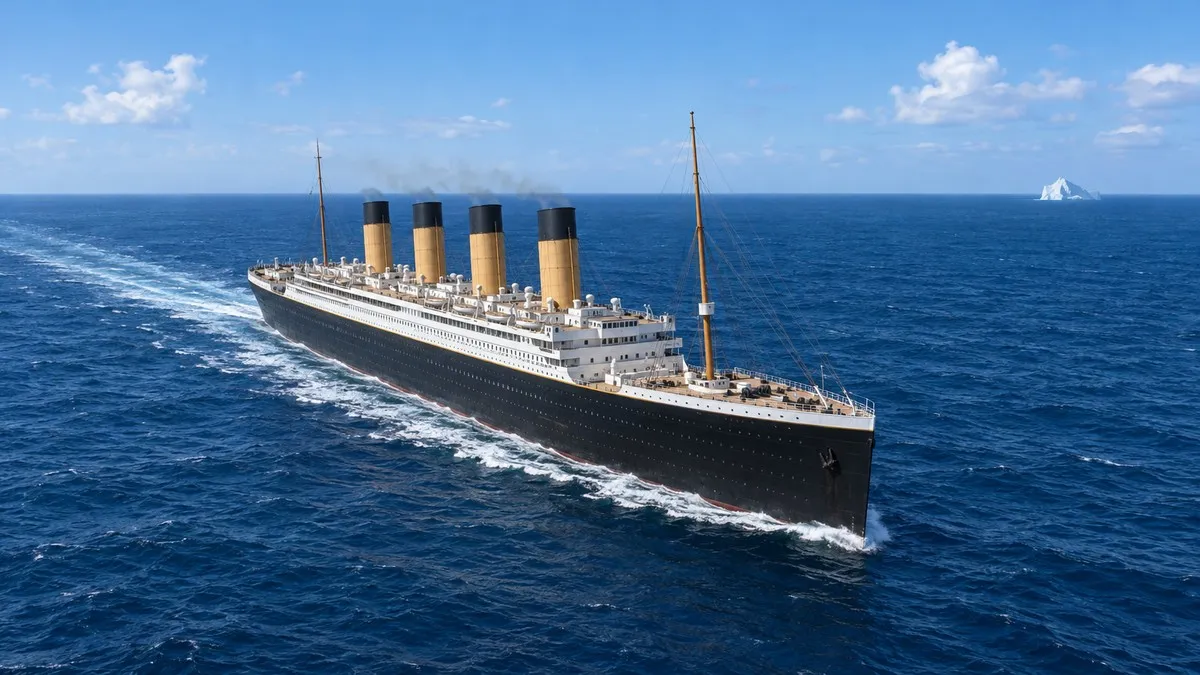
The core Titanic facts fit in one line: an 882-foot liner struck an iceberg at 11:40 p.m. on 14 April 1912, sank 2 hours and 40 minutes later, and took roughly 1,500 of the 2,200-plus people on board with her. Every one of those numbers has a story behind it, and several of them are still argued over more than a century later.
Most lists of Titanic facts mix trivia with myth. This one sticks to numbers you can trace back to a primary record: the 1912 British and American inquiries, the ship's registry entry, and the agencies that found and now protect the wreck. Read together, the 11 numbers below explain not only what happened that night, but why ships at sea are run the way they are today.
882 Feet: Titanic Facts About Her Size
The Titanic measured 882 feet 9 inches overall and 92.5 feet across the beam, according to the fact sheet published by Royal Museums Greenwich. Her registered gross tonnage was 46,329, and she had seven decks, three propellers and room for 2,435 passengers across three classes plus 885 crew.
Height is the figure people usually underestimate. The Woods Hole Oceanographic Institution puts her at 175 feet from the keel to the top of the four funnels, almost 35 feet of it below the waterline. When she sailed, the Titanic was the largest movable object people had ever built.
Gross tonnage is a measure of enclosed volume, not weight, which is why the WHOI gives a separate displacement of 52,310 long tons. If the difference between those two figures has ever confused you, this guide to how gross tonnage works explains why ships carry both.
Her engines are part of the scale too. Two triple-expansion steam engines and a low-pressure turbine produced a total of 46,000 horsepower, and four funnels sat above them.
$7.5 Million: What It Cost to Build
The United States Senate inquiry recorded that the Titanic, fully equipped, cost £1,500,000 sterling, or about $7,500,000 at the time. White Star Line had placed no limit on what the builders could spend. She was insured for £1,000,000, and the company's own insurance fund carried the rest of the risk.
Harland and Wolff built her in Belfast as yard number 401. The keel was laid on 31 March 1909, the hull was launched on 31 May 1911, and the ship was completed on 31 March 1912, almost exactly three years after work started. Sea trials were held on 2 April 1912 in Belfast Lough and the Irish Sea.
The Titanic was the second of three sisters. Olympic, the first, was launched in 1910 and arrived for scrapping in 1935; Britannic, the third, was sunk by a mine on 21 November 1916.
The cost figure also explains the confidence around the ship. According to the Senate report, J. Bruce Ismay, White Star's chairman, testified that she had been built to stay afloat with her two largest watertight compartments flooded. That design was the basis of the "unsinkable" reputation that newspapers and the company's own advertising spread before she sailed, as Britannica notes.
22 Knots: Speed and the Ice Warnings
The British Wreck Commissioner's inquiry asked how fast the Titanic was going shortly before the collision. Its answer was "about 22 knots", and to the follow-up question of whether that speed was excessive under the circumstances, the court answered simply: "Yes." Her service speed was 21 knots, with an estimated top speed of 23 to 24.
She was not short of warnings. The first ice report arrived from the Caronia at 9:00 a.m. on 14 April, and others followed into the evening. A 1996 analysis in Naval History magazine describes one that the navigating officer never saw, because it lacked the "MSG" prefix that required the master's signature.
At 10:55 p.m. the nearby Californian radioed that she had stopped, surrounded by ice. Her signal was strong enough to interrupt the Titanic's own traffic with the Cape Race station, and the Titanic's operator cut her off. Captain Stanley Lord of the Californian later told the US inquiry that the reply had been to "shut up, or stand by", because the operator was busy.
Both inquiries faulted the decision to keep up speed after the ice warnings. Today, a ship's speed and course are broadcast continuously, and Primo Nautic shows a vessel's live speed, course and navigation status from that AIS feed for anyone following a ship.
11:40 p.m.: The Collision
Lookouts saw the iceberg only moments before impact. The British inquiry found that the helm was put hard-a-starboard and the engines stopped and reversed, and that these were proper measures, promptly taken. The ship still struck. The collision happened at 11:40 p.m. ship's time, in latitude 41° 46' N, longitude 50° 14' W.
The iceberg did not cut one long gash. The court found that it pierced the starboard side in several places below the waterline, between the forepeak tank and No. 4 boiler room. That stretch covered the four forward compartments and two forward boiler rooms.
The numbers made the outcome certain within minutes. The Lloyd's Register Foundation's heritage archive records that the bow flooded to a depth of 15 feet within ten minutes, and that by 12:02 a.m. the squash court, 32 feet above the keel, was awash.
The ship had 16 watertight compartments with remote-controlled doors, and she had been built to stay afloat with two of them flooded. The iceberg opened six spaces to the sea. No arrangement of bulkhead doors could make up that difference.
2 Hours 40 Minutes: How Long the Titanic Took to Sink
From the collision at 11:40 p.m. to the moment she foundered at 2:20 a.m. on 15 April, the Titanic stayed afloat for 2 hours and 40 minutes. How that time was used depended on what the ship lacked.
There was no general alarm. Britannica notes that a general warning was never sounded, so some passengers and even crew members did not understand the danger for some time. A report by the International Maritime Organization adds that there was no public address system, so news filtered through the ship slowly. The British inquiry confirmed that no boat drill had been held during the voyage.
The radio room did better. Royal Museums Greenwich records that the first call for assistance used the code CQD, and that the operators then switched to the newer SOS. It was the first use of SOS by a passenger liner. The last transmission went out at 2:10 a.m., ten minutes before the ship disappeared.
Time was not the only constraint. Even with every boat filled to capacity, the ship did not carry enough of them.
1,178 Seats: The Lifeboat Math
The British inquiry counted 20 boats on board: 2 emergency boats for 80 people, 14 lifeboats for 910, and 4 Engelhardt collapsibles for 188. That made 1,178 seats for a ship carrying more than 2,200 people. The American inquiry arrived at 1,176 with slightly different per-boat capacities, a gap of two seats that does not change the conclusion.
The shortfall was not a design limit. According to the Senate inquiry report, the Titanic's 16 sets of davits could have handled 48 boats. The ship carried 20 because that fulfilled every requirement of the British Board of Trade.
Both inquiries confirmed that the Titanic complied with the law as it stood. The US Senate committee was blunter about the law itself, blaming the Board of Trade, "to whose laxity of regulation and hasty inspection the world is largely indebted for this awful fatality."
The lifeboat figure is also the clearest link between 1912 and today. Within two years, international rules required a seat in a lifeboat for every person on board.
1,517 Lost: How Many People Died on the Titanic
Ask how many people died on the Titanic and you will get several different answers, all from serious sources. The US Senate inquiry counted 2,223 people on board and 1,517 lost. A 1992 reappraisal by the UK's Marine Accident Investigation Branch gives 1,490 lives lost. The Lloyd's Register Foundation lists 2,228 on board and 1,523 drowned.
The National Oceanic and Atmospheric Administration's Titanic overview settles on more than 1,500 passengers and crew lost out of 2,240 on board, and that is the safest single figure to quote. NOAA also records that 119 of the 306 American passengers died.
The totals disagree because each inquiry worked from its own count of who was on board. People boarded at Southampton, Cherbourg and Queenstown, and the Lloyd's Register Foundation notes that the official figures do not match later counts.
The survivor numbers move with them. The American inquiry counted 706 saved, the British inquiry 712 rescued by the Carpathia, and the heritage archive 705. Whatever the exact figure, roughly two of every three people aboard did not survive.
25 Percent: Survival by Class
On the Titanic, class and sex shaped your chances more than anything else. The US Senate inquiry broke the figures down by class and by sex, and the pattern is stark.
| Group | On board | Saved | Lost | Saved % |
|---|---|---|---|---|
| First class | 329 | 199 | 130 | 60% |
| Second class | 285 | 119 | 166 | 42% |
| Third class | 710 | 174 | 536 | 25% |
| Crew | 899 | 214 | 685 | 24% |
| Total | 2,223 | 706 | 1,517 | 32% |
One in four third-class passengers survived, against three in five in first class. The British inquiry attributed the gap partly to where third-class quarters were located and partly to the fact that many third-class passengers were foreigners.
"Women and children first" is visible in the totals. Across the ship, 374 of 531 women and children were saved, about 70 percent, against 332 of 1,692 men, about 20 percent. The rule held unevenly. In first class, 145 of 156 women and children survived; in third class, 105 of 224 did.
Men in second class fared worst of any passenger group: 15 of 157 survived. The crew, 876 of them men, had almost the same survival rate as third-class passengers.
58 Miles: The Rescue by Carpathia
The Cunard liner Carpathia picked up the distress call at 12:25 a.m. According to the IMO's Titanic account, she steamed 58 miles through the ice field and picked up the first lifeboat at 4:10 a.m., nearly two hours after the Titanic had gone down. She docked in New York at 9:25 p.m. on 18 April.
A closer ship never came. The Californian was less than 20 miles away, but her only wireless operator had gone off duty shortly before the first distress call. Her officers saw rockets and did not go to investigate. The British court concluded that she could have reached the Titanic had she made the attempt when the first rocket was seen.
That verdict has been disputed ever since. A 1992 reappraisal by the UK's Marine Accident Investigation Branch placed the Californian about 18 miles away and judged it more likely that the Titanic was not seen from her, while agreeing that the distress signals were seen and proper action was not taken. Britannica notes that many experts now believe she could not have arrived in time.
In 1912, a ship's position was known only to the people on board and whoever was listening on the radio. Today, the position, speed and course of nearly every large ship are broadcast through AIS vessel tracking, and anyone ashore can see where a ship is at any moment.
12,500 Feet: The Titanic Wreck Today
For 73 years nobody knew exactly where the Titanic lay. The wreck was found on 1 September 1985 by a joint American and French expedition led by Robert Ballard of the Woods Hole Oceanographic Institution and Jean-Louis Michel of IFREMER. NOAA places it about 350 nautical miles off Newfoundland, in international waters, at a depth of 12,500 feet, or 3,800 meters.
The search had a hard deadline. With just 12 days of ship time, the team stopped hunting for the hull and searched instead for the trail of debris the current had spread across the seabed. According to the WHOI discovery account, the towed camera system Argo followed that trail, and just after 1:00 a.m. on 1 September it showed one of the Titanic's boilers.
The wreck is now a protected maritime memorial. Under a United States law passed in 2017, any activity that would physically alter or disturb the site needs authorization from the Secretary of Commerce, and the international agreement on the wreck entered into force between the United States and the United Kingdom on 18 November 2019, according to NOAA.
Apart from some salvage outside the major hull sections, NOAA says, most of the ship remains where it settled.
1914: The Safety Rules the Titanic Wrote
The most lasting Titanic fact is a date. On 20 January 1914, 13 countries signed the first International Convention for the Safety of Life at Sea, known as SOLAS. The IMO describes it as the first time that internationally applicable safety rules were laid down for ships, and much of it reads like a list of what went wrong on 14 April 1912:
- A ship may never carry more people than its lifeboats can hold, and every person on board needs a lifejacket.
- Ships must keep a continuous radio watch while at sea.
- A North Atlantic ice patrol must watch for icebergs and warn shipping.
The International Ice Patrol that SOLAS created is still at work more than a century later, run by the US Coast Guard. Passenger routes across the Atlantic were moved south only four days after the disaster, the WHOI notes, before the convention was even drafted.
The same logic runs through modern tracking. Continuous radio watch became continuous position reporting, and the weather at a ship's exact location is no longer something only the bridge knows. Primo Nautic shows the live position, ETA and current sea conditions of a vessel for families and shippers following it from shore, the kind of information nobody waiting for news in April 1912 could get.
Conclusion
The Titanic facts that matter most come down to a few numbers. She was 882 feet long, she was moving at about 22 knots through a known ice field, and she carried 1,178 lifeboat seats for more than 2,200 people. She sank 2 hours and 40 minutes after the collision, with the loss of roughly 1,500 lives, and the exact count still differs between the two official inquiries.
Survival depended heavily on class: 60 percent of first-class passengers lived, against 25 percent in third class. The nearest ship that might have helped had no radio operator on duty, and the one that came arrived after the Titanic was gone.
Within two years, SOLAS turned those failures into rules: lifeboats for everyone, continuous radio watch and a permanent ice patrol. The wreck, found in 1985 at 12,500 feet, is now a protected memorial.