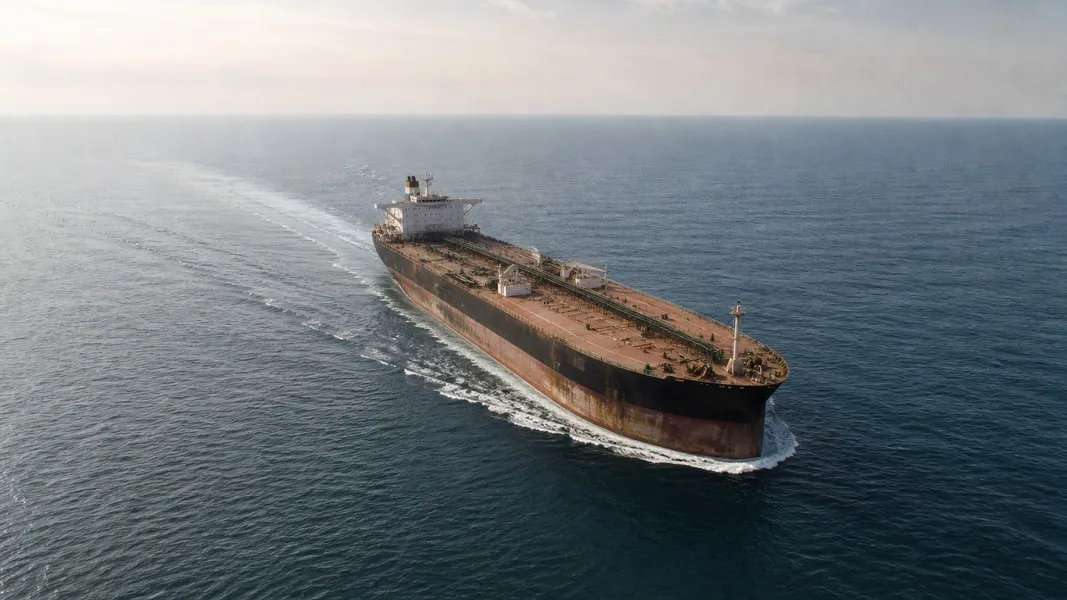
The shadow fleet is the group of tankers that moves sanctioned oil outside Western insurance, finance and oversight. Most of these ships obscure their ownership, switch flags often and carry crude for Russia, Iran and Venezuela. In 2026 the shadow fleet is no longer a side story of the sanctions era: depending on who counts, somewhere between 940 and more than 1,900 tankers sail in it, roughly one fifth of the world's tanker fleet.
Those numbers come from researchers who track these vessels month by month. Here is what their data shows in 2026:
- Core estimates range from about 940 tankers (S&P Global) to more than 1,900 (Windward), because each tracker draws the boundary differently.
- Shadow tankers carry roughly 70% of Russia's seaborne crude oil, according to the KSE Institute.
- The average shadow tanker is around 18 years old, against roughly 10 years for the mainstream fleet.
- By August 2025, only about 21% of Russian crude moved under top-tier Western insurance.
- The EU had designated around 632 individual vessels by April 2026, and the IMO flagged 367 tankers for sailing under false flags.
What Is a Shadow Fleet?
A shadow fleet, also called a dark fleet or parallel fleet, is not one organised navy. It is an ecosystem: ageing tankers bought through shell companies, registered under flags with little oversight, classed by minor societies and insured outside the Western system, all so that sanctioned oil keeps moving.
The defining feature is not what these ships carry but what they avoid: Western insurance, classification and scrutiny. Maritime intelligence firm Windward splits the population into three groups. A cleared fleet behaves normally. A gray fleet shows irregularities such as frequent flag changes and opaque ownership. A dark fleet actively manipulates its tracking signals, and that last group gives the phenomenon its name.
How Many Ships Are in the Shadow Fleet?
No single authority keeps a definitive census, which is the point of the fleet's design. Each tracker counts a different boundary, so estimates form a range rather than one number.
| Source | Scope | Estimate |
|---|---|---|
| S&P Global | Core parallel fleet | ~940 to 980 tankers, 17 to 18.5% of capacity |
| BRS | Shadow oil tankers | ~1,140 tankers |
| Lloyd's List Intelligence | Tankers in sanctioned trades | ~1,423 tankers, ~921 under sanctions |
| Windward | Dark plus gray tonnage | 1,900+ dark tankers, 1,200+ gray vessels |
| Ukrainian intelligence catalog | Named vessels | 1,337 ships as of February 2026 |
The direction is clearer than any single figure. At the end of 2022 the fleet stood at roughly 600 ships. It has more than doubled since, and by most counts about one in five oil tankers worldwide now falls into this category at some level. The Middle East Institute estimated in February 2026 that seaborne sanctioned crude represents about 18% of global tanker capacity, or 6 to 7% of the world's total unrefined petroleum flows. That is not a rounding error in the oil trade. It is a parallel market with its own ships, insurers and rules.
The Russian Shadow Fleet in 2026
Russia operates the largest share of the shadow fleet, built quickly after Western sanctions followed the 2022 invasion of Ukraine. The KSE Institute estimates that shadow tankers carry roughly 70% of Russia's seaborne crude, and its tracker puts hard numbers behind that share.
In March 2026, Russia used 55 unique tankers to export crude oil, and 71% of them belonged to the shadow fleet. From Baltic Sea ports, shadow vessels moved 69% of crude volumes. India took 55% of that Baltic crude and China 8%, while shipments with an unknown destination made up 32%, a gap that itself says something about how this trade works.
The Centre for Research on Energy and Clean Air counted 346 vessels exporting Russian crude and oil products in April 2026 in its monthly analysis. Of those, 128 were shadow tankers with no top-tier ownership or insurance ties.
The share moves month to month but stays dominant. CREA's tracking through late 2025 put sanctioned shadow tankers at 69% of Russian crude exports in September, 65% in November and 68% in December, with tankers from the G7 price cap coalition carrying most of the rest. On the product side, shadow fleet volumes stabilised around 600 thousand barrels per day through February and March 2026. Whatever individual ships get designated, the system as a whole keeps delivering.
Who Owns and Flags These Ships?
Follow the paperwork and it dissolves in your hands. A typical shadow tanker is owned by a single-vessel shell company, most often registered in Hong Kong, the UAE or Azerbaijan, created for that one ship and easily replaced if it gets sanctioned.
The flags tell a similar story. Windward's data puts Panama, Liberia, the Marshall Islands, Russia and Malta as the top five flags among dark fleet vessels, and the first three are classic flags of convenience with limited inspection capacity. The mix is shifting toward even less accountability: KSE tracking shows the share of the Russian flag itself on crude carried from Baltic ports rising from 1% in July 2025 to 18% in March 2026, as vessels burned through third-country registries and stopped pretending. Some registries have publicly denied ships that claimed their flag, which is how the IMO ends up cataloguing hundreds of tankers sailing under flags they have no right to fly.
How Old Are Shadow Fleet Tankers?
Shadow fleet tankers are old, and the gap against the mainstream fleet is wide. Shipbroker Gibson puts the shadow fleet's average age near 18 years, against roughly 10 years for mainstream tonnage. KSE data shows tankers without top-tier insurance averaging 18.1 years, against 14.4 for insured ships.
| Metric | Shadow fleet | Mainstream fleet |
|---|---|---|
| Average age (Gibson) | ~18 years | ~10 years |
| Average age by insurance status (KSE) | 18.1 years | 14.4 years |
| Crude tankers older than 15 years (KSE, March 2026) | 97% | far lower |
CREA's April 2026 data adds that 42% of the shadow tankers hauling Russian oil that month were at least 20 years old. Ships of that age would normally be heading for the scrapyard, not carrying a million barrels through busy straits.
Sailing Without Real Insurance
The International Group of P&I Clubs insures roughly 90% of the world's legitimate tonnage. The shadow fleet exists outside that system. By August 2025 only about 21% of Russian crude moved under International Group cover, down from 29% a year earlier, and among tankers with no ties to the price cap coalition, a known insurer could be identified for just 6%.
That gap lands on coastal states. CREA estimates that cleanup and compensation after a spill from a poorly insured tanker could cost taxpayers over EUR 1 billion, because there may be no solvent insurer standing behind the ship. Older hulls fail inspections more often, so the risk and the coverage gap compound each other.
How Shadow Ships Hide From Tracking
Every large commercial ship broadcasts its position through AIS vessel tracking, which is exactly why the shadow fleet works to defeat it. Analysts watch for four techniques. Going dark means switching the transponder off, which leaves gaps in a vessel's track over sanctioned trade lanes. Spoofing broadcasts a false position that satellite imagery later contradicts. Identity laundering swaps names and IMO numbers, sometimes cloning another ship entirely. Dark ship-to-ship transfers hand cargo between loitering tankers away from port.
The scale is measurable. The IMO's data system flagged 367 tankers sailing under false flags in April 2026, and CREA tracked EUR 209 million of Russian oil changing hands via ship-to-ship transfers in EU waters in that month alone, 73% of it off Cyprus.
You can see the fingerprints yourself. Pull up a tanker in Primo Nautic and a normal ship shows a continuous track; a shadow vessel's history often shows day-long silences, sudden flag changes or a route that ends in open water.
Enforcement Is Catching Up
Designations accelerated through 2025 and 2026. The EU's sanctions list passed 600 vessels in late 2025 and reached about 632 by April 2026. The UK has listed more than 544 shadow fleet vessels, and the US designated 183 in January 2025 alone.
Enforcement also moved from paper to water. France boarded a Russia-linked tanker in January 2026, and American authorities seized a Russian-flagged tanker and another vessel tied to Venezuela the same month. In March 2026 the UK announced its military may board shadow vessels transiting UK waters. The fleet keeps growing anyway, which is why analysts expect the cat and mouse to continue.
What Shadow Fleet Data Means for Ship Watchers
For anyone who follows ships, the shadow fleet turns tracking into detective work. An oil tanker tracker shows you position, course and speed, and the absences matter as much as the data: a tanker that vanishes near a known transfer zone and reappears days later riding lower in the water tells a story.
If you monitor cargo or simply enjoy watching traffic through chokepoints like the Danish straits, an app such as Primo Nautic gives you the live picture and explains what you are seeing in plain language, so an AIS gap or an odd port call stands out without you needing an analyst's training. The professionals cross-reference those same gaps with satellite photos; you get to watch the visible half of that puzzle in real time.
Key Takeaways
The shadow fleet in 2026 counts somewhere between 940 and 1,900+ tankers, about a fifth of the world fleet, and carries roughly 70% of Russia's seaborne crude. Its ships average 18 years of age, mostly sail without top-tier insurance, and hide through AIS gaps, spoofed positions, swapped identities and offshore cargo transfers. Enforcement is escalating, with hundreds of vessels designated and navies now boarding ships, yet the numbers keep climbing. The data says one thing clearly: the parallel oil trade has become a structural part of shipping, and it is increasingly visible to anyone who knows what a broken track means.