



Ship Spotting: How to Find and Identify Ships
Ship spotting is the hobby of watching, identifying and often photographing ships as they pass a port, canal or coastline. To do it well, you need three things: a place with steady traffic, a way to read what a ship is from its shape and markings, and an AIS app to confirm the name and voyage.
If you have ever stood on a pier and wondered what that long red hull was, where it came from and where it is going, you are already halfway there. This guide walks you through the process step by step, from picking a spot to logging a positive identification.
What Ship Spotting Involves
At its simplest, ship spotting means noticing a vessel and working out exactly which one it is. Some spotters keep a list of every ship they have seen. Others focus on photography, a single ship type, or one favourite shipping line.
The community is large and active. The ShipSpotting.com photo archive lists more than 3.3 million ship photos, searchable by ship name, IMO number, MMSI and call sign, with forums covering trip reports, renamings and the best locations for ship photography.
What makes the hobby satisfying is the moment a shape on the horizon becomes a named ship with a history. Everything below is about getting to that moment faster and with more confidence.
What You Need Before You Start
You do not need expensive gear. Most spotters start with what they already own and add equipment later.
- Binoculars: a mid-power pair helps you read hull names and funnel logos at a distance.
- A camera or phone: a zoom lens helps, but a phone is enough to record a sighting.
- An AIS tracking app: this matches what you see to a name, destination and route.
- A notebook or notes app: to log the name, date, place and anything unusual.
- Weather-ready clothing: piers and breakwaters are exposed, and ships do not wait for sunshine.
The app matters more than any lens. Without it, you are guessing; with it, you can confirm a sighting in seconds.
Step 1: Pick a Location With Steady Traffic
The best ship spotting locations share two features: frequent traffic and a clear public view close to the channel. Port entrances, canals and river mouths usually beat open coastline, because every ship is funnelled through a narrow gap.
Ports With Public Viewpoints
Many large ports actively welcome spotters. The Port of Rotterdam lists its own vessel spotting locations. At Slag Maasmond, the entrance to the port, about 30,000 vessels sail by every year, which the port describes as around 80 ships a day passing right in front of you.
Rotterdam also points spotters to Wilhelminakade, where cruise ships of 200 to 300 metres moor during the season, and to the 9-kilometre Landtong Rozenburg peninsula, with views over tankers, pipe layers and drilling platforms.
Canals and Narrow Waterways
Canals bring ships close to the bank. Germany's Kiel Canal connects the North Sea and the Baltic, and official canal figures show 22,262 ships carrying about 69.4 million tonnes of cargo through it in 2025. Service paths run along most of its length, so you can follow a ship on foot or by bike.
On the Lower Elbe near Hamburg, the Willkomm-Höft ship greeting station at Wedel welcomes and bids farewell to passing ships by dipping the Hamburg flag. For vessels over 1,000 GT leaving German waters, it plays the national anthem of the flag state during the day, and a loudspeaker tells visitors each ship's name, builder, size and operator.
Step 2: Check What Is Coming Before You Leave
Arriving at a pier just as the only big ship of the afternoon disappears is the most common beginner mistake. A quick look at a live ship spotting map before you leave tells you what is inbound, how fast it is moving and roughly when it will pass.
Look at the area around your chosen spot and note ships heading toward it. Their speed and distance give you a rough arrival window. Ports also publish arrival and departure lists for cruise ships, which helps you plan around the biggest vessels.
Planning around live traffic turns a lucky afternoon into a predictable one. With Primo Nautic, you can search a vessel by name, MMSI or IMO number, follow its live position, speed and course, and set an arrival alert so you know when to head out.
Step 3: Read the Ship Type From Its Shape
Before you read a single letter on the hull, the silhouette tells you what kind of ship you are looking at. Learning a handful of shapes gets you most of the way.
Common Silhouettes
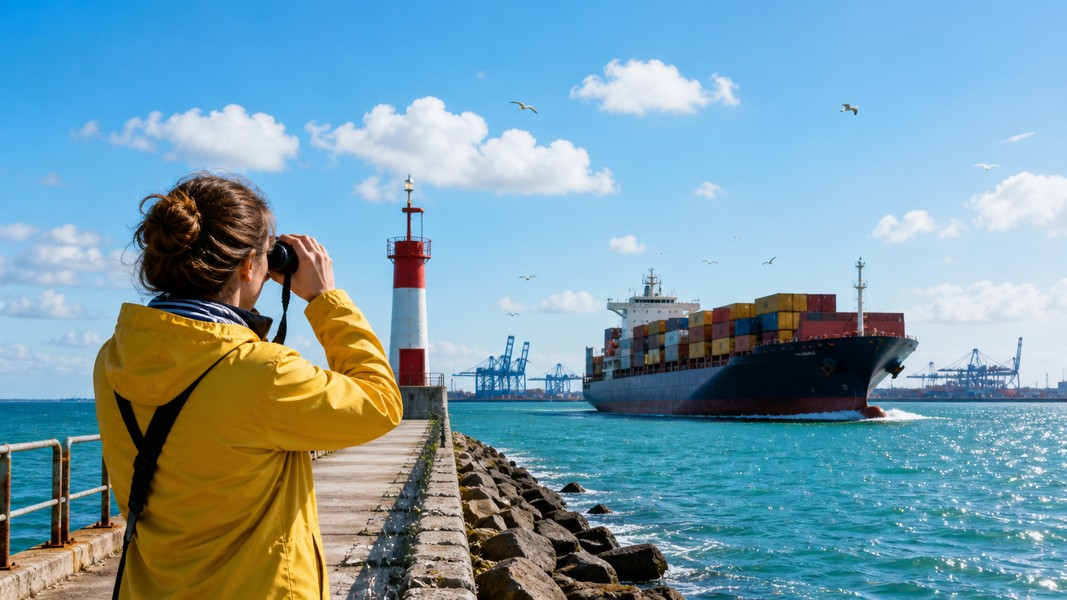
A container ship has a long, flat deck stacked with coloured boxes and a tall accommodation block, either at the stern or set forward on the largest ships. A tanker looks low and long, with a flat deck covered in pipework and a single superstructure at the back. A bulk carrier has a row of large hatch covers along the deck, often with cranes between them.
Car carriers look like floating boxes, with high, slab-sided hulls and almost no visible deck. Cruise ships stack balconies and decks high above the waterline. Tugs are short and wide, with a high bridge and heavy fendering.
Our guide to the main types of ships covers each category in more detail, and it is worth reading before your first outing.
Step 4: Find the Name and IMO Number on the Hull
Once you know the type, look for the name. It is painted on both sides of the bow and across the stern, usually with the port of registry beneath it at the stern.
The most reliable marking is the IMO number. Under SOLAS regulation XI-1/3, the International Maritime Organization requires ships to carry their identification number permanently marked in a visible place on the hull or superstructure. The rule applies to passenger ships of 100 gross tonnage and up and cargo ships of 300 gross tonnage and up.
The IMO number never changes when a ship is sold or reflagged, which makes it the safest key for your log. Names change often; the number stays with the hull for life. If you want to understand the format, our explainer on the IMO number shows how to read it and look it up.
Step 5: Use the Funnel and Hull Colours
When a ship is too far away to read, colour does the work. Shipping lines paint their funnels and hulls in consistent liveries, and experienced spotters recognise many operators from a single glance at the funnel.
Start with the lines you see most often at your location. After a few outings, you will spot patterns: the same hull colour, the same logo, the same shape of funnel. Write these down in your log next to the confirmed name, and your personal reference guide builds itself.
Livery is a hint, not proof. Ships get chartered to other operators, repainted or sold, so always confirm with the name, IMO number or AIS before you count a sighting.
Step 6: Confirm the Sighting With an AIS App
AIS, the Automatic Identification System, is what makes modern ship spotting so precise. Each equipped ship broadcasts its identity, position, speed, course and destination, and tracking apps turn those signals into a live map.
Carriage rules explain which ships you will see. According to the IMO's AIS rules, AIS is required on all ships of 300 gross tonnage and up on international voyages, cargo ships of 500 gross tonnage and up on domestic voyages, and all passenger ships regardless of size.
Choosing a Ship Spotting App
A good ship spotting app should let you tap a ship near your position and see its name, type, flag, size and destination. It should also let you search by IMO or MMSI, so you can check a number you read off the hull.
Primo Nautic adds a Ship Enthusiast mode that explains what you are looking at, not just where it is. Instead of raw data, you get context about the vessel type, its route and what makes it interesting, plus a "distance from me" view that shows how close the ship is to where you stand.
Step 7: Photograph and Log What You Saw
A sighting you did not record is easy to forget. Log the ship's name, IMO number, date, time, location and direction of travel. Add the weather and anything unusual, such as a new livery or a ship under tow.
For photos, shoot the full profile when the ship is side-on, then a closer frame of the bow or stern with the name visible. Morning and late afternoon light tends to flatter hull colours.
If you want to share your pictures, ShipSpotting.com accepts uploads linked to a ship's record, so your photo becomes part of that vessel's documented history.
Tips for Better Ship Spotting Results
Small habits make a big difference once you have the basics:
- Arrive early: the ships you tracked on the map rarely hold their estimated time to the minute.
- Learn the local tide and lock times: in canals and tidal ports, traffic bunches up around them.
- Stick to public areas: port terminals are security zones, so stay on public piers, paths and viewpoints.
- Keep a running list of liveries: it speeds up identification at distance.
- Revisit the same spot: regular visits teach you the rhythm of local traffic.
The most important tip is patience. A quiet hour at a busy spot is normal, and the ship that makes your day often arrives just as you are about to leave.
Troubleshooting Common Ship Spotting Issues
Even with a good plan, a few problems come up again and again. Each has a simple fix.
The Ship Is Not on the Map
Not every vessel broadcasts AIS. Small craft below the tonnage thresholds are not required to carry it, and warships sit outside the SOLAS rules for merchant ships. A signal can also drop out briefly near land. Rely on shape, markings and colours, and check again a few minutes later.
The Name Does Not Match the App
Ships get renamed after a sale or a new charter, and databases do not always catch up on the same day. Search the IMO number instead of the name. If the number matches, you have the right ship, whatever the paintwork says.
You Cannot Read the Hull at a Distance
Switch to type and livery first, then narrow the options with the live map. A ship of the right type, heading in the right direction, at the right distance from you, is usually the one you are looking at.
Conclusion
Ship spotting rewards preparation more than equipment. Choose a location with steady traffic, such as a port entrance or a canal, and check live traffic before you go. Identify ships in layers: silhouette first, then funnel and hull colours, then the painted name and the permanently marked IMO number.
Use an AIS app to confirm each sighting, keeping in mind that small craft and warships may not appear. Log every ship by its IMO number, since names change and the number does not. With a few outings, the shapes on the horizon turn into ships you know by name.
Most Recent Posts
Discover more articles from our blog.