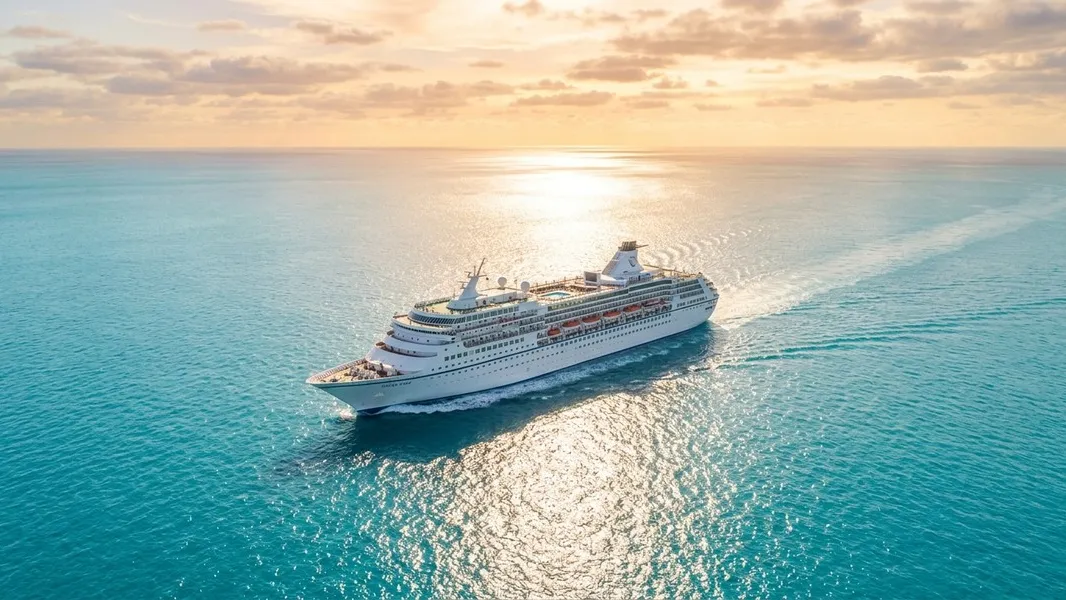
A cruise ship position finder is a web or mobile app that shows a vessel's live location on an interactive map using AIS (Automatic Identification System) data. If you want to see where a specific cruise ship is right now, whether it's carrying a family member or you're just curious, these tools give you exact coordinates, speed, course, and estimated arrival time, updated automatically as the ship moves.
This guide covers the best apps for finding a cruise ship's position live, how the underlying technology works, and what to do when a ship's location isn't showing up.
How AIS Enables Real-Time Cruise Ship Position Finding
Every large cruise ship carries mandatory Class A AIS equipment, which broadcasts position, speed, course, and voyage details over VHF radio. When the ship is underway, those signals transmit every 2-10 seconds. Receivers on shore or in orbit pick up the signals and feed the data to tracking platforms continuously.
Near coastlines and busy shipping lanes, terrestrial AIS stations capture signals with almost no delay. In the open ocean, those shore-based stations can't reach the ship. That's where satellite AIS fills in: satellites positioned over the water receive the same broadcasts from above, then relay them to tracking servers on the ground. Satellite data covers the mid-ocean gaps but can lag by anywhere from a few minutes to an hour, depending on the provider.
Most cruise ship position finders display a timestamp alongside every position, so you can always see how recent the data actually is. If you're not sure whether the location is current, check that field first.
Understanding the full picture of how ships are tracked globally is worth a closer look: our explainer on how AIS tracking works covers the technology in detail.
Why People Search for Cruise Ship Position Finders
Most people searching for a cruise ship's position aren't maritime professionals. They fall into a few distinct groups.
Families tracking a loved one on a cruise want to know the ship is safe, roughly where it is, and whether it's on schedule. They're not interested in raw navigational data: they want a human answer to "where is the ship right now?"
Friends and relatives of cruise passengers often check ship positions out of curiosity, especially during long sea days between ports. Tracking a ship from home is a way of feeling connected to the voyage.
Cargo shippers and logistics teams sometimes track passenger vessels when they share routes or ports with freight, particularly in smaller island destinations.
Each of these users has different needs, which is why the best cruise ship position finder depends on what you're actually trying to learn from the data.
Best Cruise Ship Position Finder Apps
Here's how the leading options compare for the "find this ship right now" use case:
| Tool | Best For | Updates | Cruise-Specific Features |
|---|---|---|---|
| MarineTraffic | Professional accuracy | Real-time | Name, MMSI, port search |
| CruiseMapper | Cruise-only detail | Real-time | Itinerary, deck plans, cruise line filter |
| VesselFinder | Clean live position | Real-time | IMO and MMSI lookup |
| Cruising Earth | Free auto-refresh | Per AIS report | Sister ship data, free |
| CruiseSheet | Simple visual map | Hourly | Cruise line filter |
| Primo Nautic | Families and personalization | Real-time | AI insights, ETA prediction, sea conditions |
MarineTraffic
MarineTraffic runs the largest commercial AIS data network, combining terrestrial receiver stations with satellite coverage across all major shipping corridors. You can search any vessel by name, MMSI number, or port and pull up its current position, speed, heading, and recent route. For cruise ships, it also shows scheduled port calls, historical voyage data, and vessel photos submitted by spotters near ports.
The depth of data makes it a go-to for anyone who wants precision. Search "Carnival Celebration" or "Norwegian Escape" and you'll get exact coordinates alongside a live map track showing the ship's recent path. The downside is the interface: it's designed for professional users, and families checking on a cruise may find the amount of information on screen more confusing than helpful.
MarineTraffic is available on the web and as a mobile app for iOS and Android. Most position searches are free; satellite tracking and voyage history require a subscription.
CruiseMapper
CruiseMapper is purpose-built for cruise ships, tracking over 320 vessels across 30 cruise lines. Its biggest advantage over generic vessel trackers is the combination of live AIS position data with itinerary information: you see where the ship is now and where it's supposed to be on the schedule. That context makes it immediately obvious if a ship is running late or has altered its route.
Searching by cruise line is fast: filter to Carnival, Royal Caribbean, MSC, or NCL and the map centers on every active ship from that fleet. Clicking any vessel brings up a panel with the current position, speed, next port, ETA, deck plans, and passenger reviews of the ship.
For families wanting to follow a specific ship across a full itinerary, CruiseMapper's combination of live tracking and scheduled stops is one of the most useful formats available. You can access it at CruiseMapper on the web.
VesselFinder
VesselFinder provides a clean live map with AIS positions updated in real time. Search by ship name, IMO number, or MMSI to jump directly to a vessel on the map. The position card shows exact latitude and longitude, speed in knots, course in degrees, destination, and a recent track overlay.
The interface prioritizes position accuracy over cruise-specific context. There's no itinerary data, but if you need to verify exactly where a ship is at this moment (precise coordinates and heading), VesselFinder delivers that clearly. It's a solid second check if you're comparing data across multiple platforms.
Cruising Earth
Cruising Earth is a free web-based tool that auto-refreshes each time a new AIS report comes in for the ship you're watching. Search by ship name (including full names like "Icon of the Seas" or "Symphony of the Seas") and the page updates automatically. Each ship's card shows current route, speed, ETA, and nearby sister ships from the same class.
There's no app version, but the web experience is clean and requires no account. For a quick position check from a desktop or tablet, it's one of the more straightforward free options available.
CruiseSheet
CruiseSheet tracks around 167-182 active cruise ships and updates their positions hourly. You can filter the map by cruise line, then click any vessel for current position, speed, ETA, and port schedule. The hourly update interval means it isn't suitable for watching a ship in near real time, but for checking an approximate position once or twice a day it's simple and free.
Primo Nautic
Primo Nautic takes a different approach from the rest of this list. Rather than displaying raw AIS data, it translates vessel position into personalized updates adapted to why you're tracking the ship. If you're following a family member's cruise, the AI generates warm, human-readable summaries about the voyage's progress, the sea conditions at the ship's exact location, and whether the vessel is arriving on schedule.
The app includes a dual ETA system that compares the captain's reported arrival estimate against an AI-calculated prediction based on current speed and route, with a confidence score for each. You can set arrival and departure alerts so you don't have to check manually. For families who want updates that feel like information, not data, Primo Nautic's AI context layer is what sets it apart from tools designed for maritime professionals.
Primo Nautic is available on iOS and Android. Search by ship name or MMSI to add any vessel to your tracking list.
How to Find a Specific Cruise Ship's Position
The process is consistent across most platforms:
- Open your chosen app (MarineTraffic, CruiseMapper, VesselFinder, Primo Nautic, or one of the free web tools).
- Type the ship's name into the search bar, using the full official name (e.g., "Carnival Magic" or "MSC Seashore") for the cleanest results.
- Click the ship's marker on the map to open its data card: coordinates, speed, heading, ETA, and route history.
- Review the "last updated" timestamp to confirm how current the position is.
- Bookmark or save the ship page for easy return visits throughout the voyage.
For Carnival specifically, CruiseMapper's cruise-line filter is the fastest lookup: filter to Carnival and every active fleet vessel appears on the map at once. For a complete walkthrough of the tracking process, see our guide on how to track a cruise ship.
What Affects Cruise Ship Position Accuracy
Terrestrial vs. satellite AIS coverage is the primary variable. Near ports and coastlines, shore-based stations pick up AIS signals in seconds. Mid-ocean, those stations drop out entirely and you're relying on satellite relays, which can introduce a delay of 1-60 minutes depending on the platform.
A few other factors can cause position data to appear outdated or missing:
- The ship is in an AIS dead zone: common in the South Atlantic, remote Pacific corridors, and polar routes
- The tracking tool refreshes hourly rather than continuously (CruiseSheet is one example)
- Temporary receiver issues on the vessel's end, though Class A AIS equipment on cruise ships is rarely offline
If a position looks several hours stale, cross-checking two different tools often resolves it. MarineTraffic and CruiseMapper draw from different satellite networks, so one may have received a more recent ping than the other. If the ship genuinely has no signal, the cruise line's published itinerary gives an approximate position based on scheduled port times and transit distances until AIS coverage resumes.
Conclusion
The right cruise ship position finder depends on what you're trying to accomplish. MarineTraffic and VesselFinder provide the most precise AIS data for users who want raw position accuracy. CruiseMapper is the best choice for cruise-specific detail: itineraries, fleet views, and deck plans alongside live tracking. Cruising Earth and CruiseSheet are reliable free options for quick position lookups. Primo Nautic works differently from all of them: it's built for people following a loved one at sea, turning AIS coordinates into readable voyage updates so the data feels meaningful rather than technical.