An IMO number is a unique seven-digit identifier assigned to a ship for its entire lifespan. Unlike a vessel's name or flag, the IMO number never changes, no matter how many times the ship is renamed, sold, or re-registered in a new country. It is the most reliable way to identify a specific ship in any registry, certificate, or tracking system.
If you have ever searched for a ship online, used a vessel tracker, or noticed a number that looks like "IMO 9400980" next to a ship's name, this guide explains exactly what that number means, where it comes from, and how you can use it to find and follow any qualifying vessel around the world.
What Is an IMO Number?
An IMO number is a permanent, seven-digit code prefixed with the letters "IMO", assigned to qualifying seagoing vessels by the International Maritime Organization, the United Nations agency responsible for shipping safety, security, and pollution prevention.
The scheme was introduced in 1987 through IMO Resolution A.600(15), created specifically to improve maritime safety, reduce pollution risks, and prevent the kind of fraud that was possible when ships could easily change identities. It became mandatory under SOLAS in 1996 for passenger and cargo ships of 100 gross tons and above engaged in international voyages.
The format is straightforward: the three-letter prefix "IMO" followed by seven digits. For example: IMO 9400980. The seventh digit is a check digit, calculated from the first six. You multiply each of the first six digits by factors counting down from seven to two, sum the results, and the last digit of that sum becomes the check digit. This built-in verification mechanism means that systems can instantly detect typos or fabricated numbers without querying a central database.
Today, tens of thousands of commercial ships around the world carry IMO numbers, covering the vast majority of the global merchant fleet: tankers, bulk carriers, container ships, cruise ships, car carriers, and more.
How IMO Numbers Work
The defining characteristic of an IMO number is permanence. Once assigned, the number stays with the ship for its entire operational life, regardless of name changes, ownership transfers, or new flag states.
This permanence solves a real practical problem. Ships change names more often than most people realize. An owner rebrands a vessel after a sale, a cruise line retires an old name, or a tanker is sold to a new operator who gives it a new identity entirely. Without a stable identifier, tracking a ship's history across those changes would require manually cross-referencing many separate records from different countries and registries.
The IMO number acts as the constant anchor. Every name the ship has ever sailed under, every flag it has flown, every owner that has operated it, all of these records are tied together by the same seven digits. That is why maritime authorities, classification societies, insurers, and sanctions enforcement agencies all rely on IMO numbers as the primary identity for a vessel.
Not every vessel receives one. The mandatory scheme applies to cargo and passenger ships of at least 100 gross tonnage engaged in international voyages. Smaller recreational boats, most fishing vessels, and inland waterway craft typically fall outside the requirement. Since 2013, the scheme was extended on a voluntary basis to additional vessel categories, so some vessel types outside the original SOLAS threshold can now be included if the operator chooses.
IMO vs MMSI: The Key Difference
Two numbers appear regularly in ship tracking: the IMO number and the MMSI number. They serve distinct purposes, and understanding the difference helps you use tracking tools more effectively.
The MMSI (Maritime Mobile Service Identity) is a nine-digit number tied to a ship's radio equipment and AIS transponder. It is what the ship broadcasts live when transmitting its position via AIS. Because it is linked to the radio station rather than the physical vessel, an MMSI can change when a ship switches flag states, replaces equipment, or is transferred to a new operator in certain jurisdictions.
The IMO number, by contrast, belongs to the ship itself, not its equipment or registration status. Here is how the two compare:
| Feature | IMO Number | MMSI |
|---|---|---|
| Purpose | Permanent ship identity | Radio/AIS communication identity |
| Format | "IMO" + 7 digits | 9 digits |
| Changes over time? | Never | Can change |
| Used for | Registries, certificates, legal ID | AIS broadcasts, live position tracking |
| Assigned by | International Maritime Organization | National maritime administrations |
In practice, vessel tracking services use both identifiers together. The MMSI carries the live position data broadcast by the ship's AIS transponder: current latitude and longitude, speed, heading, and navigation status. The IMO number links that live data to the permanent vessel record: name history, ownership, type, gross tonnage, class, and more.
When you search for a ship in a tracking app using its IMO number, you are using the stable, permanent identity to retrieve all the live and historical data associated with that vessel. It is the most precise search method available, particularly for ships that share similar or identical names.
Where to Find a Ship's IMO Number
For a cruise passenger, cargo shipper, or maritime enthusiast, finding a ship's IMO number is usually straightforward. There are four reliable sources.
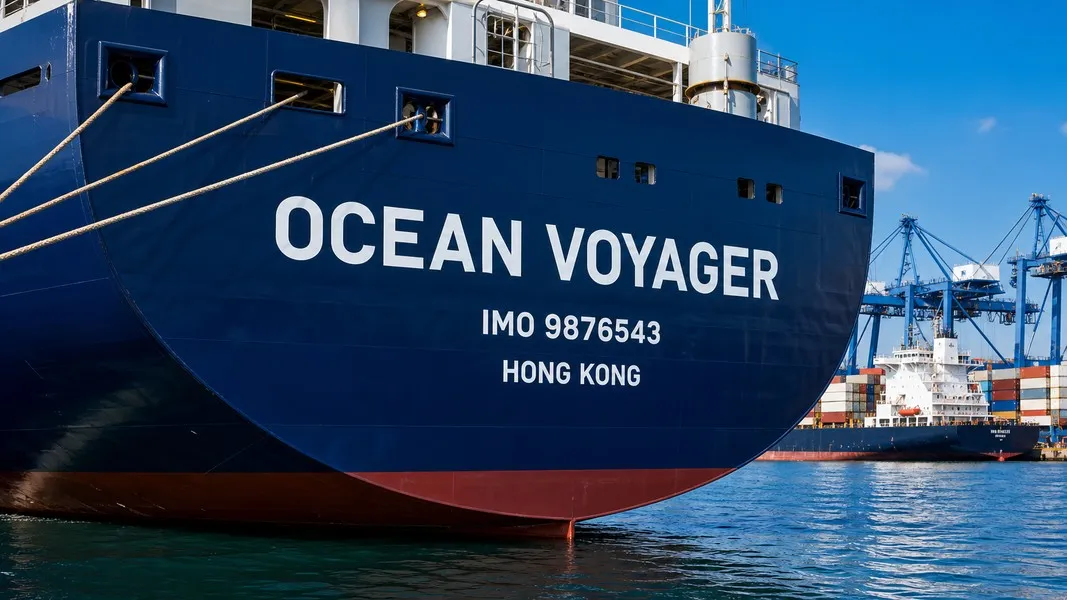
On the ship itself. SOLAS regulations require qualifying ships to display their IMO number in a permanent, visible location on the hull or superstructure. This is typically painted on the stern and sometimes on the bridge front. Many photos of ships taken at port show the IMO number clearly near the waterline or along the hull.
In your travel or shipping documents. Cruise booking confirmations, freight contracts, and bills of lading frequently include the vessel's name alongside its IMO number. If yours does not, a quick request to your cruise operator or freight forwarder will get you the number.
In official maritime databases. The IMO maintains GISIS platform, the Global Integrated Shipping Information System. This official online tool is used by maritime administrations and industry professionals to access ship identification data, including IMO numbers and company identification records. Some areas of GISIS are publicly accessible; others are restricted to maritime authorities and registered users.
On vessel tracking sites. Any major AIS vessel tracking platform displays the IMO number in a ship's profile. Search by the ship's name, open the correct vessel, and the IMO number appears alongside MMSI, flag state, gross tonnage, and type. Classification societies such as Lloyd's Register also publish ship-finder tools that display this data. For most non-expert users, this is the fastest route to finding the number.
Using an IMO Number to Track a Vessel
The IMO number itself does not broadcast any live data. What it gives you is a precise, unambiguous identifier that you can enter into any tracking system to locate exactly the right ship without risk of confusing it with another vessel.
Start with the IMO number when possible to avoid misidentification. Many ships share similar names, particularly common terms like "Pacific," "Atlantic," or fleet-numbered vessels from large shipping companies. Entering the IMO number eliminates that ambiguity entirely.
The practical workflow is simple. Gather the IMO number from your booking documents, a shipping confirmation, or by searching the ship's name on any tracking app and noting the IMO shown in the results. Then enter that number directly into the search field of a vessel tracker. The ship's profile will display its current position, speed, heading, destination, and ETA where the vessel is actively broadcasting AIS data.
Primo Nautic lets you search by vessel name, MMSI, or IMO number and returns the ship's live position along with AI-generated updates adapted to your reason for tracking. If you are following a family member on a cruise, the updates use a warm, reassuring tone focused on journey progress and sea conditions. If you are monitoring a cargo shipment, the updates shift to precise, logistics-focused information. The IMO number is the most reliable search input for getting to the right vessel quickly.
Once you find the vessel, a typical tracking profile shows current position on a map, speed and heading, destination and expected arrival time, vessel type, year built, gross tonnage, and dimensional data. Primo Nautic adds a dual ETA display: the captain's reported arrival time alongside an AI-calculated estimate, so you can see both and understand how closely they align.
What Information Is Tied to an IMO Number
Maritime databases index a substantial amount of data under each IMO number. The permanent record includes the ship's current and all historical names, every flag state the vessel has been registered under, ports of registry, gross and net tonnage, deadweight tonnage for cargo ships, and details from the classification society that certified its construction and safety systems.
Ownership and management history is also linked to the IMO number. When a ship is sold, the new owner and operator are recorded in the vessel's IMO record while the old records are retained. This makes it possible to trace a vessel's entire commercial history, which matters for cargo verification, insurance, and regulatory compliance.
The IMO scheme also assigns separate identification numbers to shipping companies and vessel owners, not just ships. This creates a two-level system: you can look up a specific vessel by its seven-digit IMO number, or look up an owner or operator by their company IMO number to see every vessel associated with that entity.
For a cruise passenger, this means you can verify that the ship you are tracking is genuinely the one operating your family member's voyage by checking the year built, size, and historical names. For a cargo shipper, it provides an independent way to confirm the identity of the vessel carrying your goods without relying solely on the carrier's own reporting.
Conclusion
An IMO number is a permanent, seven-digit identifier assigned to qualifying seagoing ships, designed to follow a vessel through every name change, ownership transfer, and re-registration. Introduced in 1987 and made mandatory under SOLAS for larger cargo and passenger ships from 1996, it is the most stable way to identify a ship in any maritime registry or tracking system.
For practical use, the IMO number is your starting point for locating the right vessel in a tracking app, verifying a ship's identity from booking documents, or reading a vessel's full ownership and name history. Paired with the MMSI for live AIS data, the IMO number connects a ship's permanent identity to its real-time position, giving you a precise and reliable picture of where any vessel is and what its history has been.