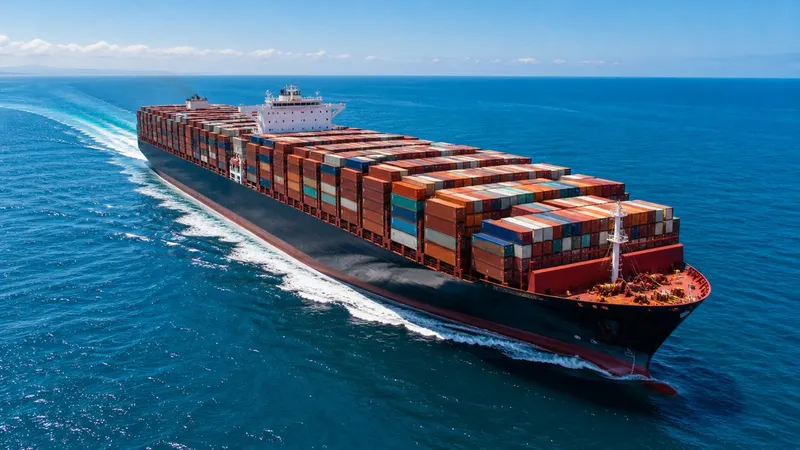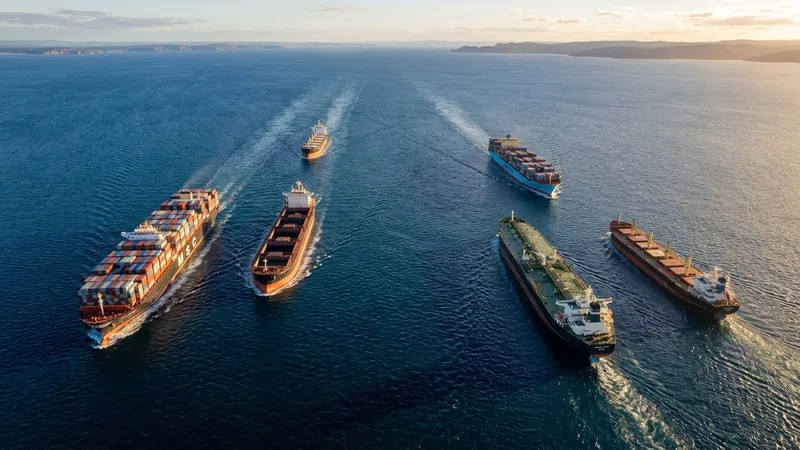
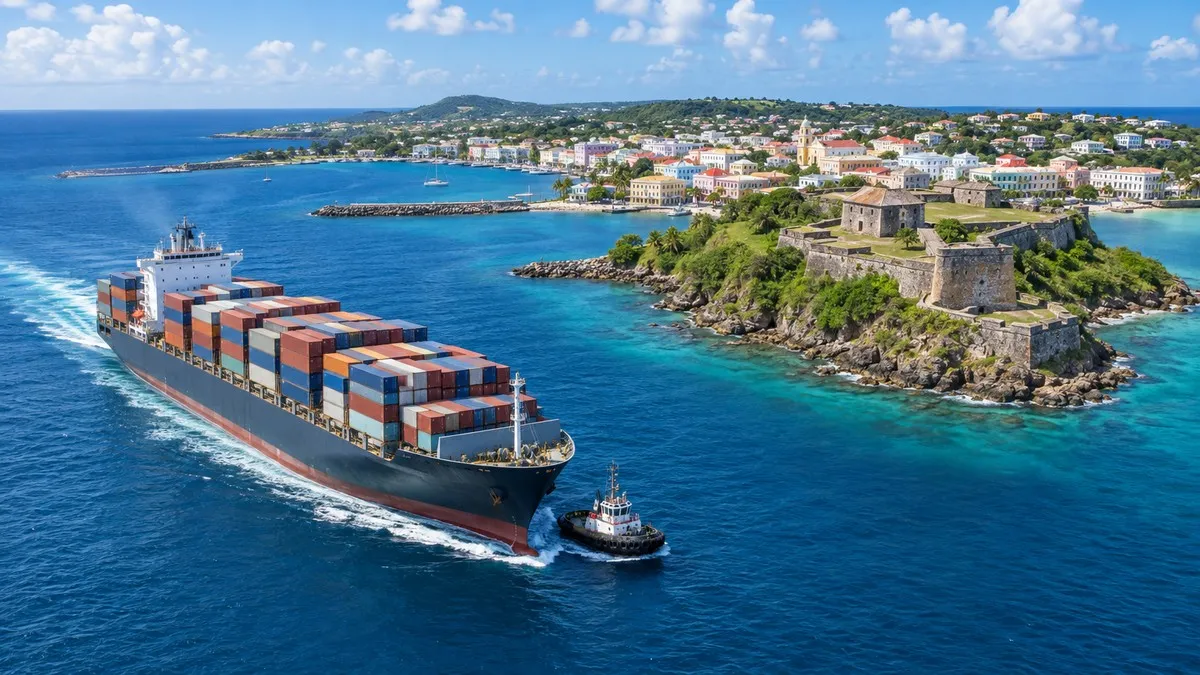
The Jones Act is the US law that says cargo moving by water between two American ports must travel on a ship that is US-built, US-owned, US-flagged and crewed mostly by Americans. It is Section 27 of the Merchant Marine Act of 1920, and the same 1920 law also gave injured seamen the right to sue their employer, which is why lawyers, shipowners and oil traders all use the name for slightly different things.
If you have heard the Jones Act blamed for fuel prices, praised for protecting American mariners, or mentioned after a hurricane in Puerto Rico, you have met only one piece of it. This guide puts the pieces together: what the law requires, which ships qualify, what it means for seamen and their families, how waivers work, what the long 2026 waiver changed, and why cruise ships sailing from US ports always seem to stop somewhere foreign.
What Is the Jones Act?
The Jones Act is the common name for the coastwise trade law codified at 46 U.S.C. § 55102. In the words of the Maritime Administration, no vessel may transport merchandise "by water, by land and water, or via a foreign port, for any part of the transportation, between points in the United States, unless the vessel is U.S.-built, U.S.-owned, and coastwise endorsed by the U.S. Coast Guard."
In plain terms: a foreign ship can bring goods into the United States, but it cannot carry goods from one US port to another. A Liberian-flagged tanker may deliver crude from Saudi Arabia to Houston. It may not then load gasoline in Houston and deliver it to Tampa.
Where the name comes from
US Customs and Border Protection explains that the law was sponsored by Senator Wesley L. Jones, hence the name. His 1920 bill revamped several US shipping laws at once, covering cabotage, ship mortgages and seamen's personal injury claims.
Cabotage is the general term for reserving domestic transport to domestic carriers. The American version goes further than ownership and crew: the hull has to come from an American shipyard too.
Two laws under one name
When people say "Jones Act" they usually mean one of two sections of the 1920 law:
- Section 27, the cargo rule. This is the coastwise trade restriction, now 46 U.S.C. § 55102, enforced by CBP.
- Section 33, the seaman rule. This gives an injured seaman the right to sue the employer for negligence, now 46 U.S.C. § 30104.
- The 1917 Jones Act, a different law entirely. The Jones-Shafroth Act gave Puerto Ricans US citizenship and is covered further down, because search engines mix it up with the shipping law constantly.
Shipping news, freight forwarders and the 2026 fuel debate are about Section 27. Maritime injury lawyers advertising "Jones Act claims" are talking about Section 33.
The Jones Act Requirements for Ships
A ship that may legally carry domestic cargo is called "coastwise qualified." The Congressional Research Service notes that "coastwise qualified" and "Jones Act qualified" mean the same thing. The status comes from a coastwise endorsement on the vessel's certificate of documentation, issued by the US Coast Guard.
The Government Accountability Office summarises the requirements as three conditions: the ship must be owned by US citizens and registered in the United States, built in the United States, and operated with predominantly US-citizen crews. Most guides split the first one into two, which gives the familiar four.
US-built
The hull and superstructure must be built in a US shipyard. The CRS report lists the Coast Guard rules that check this at 46 C.F.R. §§ 67.95 to 67.101.
A ship bought abroad, even by an American company, cannot enter the coastwise trade. There is a narrow exception for small passenger vessels, covered in the waivers section below.
US-owned
The statute says the vessel must be "wholly owned by citizens of the United States for purposes of engaging in the coastwise trade." The Coast Guard ownership rules sit at 46 C.F.R. §§ 67.30 to 67.43.
US-flagged and US-crewed
A coastwise endorsement only exists on a US certificate of documentation, so the ship flies the US flag by definition. The crewing rule sits at 46 C.F.R. § 10.221. Norton Rose Fulbright describes the standard as "predominantly crewed by US citizens or permanent residents."
That crewing rule ties the fleet to the American merchant marine. If that career path interests you, our guide on how to become a merchant mariner covers the steps.
What counts as cargo and as a domestic route
The law reaches further than most people expect. "Merchandise" includes goods owned by the federal government or a state, and even "valueless material," so even material with no commercial value counts.
The route rule is just as broad. The ban covers "any part of the transportation" between US points, "either directly or via a foreign port." Shipping cargo from Los Angeles to Vancouver on a foreign ship and then from Vancouver to Seattle on another does not escape the law if the cargo was always going to Seattle.
CBP enforces all of this through a dedicated unit, the Jones Act Division of Enforcement, and penalises violations. It also issues ruling letters on borderline cases, such as whether processing cargo at an intermediate port turns it into a new product. In one example CBP gives, merely sorting pellets by size was not enough to count as manufacturing.
How Big Is the Jones Act Fleet?
Smaller than most people assume. MARAD's US-flag fleet dashboard for August 2026 counts 190 vessels under the US flag. Of those, only 92 are Jones Act eligible. The rest fly the US flag without qualifying for domestic trade.
Across the full 190-ship US-flag fleet, tankers are the largest group with 76 vessels, followed by 59 containerships, 23 vehicle carriers, 17 general cargo ships, 6 ConRo ships, 5 ro-ro ships and 4 dry bulk carriers. MARAD classes 168 of them as militarily useful, which is the national security argument for keeping the fleet alive.
Where Jones Act ships actually sail
The CRS report points out that the oceangoing Jones Act fleet is "almost entirely engaged in domestic trade routes where overland modes are not an option, serving Alaska, Hawaii, and Puerto Rico." Between Houston and New York you can use a pipeline, a train or a truck. Between Los Angeles and Honolulu you cannot.
That is why the law feels like an abstraction in Ohio and like a daily cost in San Juan. It is also why the debate over the law tends to flare up around islands and storms.
Jones Act Seamen: Injury Rights at Sea
The second half of the 1920 law matters most to the people working on ships and the families waiting for them at home. Under 46 U.S.C. § 30104, "a seaman injured in the course of employment" may bring a civil action against the employer, "with the right of trial by jury." If the seaman dies, the personal representative may sue instead.
The statute borrows the federal rules that govern injured railway workers. That makes it a negligence lawsuit before a jury, a different route from the workers' compensation schemes that cover most jobs ashore.
Who counts as a Jones Act seaman
The statute never defines "seaman," so the courts did. The leading case is Chandris v. Latsis, decided by the Supreme Court in 1995. It set a two-part test: the worker must contribute to the function or mission of a vessel, and must have a connection to a vessel in navigation that is substantial in both duration and nature.
The Court also gave a rule of thumb: a worker who spends less than about 30 percent of working time in the service of a vessel in navigation should not qualify. It stressed that the figure is a guideline, not a hard line. Land-based workers do not become seamen just because they board a ship for a day, and seamen do not lose coverage when the job sends them ashore.
The three claims seamen usually bring
The Ninth Circuit's model jury instructions list the claims that come with seaman status:
- Jones Act negligence against the employer, with a jury trial.
- Unseaworthiness, a general maritime law claim that the vessel or its equipment was not reasonably fit for its purpose.
- Maintenance and cure, the employer's duty to pay basic living costs and medical care while an injured or ill seaman recovers.
Anyone who does not qualify as a seaman is generally limited to the Longshore and Harbor Workers' Compensation Act. The Supreme Court has called the two regimes mutually exclusive, which is why seaman status is often the first thing fought over after an accident.
Why this matters to seafarer families
For a family, the practical lesson is to keep records. Contracts, sign-on dates and the vessel's name help establish how much time was spent aboard, which is exactly what the 30 percent rule measures. This guide is general information, not legal advice, and an injured mariner should talk to a maritime lawyer early.
Following the ship itself can help too. Primo Nautic lets you track any vessel by name, MMSI or IMO number, and its "Loved One Working at Sea" purpose turns the live position, weather and arrival estimates into calm, plain updates for the people at home.
Jones Act Waivers: How They Work
A Jones Act waiver lets a vessel that is not coastwise qualified carry domestic cargo for a limited time. The authority sits in 46 U.S.C. § 501, and it is narrower than headlines suggest.
The legal test for a waiver
There are two routes. Under § 501(a), the Department of Homeland Security issues a waiver at the request of the Secretary of Defense, now styled the Department of War, when it is "in the interest of national defense to address an immediate adverse effect on military operations."
Under § 501(b), the DHS Secretary may waive the law if it is "necessary in the interest of national defense," but only after the Maritime Administrator determines that Jones Act qualified vessels are not available. CRS notes that past rulings confirm waivers are granted for national defense, "not commercial expediency."
For requests that come from industry, CBP reviews each case vessel by vessel and voyage by voyage, and its compliance guide says no blanket waivers will be granted. A request has to be submitted before the cargo is loaded.
Past waivers
Most waivers have been short and tied to fuel. CRS lists a waiver during the 2011 Libya crisis that let foreign tankers move oil, a roughly three-week waiver in 2012 to move fuel to the Northeast, and waivers in 2017 for Texas and Louisiana after Hurricane Harvey, for Florida after Hurricane Irma, and for Puerto Rico after Hurricane Maria.
There are also permanent exceptions. Under 46 U.S.C. § 12121, MARAD can waive the US-build requirement for small passenger vessels carrying no more than 12 passengers, although the boat must still be US-owned and US-crewed. Congress has also passed one-off exemptions, such as one for vessels supporting the 34th America's Cup in 2011.
The 2026 Jones Act waiver
A historically long waiver began on March 17, 2026. DHS issued it under § 501(a) at the request of the Department of War, and the White House framed it as a way to ease short-term disruptions to the oil market during the conflict with Iran.
It was first set to end on May 17, then extended to August 16, then extended again from August 17 to November 15, 2026. Under the August extension, CBP cut the list of covered products from 671 tariff codes to 237 and added a pre-voyage approval step: anyone wanting to use a foreign ship must first send a "vessel availability request" to the Department of War, MARAD and CBP, and US-flag operators get 24 hours to say whether they can carry the cargo instead.
The fight over renewal
By early November the extensions totalled 250 days, and the waiver comes up for renewal on November 15. According to The Maritime Executive, independent analyses suggest the foreign tankers had no discernible effect on prices at the pump. The American Maritime Partnership is campaigning for the waiver to lapse and says more than 28 percent of reported waiver voyages were on vessels or companies tied to China. The American Petroleum Institute has applauded the long waiver.
Congress is watching as well. House Transportation Committee Democrats wrote to the President in May asking for more scrutiny of whether voyages met the military operations standard, and in October Representative Salud Carbajal asked DHS about at least 25 waiver voyages that were not disclosed. With Democrats taking control of both chambers, he is set to chair the House subcommittee on the Coast Guard and maritime transportation from January.
How to follow waiver voyages yourself
MARAD publishes the post-voyage reports that waiver users must file, listing each vessel, its flag and its route between US ports. Those reports are a practical starting point if you want to see which foreign tankers have been working the US coast.
Take a vessel name or IMO number from a report and look it up in Primo Nautic to see where the ship is now, how fast it is moving and when it is expected to arrive. Our guide to tracking a tanker live explains what the position data can and cannot tell you.
The Jones Act and Puerto Rico
Puerto Rico is where the Jones Act debate is loudest. An island cannot swap ships for trucks or trains, and the Cato study cited below finds that the burden of higher domestic shipping costs falls disproportionately on island residents.
Who the law covers, and who it does not
Not every US territory is treated the same. CRS notes that the US Virgin Islands, American Samoa and the Northern Mariana Islands are exempt from the Jones Act. Puerto Rico is exempt for passengers but not for cargo, so a foreign cruise ship may carry passengers between San Juan and Miami while a foreign freighter may not carry their furniture.
That difference creates odd routings. CRS describes cases where goods were sent to the US Virgin Islands, which are exempt, and then on to Puerto Rico, with both legs on foreign-flag ships.
What the GAO found
The Government Accountability Office studied the Puerto Rico trade in its 2013 report GAO-13-260. It found that most cargo between the mainland and the island moves on four Jones Act carriers running dedicated weekly services with containerships and container barges, some of them operating beyond their expected service life.
Shippers told GAO that foreign carriers' rates were "often, although not always" lower. GAO concluded that the effects of changing the law for Puerto Rico are "highly uncertain," and warned that unrestricted foreign competition could lead to the disappearance of most US-flag vessels in that trade.
What economists estimate
A 2024 research brief for the Cato Institute by Russell Hillberry and Manuel Jimenez of Purdue University tried to put a number on it. They estimate that the Jones Act works like a 30.6 percent average tariff on final products shipped from the mainland, costing the Puerto Rican economy $1.4 billion a year in 2016 dollars.
The authors are careful to say other policies may have contributed to the patterns they found. Supporters of the law answer with the GAO's point: without it, the island might lose the reliable weekly service it depends on.
After hurricanes
Disasters bring the island's dependence into focus. After Hurricane Maria in 2017, the administration issued a temporary waiver on September 28 to speed relief cargo, and CRS notes the law came into prominence amid the debate over the island's recovery.
If you are shipping from the mainland to Puerto Rico, Hawaii or Alaska, the Jones Act decides which ships can carry your container. The Cargo Shipment purpose in Primo Nautic follows that vessel with precise, logistics-focused updates, comparing the captain's reported ETA with its own calculated estimate and sending an alert when a delay appears.
The Other Jones Act: The 1917 Citizenship Law
Search for "Jones Act 1917" and you land on a completely different law. The Jones-Shafroth Act, signed by President Woodrow Wilson on March 2, 1917, gave Puerto Ricans US statutory citizenship, according to the Library of Congress. It also split the island's government into executive, judicial and legislative branches.
Despite the shared name, the law has nothing to do with ships. Because both laws concern Puerto Rico, the confusion shows up constantly in search results and social media arguments. If someone says "the Jones Act made Puerto Ricans citizens," they mean 1917. If they say "the Jones Act raises prices in Puerto Rico," they mean 1920.
Cruise Ships and the Jones Act
Cruise passengers often ask why a ship leaving Florida, California or Washington has to visit a foreign port. The answer is a sister law that predates the Jones Act: the Passenger Vessel Services Act of 1886, now 46 U.S.C. § 55103.
Why your cruise stops in a foreign port
The PVSA says a foreign vessel may not transport passengers between US ports, "either directly or by way of a foreign port." Most large cruise ships are foreign-built and foreign-flagged, so a route that only links US ports is off limits to them.
The law reaches further than paying guests. CRS notes that CBP treats anyone aboard who is not crew as a passenger, ticket or no ticket.
The distant foreign port rule
A one-way cruise between two different US ports is allowed if the ship visits a "distant foreign port" on the way. CRS describes that as any port outside North and Central America, Bermuda, the Bahamas and the Virgin Islands.
The CBP compliance guide gives a worked example: a foreign ship may embark a passenger in Miami, sail to Aruba, then let the passenger off in Key West, because Aruba counts as a distant foreign port. Swap Aruba for Nassau and the same itinerary would break the law.
The penalty per passenger
The original 1886 penalty was $200 per passenger. CBP's 2019 guide lists $798 for each passenger transported and landed after November 2, 2015, with the figure adjusted for inflation over time. Penalties fall on the vessel owner or operator, not on the passenger, and CBP may cancel or reduce them on petition.
This is why a passenger who decides to leave a cruise early at a US port of call can create a penalty for the cruise line, and why lines are strict about disembarking only at the final port.
When the foreign stop was waived
Congress passed the Alaska Tourism Restoration Act, which temporarily let named cruise ships sail straight from Seattle to Alaska without the usual stop in Canada. That waiver expired in March 2022. Puerto Rico has a standing passenger exception under 46 U.S.C. § 55104, which is why foreign cruise ships can sail between San Juan and mainland ports.
The Debate: Arguments For and Against
Both sides make concrete claims, and both cite official sources.
The case for the Jones Act
Supporters argue that the law keeps a US shipbuilding base and a pool of credentialed American mariners that the military can call on in wartime. MARAD's count of 168 militarily useful US-flag vessels is part of that argument. GAO's warning that open competition could wipe out most US-flag ships in the Puerto Rico trade is another.
They also point to security. The American Maritime Partnership's claim about Chinese-linked tankers working US ports under the 2026 waiver is a new version of an old argument: foreign ships on domestic routes mean foreign access to sensitive waterways.
The case against
Critics argue the build requirement raises the cost of every domestic ship, which keeps the fleet small and old; GAO found some Puerto Rico vessels running beyond their expected service life. The Cato estimate for Puerto Rico and GAO's finding that foreign carriers are often cheaper are the core of that case.
They add that the cost lands on the people with the fewest alternatives, island residents. CRS records that Puerto Rico, which imports LNG from Trinidad and Tobago, has sought a 10-year waiver to receive bulk LNG shipments from the mainland.
Where things stand
For now the practical battleground is the waiver process, which is why the November 2026 renewal decision drew so much lobbying.
What the Jones Act Means If You Track Ships
For anyone who follows vessel traffic as a hobby or for work, the Jones Act explains patterns that otherwise look strange. A US-flag container ship shuttling between Tacoma and Anchorage, an articulated tug-barge running the Gulf coast, or a foreign tanker suddenly making repeated runs between two American ports during a waiver are all the law at work.
It also explains why a round trip from Seattle to Alaska calls at a Canadian port, and why a one-way cruise between Florida and California has to reach a distant foreign port somewhere along the way. Once you know the rule, the itinerary makes sense.
Conclusion
The Jones Act is really several ideas sharing one name. Section 27 of the 1920 Merchant Marine Act reserves cargo between US ports for ships that are US-built, US-owned, US-flagged and mostly US-crewed, and MARAD counts only 92 vessels in the US-flag fleet that meet that standard today. Section 33 gives injured seamen the right to sue their employer before a jury, with the 30 percent rule from Chandris deciding who counts as a seaman.
Waivers are meant to be rare, short and tied to national defense, which is why the 250-day fuel waiver of 2026 has become so contested ahead of its November 15 renewal date. Puerto Rico carries the heaviest cost of the cargo rule, with economists estimating it at $1.4 billion a year, while GAO warns that removing it could cost the island its regular US-flag service. The 1917 Jones-Shafroth Act is a separate law about citizenship, and the cruise ship foreign-port rule comes from the even older Passenger Vessel Services Act.