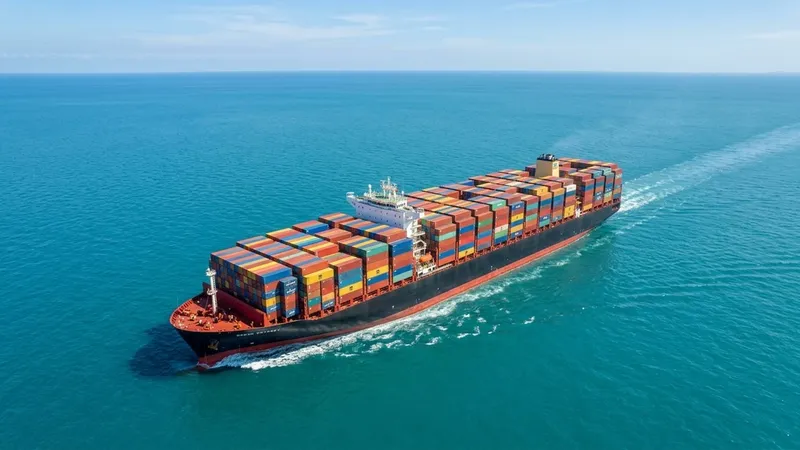
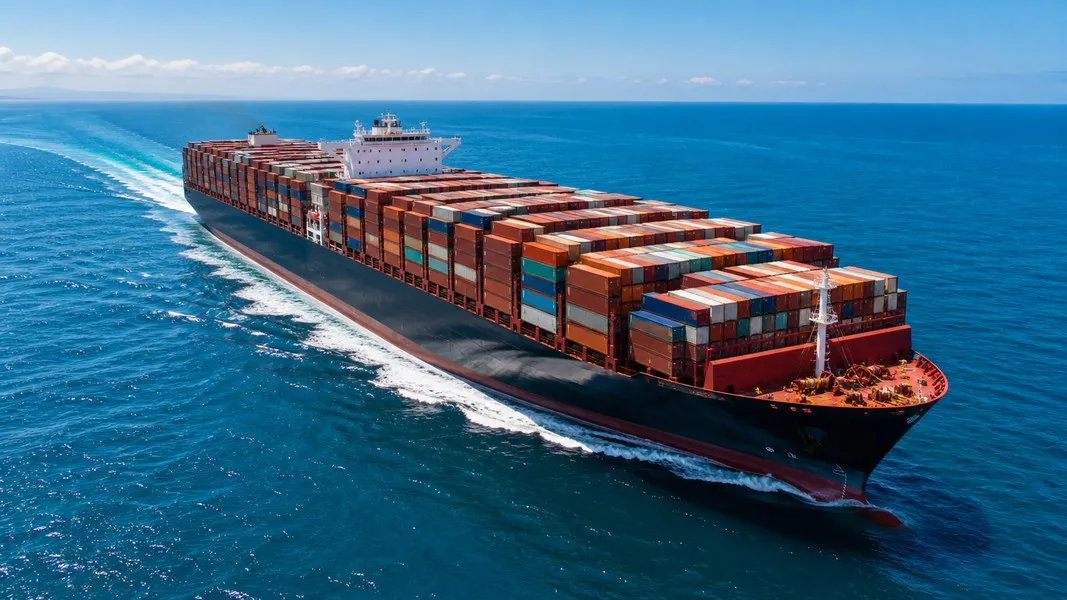
The largest container ship in the world is the MSC Irina, with a maximum capacity of 24,346 twenty-foot equivalent units. She measures 399.9 metres from bow to stern and 61.3 metres across the beam, and she has held the record since March 2023. No ship delivered since has beaten her.
That record has stood for longer than most people expect, and the reason is not engineering. Shipyards could build a bigger hull tomorrow. The ports, the canals and the arithmetic of filling that many slots are what stopped the growth. This guide covers the ships that hold the top places, how they are measured, what the size classes actually mean, and where the giants sail once they leave the yard.
What Counts as the Largest Container Ship
Two different measurements get called "biggest", and they give different answers.
The first is nominal capacity, the number of twenty-foot boxes a ship is designed to hold. That is the figure used in every ranking, including this one. The second is the record for containers actually loaded on a single voyage, which is always lower because weight limits bite before slots run out.
As of September 2025, the loading record belonged to the ONE Innovation, which carried 22,233 TEU from Singapore to Felixstowe. Her nominal capacity is 24,136 TEU, so even a record-setting voyage left roughly two thousand slots empty.
How TEU Capacity Is Measured
TEU stands for twenty-foot equivalent unit. One standard 20-foot container is one TEU, and a 40-foot container counts as two. A ship rated at 24,346 TEU could in theory carry that many 20-foot boxes, or around 12,000 forty-foot boxes, or any mix in between.
The catch is weight. Deadweight tonnage, not slot count, is the real limit on a loaded voyage. The MSC Irina has a deadweight of roughly 237,560 tonnes, which covers cargo, fuel, ballast water, stores and crew together. A full load of dense cargo hits that ceiling long before the last slot is filled, which is why nominal capacity and actual loading rarely match. If you want the mechanics of the unit itself, we covered what TEU measures in more detail.
The Current Record Holder: MSC Irina
The MSC Irina was delivered on 9 March 2023 by Yangzi Xinfu Shipbuilding to Mediterranean Shipping Company. She sails under the Liberian flag and is registered at 233,328 gross tons.
Her defining feature is not length. At 399.9 metres she is the same size as a dozen rivals, all of which stop just short of 400 metres for port and canal reasons. The gain came from beam. At 61.3 metres she carries 24 rows of containers side by side, and those extra rows are where the capacity came from.
She is also fitted with an air lubrication system, which pumps a carpet of bubbles under the hull to cut friction and fuel burn.
Her sister ships share the same 24,346 TEU rating, so the top of the ranking is effectively a six-way tie. MSC Loreto, MSC Michel Cappellini, MSC Mariella, MSC Micol and MSC Türkiye all belong to the Irina class.
The 24,000 TEU Club
Every ship in the current top ten exceeds 23,700 TEU, a threshold that did not exist before 2019. The table below covers the flagship of each class rather than every sister ship.
| Ship | Operator | TEU | Length | Delivered |
|---|---|---|---|---|
| MSC Irina | MSC | 24,346 | 399.9 m | 2023 |
| OOCL Spain | OOCL | 24,188 | 399.9 m | 2023 |
| OOCL Wisdom | OOCL | 24,168 | 399.99 m | 2026 |
| ONE Innovation | ONE | 24,136 | 399.9 m | 2023 |
| MSC Tessa | MSC | 24,116 | 399.9 m | 2023 |
| Ever Alot | Evergreen | 24,004 | 399.9 m | 2022 |
| Ever Ace | Evergreen | 23,992 | 400 m | 2021 |
| HMM Algeciras | HMM | 23,964 | 399.9 m | 2020 |
| MSC Gülsün | MSC | 23,756 | 399.9 m | 2019 |
How the Record Changed Hands
The sequence is tighter than it looks. The OOCL Hong Kong took the title in 2017 at 21,413 TEU, the first ship past 21,000. The MSC Gülsün followed in 2019 at 23,756 TEU as the first to stack 24 rows across.
Evergreen's Ever Alot broke 24,000 TEU in 2022. Then the MSC Tessa and the MSC Irina were both delivered on the same day in March 2023, by different Chinese yards, and the Irina won by 230 slots. Detailed dimensions for each class are catalogued by Brookes Bell, whose ranking tracks flagships and their sisters together.
The Evergreen and HMM Flagships
The Evergreen A class runs to 13 ships built between 2021 and 2023, split between Samsung Heavy Industries in South Korea and two Chinese yards under China State Shipbuilding Corporation. The Korean-built units are rated at 23,992 TEU and the Chinese-built ones at 24,004, which is why Evergreen appears twice near the top.
HMM's 2020 pair, the Algeciras at 23,964 TEU and the Oslo just behind, held the record briefly and are still the largest ships operated by a Korean carrier.
Container Ship Size Classes Explained
Container ships fall into seven recognised size categories, and the boundaries come from waterways rather than from any shipbuilding standard.
Ships under 3,000 TEU are feeders, and they are the only segment where onboard cranes are common. More than 60 percent of vessels in the 1,500 to 2,499 TEU range are geared, while almost no ship above 4,000 TEU carries its own cranes. Everything larger depends entirely on shore equipment.
Panamax and Neopanamax
Panamax was defined by the original Panama Canal locks. Neopanamax is defined by the expanded locks opened in 2016: wide enough for 19 rows of containers and a capacity around 12,000 TEU, which puts such a ship in the same size bracket as a capesize bulk carrier.
Very Large and Ultra Large
Researchers drew the modern line in 2016. A Very Large Container Ship carries 10,000 to 20,000 TEU. An Ultra Large Container Ship carries more than 20,000. The separate Ultra Large Container Vessel class starts at 14,501 TEU, 366 metres of length and 49 metres of beam.
For scale, the Maersk Triple E class sits at 400 metres, 59 metres of beam, 14.5 metres of draft and 18,270 TEU, and it can still transit the Suez Canal.
Why 400 Metres Became the Ceiling
Look down the ranking and one number repeats: 399.9 metres, over and over, never quite 400. That is not coincidence.
Length is capped by berths and by the reach of quay cranes. Beam is capped by crane outreach, since a gantry has to lift a box from the outermost row on the far side of the ship. Draft is capped by channel depth at the ports the ship is meant to serve. Cross any of those thresholds and a ship becomes uncommercial, because the list of ports that can work her shrinks.
A ship that cannot be discharged quickly enough is not efficient, whatever its slot count says. The economics of a 24,000 TEU vessel depend on turning her around in a handful of ports with the deepest water and the biggest cranes.
The Canal and Strait Limits
The Suez Canal, the Singapore Strait and the Malacca Strait each impose their own limits on beam and draft, and those constraints have shaped hull design for two decades.
Recent politics added another layer. Container ship transits through Suez fell to 150 crossings in January 2026, the lowest January figure in at least a decade and 16.7 percent below the year before. Ships above 18,000 TEU had avoided the canal entirely for more than twenty months before a first cautious return in December 2025, according to AXSMarine fleet data.
Why Container Ships Stopped Getting Bigger
The plateau at roughly 24,000 TEU is an economic ceiling more than a technical one. Vessels of that size can only be filled on a handful of long-haul routes, and only a handful of terminals can service them at speed.
Very few ships approaching 20,000 TEU have ever called at a United States port, as the BBC reported in its assessment of the size race. The transpacific trade to the US East Coast simply does not have the terminal depth or the crane reach that Rotterdam, Singapore and Shanghai offer.
There is a risk argument too. Putting 24,000 boxes on one hull concentrates exposure: one grounding, one fire, one blocked canal, and a very large share of a trade lane stops moving at once.
The Shift From Size to Fuel
Since 2023, the competition has moved from capacity to propulsion. The newest flagships are not bigger, they are cleaner.
The clearest example is the OOCL Wisdom, named on 8 May 2026 at the Nantong COSCO KHI yard. She measures 399.99 metres by 61.3 metres with a depth of 33.2 metres, carries up to 24,168 TEU and 225,000 tonnes deadweight, and runs at a service speed of 22.7 knots. She is the world's largest methanol dual-fuel container vessel, the first of a series of seven, and her main engines, auxiliary engines and boilers can all switch between methanol and conventional fuel oil.
OOCL states that methanol operation cuts about 150,000 tonnes of carbon dioxide and nearly eliminates sulphur oxide emissions. The full specification is set out in the naming announcement published by the carrier.
Smaller Hulls, Newer Engines
Maersk took the opposite route. Its A class, delivered between January 2024 and May 2025, runs to 12 ships of only 16,000 TEU at 350.59 metres and 54 metres of beam, built by Hyundai Heavy Industries. They are dual-fuel methanol ships, and they carry the bridge at the bow rather than amidships, which frees deck space for containers.
MSC has taken the LNG path instead, operating close to 90 dual-fuel units, more than a third of every such ship in service worldwide. CMA CGM follows with 76.
Where the Biggest Ships Actually Sail
Megamax vessels are concentrated on the Asia to Europe corridor, which is the only trade with enough volume in both directions to keep them full.
That lane set a record in February 2026, when weekly deployed capacity exceeded 521,000 TEU for three consecutive weeks, the highest level ever recorded on the route. The Ocean Alliance carriers hold the largest single share of that capacity at 32.4 percent.
Fleet scale tells the same story. MSC passed 7.2 million TEU of total capacity in February 2026 across 980 vessels, around 21.4 percent of the world fleet, with a further 2.18 million TEU on order.
The Ports That Can Handle Them
Only a small group of terminals can take a fully loaded 24,000 TEU ship, and they are the same names year after year.
Shanghai handled 55.1 million TEU in 2025, the first port ever to clear 55 million, up 6.9 percent on the previous year. Singapore followed at 44.7 million and Ningbo-Zhoushan at 43.9 million after the fastest growth in the top ten. The full port throughput ranking covers the 125 largest container ports.
The concentration matters when you are waiting on cargo. A megamax calls at fewer ports than a mid-sized ship, so a delay at one terminal ripples down the whole rotation.
How to Track the Largest Container Ships
Every one of these vessels broadcasts its position over AIS, so following the record holders is straightforward once you know what to search for.
Search by ship name if you know it, or by IMO number if you want certainty, since names get reused and transferred between owners. The MSC Irina, the OOCL Wisdom and the Ever Ace all appear on public tracking maps with live position, speed and heading.
Primo Nautic adds the part raw AIS data leaves out. Instead of a position readout, it explains what the vessel is doing in plain language, gives an independent ETA alongside the captain's reported arrival time, and reports the weather at the ship's actual location rather than at the destination port.
Following a Specific Shipment
If your interest is cargo rather than the ship itself, the useful move is to find the vessel your booking is loaded on and follow that hull. Our guide to container ship tracking walks through the steps for that.
Primo Nautic will flag a delay against the expected schedule and send an arrival alert, which is more practical than refreshing a map when a voyage from Asia to Europe runs several weeks.
What the Size Race Means for Shippers
Bigger ships lowered the cost of moving a single box, and that saving is real. The trade-off is fewer sailings, fewer ports of call, and a schedule that is harder to recover when something slips.
The global orderbook reached a record 9.1 million TEU in March 2025, close to 800 newbuildings against a world fleet of about 7,300 ships. Roughly a third of those slots deliver after 2028, and first-tier yards are sold out until near the end of the decade. Very little of that new capacity is aimed at breaking the size record. It is aimed at replacing old tonnage with efficient, dual-fuel hulls.
For anyone booking cargo, the practical consequence is that vessel identity matters more than it used to. Which ship, which rotation and which alliance now determine your transit time more than the headline capacity of the fleet.
Key Takeaways
The MSC Irina remains the largest container ship afloat at 24,346 TEU, a record set in March 2023 and unbeaten since. Five sister ships match her exactly, and the rest of the top ten sits within a few hundred slots.
The 400 metre mark is a commercial boundary, not an engineering one. Berth length, crane outreach, channel depth and canal limits all converge near the same point, and a ship that outgrows them loses the ports that make her profitable.
Growth has moved from capacity to propulsion. The OOCL Wisdom at 24,168 TEU and the smaller Maersk A class both run on methanol, MSC leads on LNG, and the record orderbook is a fleet renewal programme rather than a race for a bigger number. The giants concentrate on the Asia to Europe lane and on a short list of deepwater ports, which is why a single terminal delay can be felt across an entire trade.