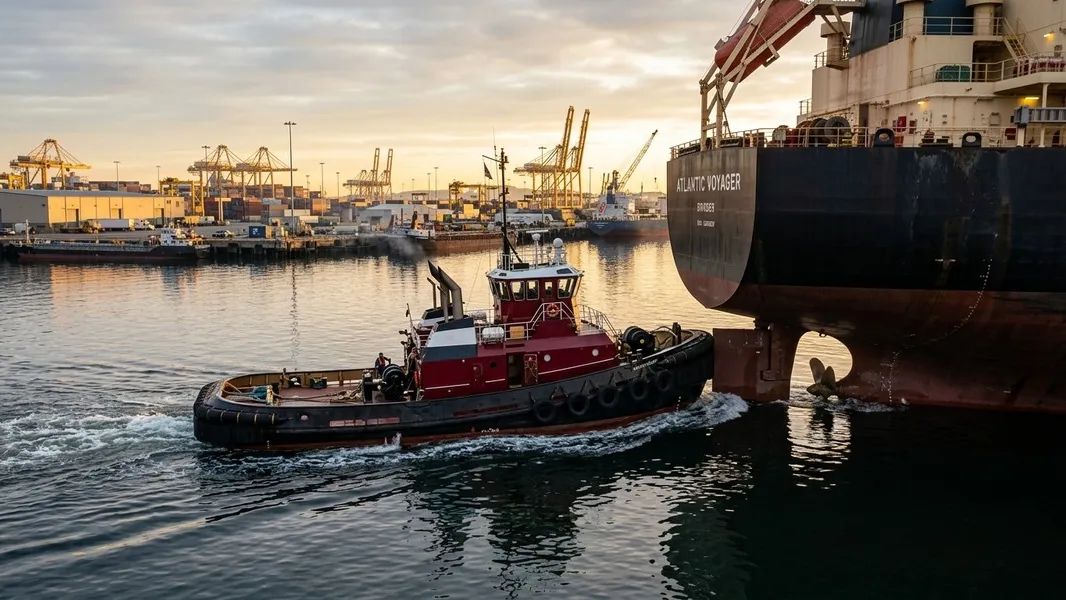
A tug boat is a small, extremely powerful vessel designed to push and pull larger ships through harbors, channels, and tight waterways. Despite its compact size, it generates more raw force per meter than almost any other vessel at sea, making it essential to port operations worldwide.
You have almost certainly seen one without knowing its name. That stubby, muscular little boat nudging a giant cruise ship into its berth, or escorting a tanker through a narrow channel, is a tug boat at work. They are the workhorses that make modern shipping possible wherever precision matters more than speed.
What Is a Tug Boat?
A tug boat is built around a single purpose: applying controlled force where larger vessels cannot maneuver on their own. Cargo ships, cruise liners, and tankers are optimized for open water efficiency, not port agility. Their engines are powerful but not designed for the slow, precise sideways movements that berthing requires. That is where tug boats come in.
Typical harbor tugs measure around 40 to 50 meters in length, which makes them tiny alongside the ships they guide. What they lack in size they make up for in torque. Their hull design is low and heavily reinforced, built to withstand repeated contact with much larger steel hulls.
The history of commercial tug services goes back further than most people expect. Tug operations trace to at least 1892, when Thomas Crowley began with a single rowboat in San Francisco Bay, eventually growing into one of the largest maritime companies in the United States. That early model, a small boat generating force to move something much heavier, is still exactly what the industry does today, only with engines measured in thousands of horsepower rather than oars.
The defining characteristic of a tug boat is bollard pull: the maximum pulling force it can exert while stationary, measured in metric tons. This single figure tells you more about how capable a tug is than any other specification.
How Does a Tug Boat Work?
The power behind a tug boat comes from high-torque diesel engines driving specialized propulsion systems. Unlike cargo vessels that prioritize fuel economy over long distances, a tug's engine is optimized to deliver maximum rotational force at low speeds. Brands like Caterpillar, Cummins, and Detroit Diesel supply much of the industry, with engine configurations tuned for sustained torque output rather than speed.
What makes modern tugs exceptional is the azimuth thruster. These rotating drive units can spin 360 degrees, meaning the tug can push or pull in any direction without needing to turn its hull first. An azimuth stern drive (ASD) tug can move sideways, spin in place, and apply force at precise angles, all of which transforms docking a 200,000-ton ship into a matter of controlled geometry rather than guesswork.
When a large vessel arrives at port, the captain and harbor pilot coordinate with one or more tugs as a combination of brakes and steering corrections. One tug might press against the bow to slow approach speed, another pulls on a stern line to create rotation around the ship's pivot point, and a third holds the hull away from the dock while the mooring lines are rigged. The tug captain coordinates with the harbor pilot via radio, applying short bursts of thrust measured in seconds.
The key measurement is bollard pull: the force a tug exerts against a fixed point while running at full throttle. Typical harbor tugs achieve 30 to 50 metric tons of bollard pull. The most powerful ocean-going tugs reach 300 to 500 tons, with vessels like the Aurora Saltfjord once holding the world record at 397 metric tons.
Types of Tug Boats
Not all tugs do the same job. The types of ships that need assistance determine what kind of tug shows up, and port operators maintain different tug types to handle different vessel categories.
Conventional tugs use a fixed propeller at the stern, the same basic layout used for over a century. They are effective for open-water towing but limited in tight harbors because turning the hull takes space and time. You will still find them on rivers and in less congested port settings.
Tractor tugs place the propulsion units near the bow rather than the stern, which gives them superior pulling power in tight spaces and makes them very stable under heavy loads. Within this category, Voith Tractor tugs use cycloidal propellers that generate thrust in any direction without rotating the drive unit itself, giving them exceptional precision.
Azimuth stern drive (ASD) tugs are currently the most common type in modern ports. They combine the maneuverability of tractor tugs with a stern-mounted azimuth drive, making them versatile enough to handle most docking situations. Harbor ASD tugs typically run between 1,000 and 3,000 horsepower, while coastal variants scale up to 4,500 HP and ocean-going tugs exceed 12,000 HP.
Pusher tugs are designed specifically for inland waterways and river operations. Instead of towing on a line, they push barges ahead of them, often handling multiple barges lashed together into a convoy called a tow. On major river systems, a single pusher tug may move more cargo in one journey than a medium-sized cargo ship.
How Powerful Are Tug Boats?
The power of a tug boat relative to its size is genuinely difficult to grasp until you watch one stop a cruise ship. A typical harbor tug runs engines producing 1,000 to 3,000 horsepower and achieves bollard pull of 30 to 50 metric tons. A coastal tug steps up to 2,500 to 4,500 HP. Ocean salvage tugs capable of refloating grounded vessels exceed 4,500 to 12,000 HP, with some specialized offshore units going higher.
To put bollard pull in practical terms: a 50-metric-ton bollard pull means the tug can hold a static load equivalent to roughly 50 fully loaded family cars pulling in the opposite direction. Applied to a ship that weighs 100,000 tons but is moving at walking pace, that force is more than enough to brake, redirect, or hold position against wind and current.
The world record for bollard pull sits in the 397-metric-ton range, achieved by purpose-built offshore supply vessels and ice-class tugs operating in conditions far more extreme than any harbor.
The relationship between horsepower and bollard pull is not linear. Propulsion efficiency, thruster design, hull resistance, and the diameter of the propellers all affect how much of the engine's output converts into usable force. This is why two tugs with similar HP ratings can produce very different bollard pull figures, and why engine horsepower alone is a poor guide to a tug's real capability.
Tug Boats in Port Operations
Every major port in the world maintains a fleet of tug boats on permanent standby. When a cruise ship or container vessel approaches, port control assigns tugs based on the vessel's size, wind conditions, tidal current, and the geometry of the berth it is heading toward. Large cruise ships docking in tight city terminals typically require two to four tugs working simultaneously.
The tug boat captain's job is one of the most demanding roles in harbor work. They must read the slow momentum of a vessel weighing tens of thousands of tons and apply precisely timed bursts of force at correct angles. Too much push and the hull contacts the dock structure. Too little correction and wind drag pulls the ship off course before the mooring lines reach the bollards.
The coordination happens quickly and quietly. Harbor pilots board the arriving ship and communicate with the tug captains via VHF radio, using standardized commands and compass bearings to indicate exactly where force should be applied and for how long. Most large ship dockings involve dozens of these exchanges over the span of twenty to forty minutes.
Tugs are also the first responders when something goes wrong at sea. Salvage tugs specialize in reaching disabled vessels, attaching tow lines in difficult conditions, and bringing them to a place of safety. These are the largest and most powerful tugs afloat, equipped for ocean-going work and often stationed near known shipping hazards or deep-water ports with heavy traffic.
Tracking Tug Boats in Real Time
Tug boats broadcast their position and identity via AIS tracking, the same system used by cargo ships, ferries, and cruise liners. The IMO mandates AIS for all commercial vessels over 300 gross tons, and most working tugs fall well within scope. Every commercial tug carries an AIS transponder that transmits its MMSI number, position, speed, and heading continuously to nearby shore receivers and satellite networks.
On any given day, you can watch tugs working a major port in real time using a vessel tracking app. Primo Nautic lets you search by vessel name or MMSI number to find any commercial vessel, including the tug boats guiding ships into berth at ports worldwide. The app identifies vessel categories using AIS type codes, so you can spot harbor tugs and pilot vessels operating in any given area at a glance.
This is particularly useful if you are tracking a family member on a cruise ship and want to understand what is happening as the vessel approaches port. When you see the ship's speed drop toward zero and its course shifting unpredictably, that is usually the moment the tugs take over. Watching the smaller vessels appear alongside on a live map makes the whole docking sequence easy to follow in real time.
Primo Nautic also surfaces weather conditions at the vessel's exact location alongside position data, which adds context when tugs are working in wind or swell that would otherwise make the approach difficult to read from a distance.
Conclusion
Tug boats are the most power-dense working vessels on the water. Their combination of high-torque diesel engines, rotating azimuth thrusters, and purpose-built reinforced hulls gives ports the ability to handle ships hundreds of times their own size with precision and safety. Whether it is a compact harbor tug nudging a cruise liner into its berth or a deep-ocean salvage tug crossing thousands of miles to reach a disabled freighter, these vessels do work that no other ship can replicate.