



Speed in Knots: What It Means and How to Convert It
A knot is a unit of speed equal to one nautical mile per hour. When a cruise ship travels at 20 knots, it covers roughly 23 miles per hour, fast enough to cross the Atlantic in under a week. Speed in knots shows up in every ship tracking app, weather forecast at sea, and maritime report, yet most people have never had the unit explained clearly.
This guide covers what knots are, how to convert them to mph and km/h, why ships still use them, and what different vessel speeds actually feel like when you're watching a ship move across a live tracker.
What Is a Knot?
A knot is one nautical mile per hour. One nautical mile equals exactly 1,852 meters, a distance corresponding to one arcminute of latitude on Earth's surface. That geographic precision is what made the unit so practical for ocean navigation long before GPS existed.
The word "knot" comes from a 17th-century speed measurement device called the chip log. Sailors threw a wooden board off the stern of the ship, attached to a rope with knots tied at evenly spaced intervals. They counted how many knots passed through their hands in a fixed time window, usually 30 seconds, to estimate the ship's speed. The count gave them speed directly in nautical miles per hour, and the name stuck from that day forward.
This history also explains why saying "20 knots per hour" is a common and redundant mistake. The "per hour" part is already built into the word "knot." Saying "20 knots" and "20 knots per hour" mean exactly the same thing, with the second phrasing doubling up unnecessarily.
How Speed in Knots Converts to MPH and KM/H
The exact conversion values are:
- 1 knot = 1.15078 mph
- 1 knot = 1.852 km/h
To convert knots to mph, multiply by 1.15. To convert to km/h, multiply by 1.852. Here is a quick reference table for common vessel speeds:
| Knots | MPH | KM/H |
|---|---|---|
| 5 | 5.8 | 9.3 |
| 10 | 11.5 | 18.5 |
| 15 | 17.3 | 27.8 |
| 20 | 23.0 | 37.0 |
| 25 | 28.8 | 46.3 |
| 30 | 34.5 | 55.6 |
A useful mental shortcut for knots to mph: add about 15% of the number. Twenty knots is roughly 23 mph. For km/h, double the value and subtract around 7%. Twenty knots works out to about 37 km/h.
The most common mistake people make is assuming knots and km/h are roughly equal. They are not. One knot is nearly double one km/h. If you see a ship reporting "22 knots," that translates to 25 mph, not 22 km/h. Getting this wrong can significantly underestimate how fast a vessel is actually moving.
Why Ships Use Knots Instead of MPH
Nautical miles and knots are designed to work together with how ocean charts are built, and that pairing is the core reason both have survived for centuries.
Maritime charts measure distances in nautical miles. When speed is expressed in knots (nautical miles per hour), calculating travel time becomes simple division: distance divided by speed equals hours. A ship covering 300 nautical miles at 15 knots takes exactly 20 hours. No unit conversion is needed, no rounding required.
That practical elegance has kept knots in use long after faster and more complex navigation tools arrived. The International Maritime Organization requires knot-based speed reporting for vessels globally, ensuring consistent data across every ship, port authority, and tracking platform on the planet.
Aviation adopted knots for the same underlying reason. Air navigation charts use nautical miles for great-circle routes, so airspeed indicators are calibrated in knots. A commercial airliner cruising at 490 knots is traveling about 563 mph. The unit persists in aviation because the charts underneath the plane still measure in nautical miles.
Once you see the connection between the nautical mile and knot-based speed, continued use of the unit stops seeming archaic. It becomes the obvious choice.
What Different Knot Speeds Feel Like at Sea
Attaching knot values to recognizable vessels helps turn an abstract unit into something concrete.
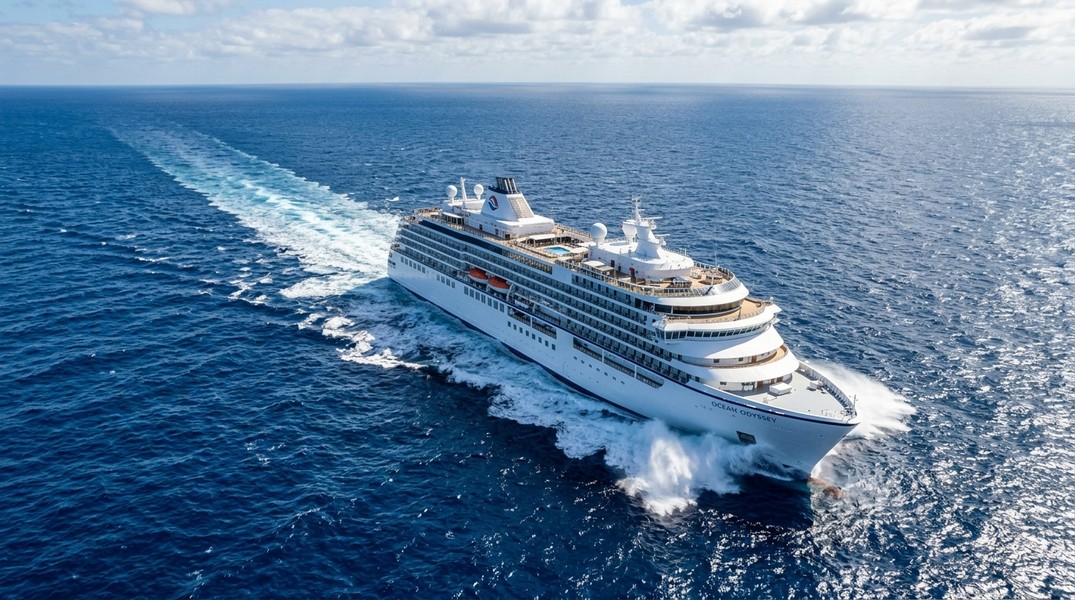
Cruise ships typically cruise at 15 to 22 knots. At that range, passengers feel a gentle forward motion on deck, similar to highway driving but considerably smoother. Fuel consumption rises sharply above 22 knots, which is why most cruise lines hold steady between 18 and 20 knots on open ocean legs rather than pushing engines toward their limits.
Container ships can reach 25 knots when running on schedule, though modern slow-steaming practices have many vessels running 12 to 15 knots to reduce fuel costs and emissions. Tankers are among the slowest large commercial ships, typically operating at 12 to 15 knots due to their weight and cargo volume.
The Titanic was traveling at approximately 21 knots when it struck the iceberg, a standard liner cruising speed for its era, but dangerously fast given the ice conditions in the North Atlantic that night. Speed in knots is not just a technical number; it carries real consequences when conditions change quickly.
Wind Speed in Knots and What It Means for Sailors
Weather services worldwide report wind speeds in knots, particularly at sea. If you are tracking a ship and checking conditions at its location, the wind readings in the forecast are almost certainly expressed in knots.
The Beaufort scale links specific knot ranges to sea state descriptions, giving a structured framework for understanding what wind speed means for a vessel in motion. The scale runs from calm conditions at 0 knots all the way to hurricane-force winds above 63 knots.
At 10 knots of wind, conditions are a light breeze with small ripples on the surface, comfortable for any vessel. At 20 knots, seas become choppy with waves up to 2 meters, but most ships handle this easily. At 30 knots, conditions shift to rough seas with 2 to 4 meter waves, and cruise ships often slow down or adjust course for passenger comfort. Above 50 knots, you are in gale-force or storm conditions with waves potentially exceeding 5 meters, the point at which port calls may be skipped and itineraries rerouted entirely.
Cruise lines pay particular attention to wind speeds when approaching tender ports. These are anchorage locations where passengers board small transfer boats to reach shore, rather than docking directly. At 25 to 30 knots of sustained wind, tender operations are typically suspended because the small vessels cannot operate safely in those seas.
Primo Nautic displays live weather conditions at the exact vessel location, including wind speed and sea state. Rather than requiring you to look up a separate weather forecast, you see the conditions at sea right alongside the ship's position, speed, and ETA in a single view.
How Knot Speed Affects Ship ETA
Speed in knots has a direct and measurable effect on when a ship arrives, and even modest reductions in speed create significant shifts in schedule.
The core formula: time equals distance divided by speed. A vessel covering 500 nautical miles at 20 knots arrives in 25 hours. If that same ship slows to 15 knots, the journey extends to just over 33 hours, an 8-hour delay from a 5-knot reduction. For families waiting at a port or tracking a cargo shipment, that kind of shift matters.
AIS data reports two distinct speed measurements. Speed over ground (SOG) reflects actual vessel movement relative to the seabed, accounting for the effect of ocean currents. Speed through water (STW) reflects only the propeller-driven speed through the water itself, before any current is applied. A ship pushing 20 knots through the water while fighting a 5-knot opposing current will only make 15 knots over ground, and it is the SOG value that determines real-world ETA.
Understanding how AIS vessel tracking works helps explain why ETAs can shift by several hours overnight without an obvious cause. A speed drop from 20 to 15 knots, triggered by weather, port traffic management, or fuel economy decisions, reshuffles the arrival time entirely.
Primo Nautic converts this raw speed and position data into plain-language updates. When a cruise ship drops speed to navigate difficult weather, families tracking a loved one on board see a revised ETA notification rather than just a changed number on a map. The link between knot speed, the nautical miles remaining, and the predicted arrival time becomes legible in terms anyone can follow without maritime expertise.
Conclusion
A knot is one nautical mile per hour, a unit built around the geometry of the Earth that has outlasted centuries of technological change in navigation. Converting knots to mph or km/h takes a single multiplication. Understanding what knot speed means for sea conditions, vessel type, and ETA predictions takes the practical context covered in this guide.
When you see a ship reporting 20 knots on a live tracker, you now know that is 23 mph, that a 5-knot slowdown could add hours to the arrival time, and that wind speed in knots from a forecast tells you exactly what conditions are like on deck. Speed in knots is more than a data point. It is the unit that connects ship position, travel time, weather, and navigation into a coherent picture.
Most Recent Posts
Discover more articles from our blog.