



Ship a Car Overseas: Steps, Costs and Transit Times
To ship a car overseas, you book it through a freight forwarder on either a roll-on/roll-off (RoRo) vessel or inside a shipping container, file the export paperwork with customs at least 72 hours before the ship sails, deliver the car empty with no more than a quarter tank of fuel, insure it, and clear import customs at the other end. The whole job usually takes a few weeks from booking to collection.
The steps are simple on paper. What trips people up are the details: the carrier refusing a car with a full tank, a missed customs deadline, or a vessel arriving days later than the date on the booking. This guide walks through each stage in order, with the rules the carriers and customs authorities actually publish.
What You'll Need Before You Ship a Car Overseas
Get these together before you ask for quotes. A forwarder can price the job faster, and you avoid a scramble a few days before the cut-off.
- Proof of ownership: for a US-titled car, the original certificate of title, plus the vehicle identification number (VIN).
- Shipper details: your passport or ID, and your address at the destination.
- Destination rules: whether the destination country accepts your car's age, emissions class and safety equipment, and what duty and tax it charges.
- Photos of the car: every panel, the interior and the odometer, taken shortly before handover.
- Two keys: one goes with the car, one travels with you or the person collecting it.
The destination rules deserve the most time. A car that cannot be registered where it lands is an expensive problem that no shipping method fixes.
Step 1: Choose RoRo or Container Shipping
There are three common ways to move a private car by sea, and the choice drives cost, protection and what can travel inside the car.
| Method | How it works | Best for | Main limit |
|---|---|---|---|
| RoRo | The car is driven onto a car carrier and lashed on a vehicle deck | Running cars on busy routes | No personal items inside the car |
| Shared container | Your car shares a 40ft container with two or three others | Lower cost with more protection | Depends on other cars filling the box |
| Exclusive container | One car per 20ft or 40ft container | Classic, valuable or non-running cars | Highest cost of the three |
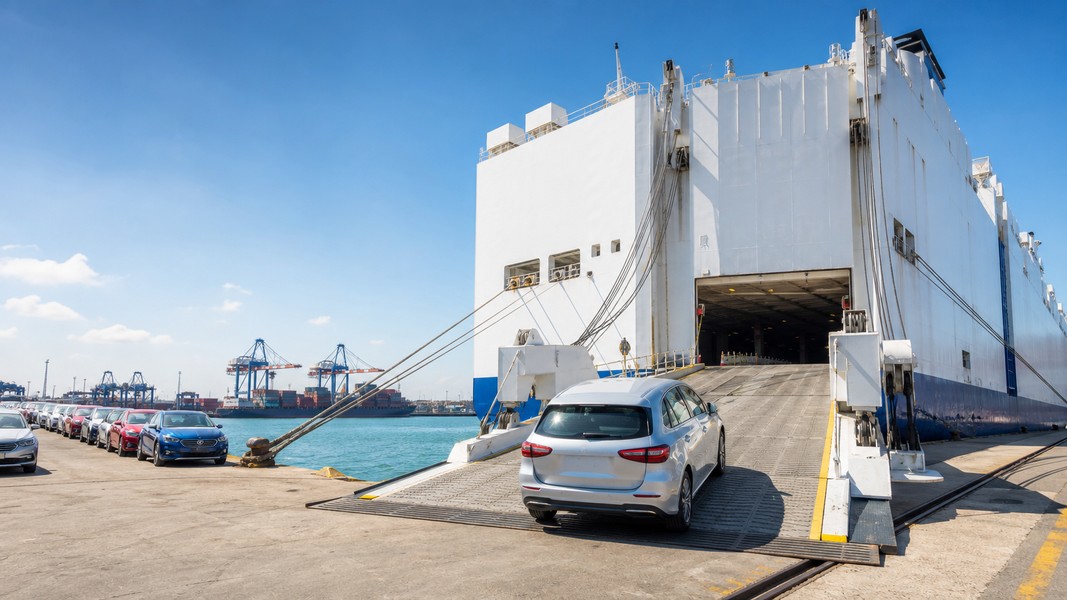
RoRo ships are floating multi-storey car parks. Cars roll on and off under their own power, with no cranes involved, which is why it is usually the cheapest option on routes the car carriers serve. If you want to understand the ships themselves, our guide to roll-on/roll-off ships explains how the decks and ramps work.
The scale is large. Höegh Autoliners loads around 1.6 million car equivalent units a year, and Wallenius Wilhelmsen runs about 125 vessels across 15 trade routes. Your car joins thousands of new vehicles heading for dealers.
Containers suit cars that cannot drive onto a ship, cars worth more than the price difference, and anyone moving household goods at the same time. Car shippers also point out that a container is sealed for the voyage, which reduces handling.
How Long Shipping a Car Overseas Takes
Transit time depends on the route and on how often the method sails. For the United States to Europe, Doma Shipping, a car shipping firm, puts RoRo at about 2 to 4 weeks, container shipping at 3 to 6 weeks and air freight at 1 to 2 weeks. Those figures cover the ocean or air leg only, not customs clearance.
Containers tend to take longer because a shared box waits until it is full and is unloaded at a warehouse after arrival. RoRo cars roll straight off the ship at the terminal. Add a few days at each end for inland transport and paperwork when you plan around the dates.
Step 2: Book Through a Freight Forwarder
You will rarely book a RoRo carrier directly. The Wallenius Wilhelmsen private vehicle page states plainly that the carrier does not deal with private persons, and requires private shippers to go through a freight forwarder who handles inland transport, export documents, booking, insurance and claims.
A good forwarder does more than book space: they own the paperwork at both ends of the voyage. Ask each one you speak to which carrier and port they would use, whether the quote covers destination charges, and who files the export declaration.
Space is not guaranteed until the forwarder places a firm booking. Wallenius Wilhelmsen also requires shipping instructions no later than three days before the vessel arrives at the loading port, so a late booking can push your car onto the next sailing.
Step 3: How Much It Costs to Ship a Car Overseas
There is no single price, because the quote is built from several parts. On Wallenius Wilhelmsen's terms, ocean freight is charged per unit for cars, or on the greater of volume or weight, and varies with the ports and the cargo. On top of that come local port charges at loading and discharge, and surcharges such as the Bunker Adjustment Factor, which follows fuel prices.
A full door-to-door quote usually covers these items:
- Inland transport to the loading port, and from the discharge port to your door
- Ocean freight and fuel surcharges
- Terminal handling and local port charges at both ends
- Export filing, import clearance and the forwarder's fee
- Marine insurance
- Import duty and taxes at the destination
To put rough numbers on it, West Coast Shipping, a US car shipper, gives an illustrative estimate of about 2,750 US dollars of ocean freight in a shared container for a Porsche 911 from Germany to New York, or about 3,750 US dollars with inland legs at both ends. The same source adds 1,500 to 5,000 US dollars for an exclusive container and 15 to 30 percent in peak months. Treat these as orders of magnitude only: your route, the season and the vehicle's size change the result.
Import Duty Is Often the Largest Line
Duty can outweigh the freight itself. US Customs and Border Protection lists a base duty of 2.5 percent for imported cars and 25 percent for trucks, and the European Commission notes that the EU applies a 10 percent tariff on cars. Additional tariffs have been layered on top in some trades since 2025, so get the current total from a customs broker before you commit.
Step 4: Clear Export Customs 72 Hours Ahead
The export rules are where a missed deadline costs the most. For cars leaving the United States, the CBP export rules require the vehicle and its documents, including the VIN and the original title, to be presented to customs at least 72 hours before export by vessel.
A second filing runs in parallel. Under the Foreign Trade Regulations, Electronic Export Information has to be filed through the Automated Export System for every used self-propelled vehicle 72 hours before export, regardless of destination, value or condition, as the CBP export FAQ confirms. Your forwarder normally files this, but check that they have.
Other countries have their own export steps. Ask your forwarder for the list at your origin, and keep copies of every document stamped or returned to you.
Step 5: Prepare the Car for the Voyage
Carriers publish strict rules for used vehicles, and a car that breaks them is refused at the terminal. The Wallenius Wilhelmsen customer guide is a good reference because other RoRo lines apply similar terms:
- Fuel: no more than a quarter of a tank of petrol, diesel or LPG.
- Empty interior: no personal effects in the seats, footwells, trunk or storage spaces. Only the car's standard equipment may stay.
- Clean: washed inside and out to the destination's clean cargo requirements, including the underside.
- Alarm off: the alarm system must be disconnected, and batteries are disconnected by the carrier.
- No leaks: a car leaking oil, or missing its fuel cap, is refused until it is fixed.
Electric and plug-in hybrid cars follow extra rules. The carrier asks for photos showing the car in good condition, needs it to be drivable without mechanical faults, and assesses each alternative fuel vehicle before accepting the booking. An older version of the same guide set the charge limit below 70 percent.
The cleaning rule matters at both ends. CBP notes that the US Department of Agriculture requires the undercarriage of imported cars to be free of foreign soil, and recommends steam cleaning before shipment.
Step 6: Buy Marine Insurance
The carrier's liability is limited by international rules and may not cover your car's full value. Wallenius Wilhelmsen strongly recommends a marine insurance policy for exactly that reason, and points to the liability chapter of its bill of lading terms.
With insurance, a damage claim goes to your insurer, who settles it under your policy. Without it, your forwarder files a formal claim with the carrier within the period set by the bill of lading, supported by repair estimates, the signed dock receipt from loading and the signed delivery record from discharge. That is one more reason to take dated photos before handover.
Ask your forwarder whether the cover is all-risks or total loss only. A total loss policy pays if the car is destroyed or lost, and nothing for a dented panel.
Step 7: Track the Vessel While Your Car Is at Sea
Once the car is loaded, your bill of lading or sea waybill names the vessel. From that point, the ship's position is your best guide to when the car will arrive.
Schedules move. Wallenius Wilhelmsen sends a notice of arrival to the forwarder's agent about four days before the vessel arrives, and still advises checking the vessel's ETA because changes do occur. Port congestion, weather and extra port calls can all shift the date by days.
Primo Nautic lets you follow the exact ship carrying your car by searching its name or IMO number. With the Cargo Shipment purpose selected, the updates focus on position, speed and arrival timing, and the app compares the captain's reported ETA with its own route-based estimate, so you see a slip before the paperwork tells you.
Primo Nautic can also send arrival and delay notifications. That gives you time to book the customs broker, arrange onward transport and plan the trip to the port around the real arrival date rather than the one on the booking.
Step 8: Clear Import Customs and Collect the Car
At the destination, the car has to be cleared before it leaves the port. Our walkthrough of the customs clearance process covers the stages in detail, but for a car there are a few extra checks.
In the United States, the CBP import guidance requires form HS-7 to declare whether the car meets Department of Transportation standards. As a general rule, cars less than 25 years old must comply with all applicable Federal Motor Vehicle Safety Standards to be imported permanently, and emission standards apply as well. Returning residents can apply their personal exemption toward the car's value if it meets the conditions CBP sets.
Before anyone goes to the port, your forwarder should confirm the local fees, accepted payment methods and required documents with the carrier's agent. Wallenius Wilhelmsen recommends that the person collecting the car brings a spare key.
Tips for Better Results
Book outside peak months when you can. Shippers quote higher rates in busy seasons, and RoRo space on popular routes fills up.
Match the method to the car rather than the cheapest quote. A classic or non-running car belongs in a container, while a reliable daily driver on a major route is a natural fit for RoRo.
Ask for the vessel name as soon as the booking is confirmed. Knowing the ship early means you can watch its earlier port calls and see whether it is running to schedule before your car is even loaded.
Troubleshooting Common Issues
The car was refused at the terminal. The usual causes are too much fuel, personal items left inside, an oil leak or a missing fuel cap. Fix the issue and rebook; the carrier will not load the car until it complies.
The car missed its sailing. Check whether the 72-hour export filing and the carrier's three-day instruction deadline were both met. If either slipped, your car moves to the next departure on that route.
The arrival date keeps moving. Follow the vessel's live position and ETA rather than the original booking date, and only confirm collection once the ship is alongside or close to the port.
There is damage at collection. Note it on the delivery record before you sign, photograph it at the port, and send the evidence to your insurer or forwarder straight away.
Conclusion
Shipping a car overseas comes down to four decisions: RoRo or container, which forwarder, how much insurance, and when to plan collection. Get the 72-hour export filing in on time, deliver the car empty with a quarter tank, and insure it for its real value. Check the destination's duty and registration rules first, since they decide whether the move makes sense at all. Once the car sails, the vessel's real position is a better guide to the arrival date than the schedule you booked against.
Most Recent Posts
Discover more articles from our blog.