




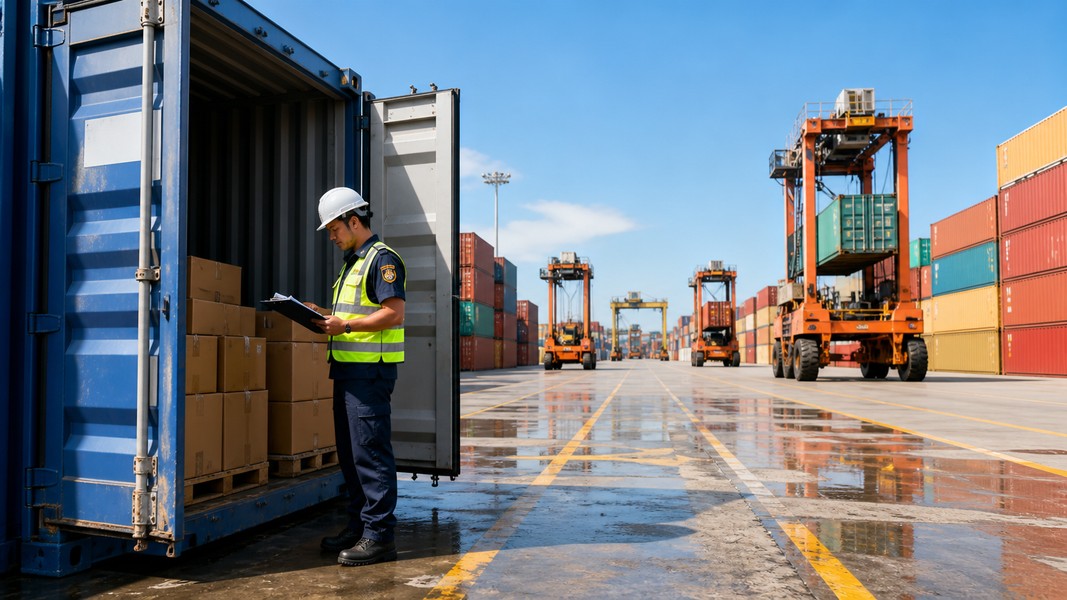
Customs Clearance: The Import Process Stage by Stage
Customs clearance is the process of declaring imported goods to a country's customs authority, paying any duties and taxes, and getting official permission to release the cargo into the country. For an ocean shipment it starts before the container is even loaded at origin and ends when customs lets the goods leave the terminal.
If you import by sea, clearance is where a shipment that arrived on time can still sit for days. The good news is that most of the process runs on paperwork you can prepare in advance. This guide walks through each stage in the order it happens, shows where delays come from, and explains what the status updates in your tracking actually mean.
What Customs Clearance Means for a Sea Shipment
Every country runs its own system, but the logic is the same everywhere. Customs wants to know what is arriving, who is responsible for it, what it is worth, and whether it is safe and legal to bring in. Clearance is the moment customs is satisfied on all four points.
Two words get used loosely and are worth separating. The World Customs Organization's Time Release Study defines release as customs placing the goods at the disposal of the importer, and clearance as the completion of every customs formality, including payment. The two usually happen together, but with deferred payment accounts the goods can be released first and cleared later.
For an importer, release is the milestone that matters, because it is what allows the container to leave the port. Everything below is about reaching it with as little waiting as possible.
The Customs Clearance Workflow at a Glance
The process for a containerised import breaks into six stages:
- Advance data: security information filed before the container is loaded at origin.
- Entry preparation: classifying the goods, confirming their value and gathering documents.
- Declaration and duties: filing the import entry and paying or securing duties and taxes.
- Risk review: customs screens the shipment and may place a hold or order an exam.
- Customs release: the status that tracking tools show as clearance complete.
- Carrier release and pickup: the shipping line releases the box and it leaves the terminal.
Stages one and two happen while the ship is still at sea or not yet loaded. Stages three to six cluster around arrival, which is why a shipment that looks quiet for weeks can suddenly need several decisions in two days.
Stage 1: Advance Data Before the Container Is Loaded
Customs clearance at destination begins at the port of origin. Security rules in the major import markets require shipment data before the cargo sails, so customs can assess risk while the goods are still on the other side of the world.
In the United States this is the Importer Security Filing, often called 10+2. According to CBP guidance, the ISF must reach U.S. Customs and Border Protection no later than 24 hours before the cargo is loaded onto the vessel bound for the United States. The importer's part covers details such as the seller, buyer, manufacturer, country of origin and the six digit commodity code.
The European Union runs a similar system called Import Control System 2. The European Commission states that operators bringing goods into or through the EU must submit a complete Entry Summary Declaration in ICS2 before the goods arrive.
Advance filings are usually handled by the forwarder or broker, but the data comes from you and your supplier. A missing manufacturer address at this stage becomes a hold at destination.
Stage 2: Classify, Value and Prepare the Entry
The heart of any import declaration is three facts: what the goods are, where they come from and what they are worth. Each one decides how much duty you pay.
Classification means assigning the commodity code from the Harmonized System. GOV.UK guidance notes that the commodity code on your declaration determines the rate of duty and whether you need an import licence. Valuation usually starts from the price on the commercial invoice, adjusted for freight and insurance depending on the country's rules.
This is also the stage to collect the paperwork your broker will ask for: the commercial invoice, packing list, bill of lading and any certificates of origin or permits your goods need. If you want a full list, the shipping documents checklist covers each one and who issues it.
Restricted goods add a step. Plant and animal products, medicines, chemicals and similar categories often need registration or inspection by another agency on top of customs, and those approvals run on their own timelines.
Stage 3: File the Declaration and Secure Duties
Once the entry is ready, it is filed with customs. In most countries a licensed broker or customs agent does this electronically on your behalf.
The U.S. process has firm deadlines. CBP's entry process gives the importer of record up to 15 calendar days after arrival to file entry documents, and the entry summary on CBP Form 7501 must be filed with estimated duties deposited within 10 working days after entry. Most importers do not wait that long: filing early is what makes release on arrival possible.
In the UK, duties and import VAT are settled through the Customs Declaration Service. Besides immediate payment, importers can use a duty deferment account, cash accounting, a guarantee account or postponed VAT accounting, and can authorise their customs agent to use those accounts on their behalf.
Filing before the vessel arrives is the single biggest lever you control. Customs can review a pre-filed entry while the ship is still at sea, so release can come the day the container is discharged.
Stage 4: Risk Review, Holds and Examinations
Every declaration is screened. Most shipments pass on data alone and move straight to release. A smaller share is selected for a closer look, either at random or because something in the filing raised a flag.
In the United States, an exam can mean a non-intrusive X-ray or gamma scan of the sealed container, a tailgate exam where officers open the doors and inspect the cargo near the back, or an intensive exam where the container is moved to a centralized examination station and partly or fully unloaded.
The importer pays for the handling. One East Coast examination station's published fee schedule lists 250 USD for a non-intrusive exam and 250 USD for a tailgate exam, with storage for a full container starting at 150 USD a day and doubling after four days. Those charges come on top of the port fees that keep running in the background.
Common triggers include a vague cargo description, a mismatch between the ISF and the entry, a new importer or supplier, and goods that fall under other agencies' rules. Clear descriptions and consistent data across every filing are the best protection.
Stage 5: Customs Release and Clearance Complete
When customs is satisfied, it issues a release. In the U.S. system this shows up as a release message to the broker and the terminal; in carrier and forwarder tracking it often appears as "import customs clearance complete" or "customs released".
That status means customs no longer has a claim on the container. It does not mean the container is ready to collect. The terminal and the shipping line have their own conditions, and a box can show customs clearance completed while still being held for other reasons.
The export side has a mirror image. "Export customs clearance complete" means the goods were cleared to leave the origin country, which happens before loading and says nothing about the destination.
Stage 6: Carrier Release, Pickup and Free Time
The last gate is the shipping line. The carrier releases the container once freight charges are settled and the bill of lading has been surrendered or released electronically. Only when both customs and the carrier have released it can a trucker book a pickup at the terminal.
This is also where the clock matters most. Terminals and carriers allow a set number of free days after discharge; after that, storage and demurrage start to accrue daily. A slow clearance eats into that window directly, which is why many of the charges explained in our guide to demurrage charges trace back to customs delays rather than trucking problems.
How Long Does Customs Clearance Take?
There is no single number, because the variable is not the port but the file. A complete entry filed before arrival can be released on the day the vessel discharges, or within a day or two. A document gap adds as long as it takes to fix, and an intensive exam can add days or longer depending on how busy the examination station is.
Customs administrations measure this themselves. The WCO's Time Release Study methodology tracks the time from the arrival of goods to their physical release, and Article 7.6.1 of the WTO Trade Facilitation Agreement encourages members to measure and publish their average release times. If you import regularly into one country, its published release time studies give a realistic baseline.
For planning, treat customs as a stage with a best case and a bad case, and budget free time against the bad case.
Choosing a Customs Clearance Agent
Most importers do not file their own declarations. The GOV.UK guidance puts it simply: most businesses that import goods use a transporter or customs agent.
A good customs clearance agent should know the procedures for the countries you trade with, handle the volume of declarations you expect, and be clear about how they charge, whether by fixed fee, per declaration or both. GOV.UK also reminds importers that you remain responsible for due diligence on your declarations even when someone else files them.
Hiring a broker moves the paperwork, not the responsibility. Check what your broker files in your name, and keep the supplier data flowing to them early.
Where Vessel Tracking Fits the Workflow
Almost every deadline in customs clearance is anchored to one date: when the ship arrives. The advance filings, the entry, the free time and the pickup all move with it, so an arrival that slips by two days changes the whole plan.
An ETA is a forecast, and forecasts change. Primo Nautic follows the ship itself through AIS data and shows two arrival estimates side by side: the captain's reported ETA and an AI-calculated route ETA with a confidence score. When the two diverge, that gap is an early signal that the arrival date, and every deadline tied to it, may move.
For importers, the Cargo Shipment purpose in Primo Nautic turns that data into concise logistics updates, with delay and arrival notifications. That gives you time to confirm the entry has been filed, line up the trucker and check the free time before the container is discharged.
A Real Scenario: One Container From Asia to the U.S.
Here is how the stages line up for a single 40 foot container of furniture shipped from Ningbo to Los Angeles.
Two weeks before sailing, the supplier sends the commercial invoice and packing list, and the broker confirms the commodity codes. At least 24 hours before loading, the ISF is filed with the manufacturer's full address. The vessel sails, and the importer follows it at sea while the broker prepares the entry.
Five days before arrival the entry and entry summary are filed, and duties are secured through the importer's bond. The container is not selected for an exam, and customs issues the release on the day of discharge. Tracking changes to import customs clearance complete. The freight has already been paid, so the carrier releases the box the same day, and the trucker collects it inside the free time.
Now change one detail: the ISF listed the trading company instead of the actual factory. The mismatch flags the container, it goes for an exam, and the importer pays exam fees plus storage while the free days run out. Same ship, same port, very different bill.
Conclusion
Customs clearance is a sequence, not a single event. Advance data goes in before loading, the entry and duties are prepared while the ship is at sea, customs screens the shipment and may examine it, and release only turns into a pickup once the carrier lets the container go.
Most delays trace back to the file, not the port. Accurate descriptions, consistent data across every filing and an entry lodged before arrival are what turn clearance into a same-day step. Knowing exactly when the vessel will arrive keeps every other deadline in the workflow honest.
Most Recent Posts
Discover more articles from our blog.