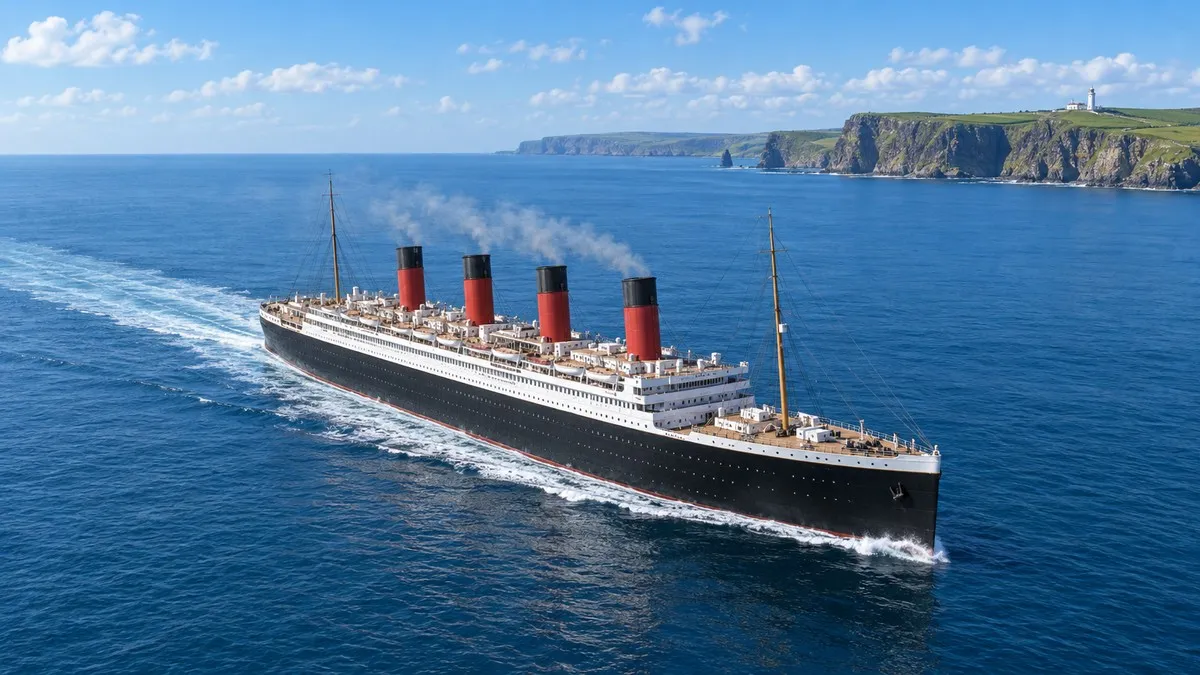
The Lusitania sinking was the loss of the British ocean liner RMS Lusitania, torpedoed by the German submarine U-20 off the south coast of Ireland on 7 May 1915. The ship went down in 18 minutes, and 1,198 of the 1,959 people on board died, including 128 American citizens.
Those two numbers, 18 minutes and 1,198 lives, explain why the event still matters. A ship built to be the fastest on the Atlantic was gone before most of her lifeboats touched the water. This guide walks through what happened minute by minute, why she sank so fast, what was really in her hold, and how far the sinking pushed the United States toward war.
What Was the Sinking of the Lusitania?
In short, it was a civilian liner attacked without warning in a declared war zone. The Imperial War Museums describe a crossing from New York to Liverpool, a single torpedo, and a second explosion whose cause is still debated.
| Fact | Detail |
|---|---|
| Date | 7 May 1915, about 2:10 p.m. |
| Location | Off the Old Head of Kinsale, County Cork, Ireland |
| Attacker | German submarine U-20, Captain Walther Schwieger |
| On board | 1,959 passengers and crew |
| Deaths | 1,198, including 128 Americans |
| Time to sink | 18 minutes |
The Lusitania was not a warship, and that is what made the attack a turning point. Until early 1915, U-boats had mostly followed prize rules: surface, search the cargo, and let people leave before sinking a merchant ship. On 4 February 1915 Germany declared the waters around Britain a war zone where any ship could be sunk on sight.
The Greyhound of the Seas Before the War
Cunard built the Lusitania for the transatlantic passenger trade. According to Encyclopaedia Britannica, she was launched on 7 June 1906 and was the largest ship in the world when completed, about 787 feet (240 metres) long and around 31,550 tons. Her sister ship Mauretania overtook her in size the following year.
Speed was her real claim to fame. In October 1907, a month after her maiden voyage, she won the Blue Riband for the fastest Atlantic crossing, averaging nearly 24 knots. If you are not used to the unit, our guide to speed in knots shows how that compares with road speeds.
War cut that speed back. From November 1914, Cunard ran the ship with six of her boilers closed. The British inquiry found this reduced her top speed from 24.5 to 21 knots, still faster than any other liner on the route.
Why the speed cut mattered
A liner's main defence against a submarine in 1915 was outrunning it. On the morning of 7 May, timed to reach Liverpool at about four the next morning, the Lusitania was making about 18 knots. That left her well within reach of a submerged U-boat lying in her path.
The Warning in the New York Papers
On Saturday 1 May 1915, the day the Lusitania sailed, a notice from the Imperial German Embassy appeared in five New York newspapers, in most cases right beside Cunard's own sailing advertisement. It read in part:
Travelers sailing in the war zone on ships of Great Britain or her allies do so at their own risk.
The notice was dated 22 April, more than a week earlier. Captain William Thomas Turner later said he had seen the advertisement or "something of the kind" before sailing. The New York Times reported the same day that Cunard's agent insisted travel was safe.
Nearly 2,000 people boarded anyway. The liner was the fastest on the route, and Cunard's agent said travel was safe. That confidence is the background to everything that happened six days later.
How the Lusitania Sank on 7 May 1915
The sequence below comes mainly from the British inquiry record led by Lord Mersey, the IWM's account, and the U-20 log held by the US National Archives.
The approach to Kinsale
On the morning of 6 May, as the ship neared the danger zone, the crew swung out all 22 of her Class A lifeboats, ready for lowering. The British Admiralty had warned Turner of U-boat activity off southern Ireland and recommended zigzagging, changing course every few minutes. Britannica records that he chose not to.
U-20 had already sunk the schooner Earl of Lathom on 5 May and two more British ships on 6 May. By the 7th, Schwieger was low on fuel and torpedoes and heading home. Then his crew sighted a four-funnelled liner.
The torpedo at 2:10 p.m.
The weather was fine and the sea smooth. The Lusitania was near the Old Head of Kinsale, roughly 8 to 10 miles offshore by most evidence, though Turner himself put it at 15. She had been running a straight course, then turned, and the turn handed U-20 a shot from about 200 metres.
One torpedo struck the starboard side. Schwieger wrote in his log of an "extraordinarily large explosion" that tore apart the superstructure above the point of impact and the bridge. Moments later came a second, heavier explosion from inside the ship.
Eighteen minutes to the seabed
Water poured in and the ship took a heavy list to starboard. Eighteen minutes after the torpedo hit, the Lusitania was gone. The coast was in sight, and help was still slow to arrive for the people in the water.
Survivor Margaret Gwyer, whose oil-stained camisole is now at the IWM, fell from a lifeboat and was sucked into one of the funnels. A boiler explosion blew her back out to the surface, and she was later reunited with her husband.
Why So Few Lifeboats Got Away
The Lusitania did not sail short of boats. Ship records cited by the US National Archives Foundation show lifeboats for 2,605 people and life jackets for up to 3,000. The problem was getting them into the water.
The list upset the lifeboat-lowering gear, so boats could only be lowered safely from the starboard side. National Geographic notes that some boats could not be reached at all, while others were destroyed as they crashed into the water. Only six of the 48 lifeboats were launched successfully before the ship sank.
Panic made it worse. Schwieger noted in his log that boats were lowered empty and then swamped as people jumped into them. The inquiry described steerage passengers arriving on the boat deck "in a swarm" and well-meaning passengers who tried to help launch boats and did more harm than good.
Who died in the water
The British inquiry counted 39 infants on board; 35 were lost and only four were saved. Many of the women and children who were lost died from exhaustion after they were in the water. More than half of the crew also lost their lives.
The Second Explosion: Five Theories
The second blast is the core mystery of the Lusitania sinking, because it may explain how one torpedo sank so large a ship so quickly. The Lusitania Resource, a long-running research site, sets out the main explanations:
- Coal dust: Robert Ballard, who found the Titanic wreck, argued the torpedo hit the forward coal bunker and kicked up dust that ignited. The objection: bunker coal against a cold steel hull was likely damp.
- Aluminum powder: Researcher Patrick O'Sullivan proposed that powder stored in the cargo magazine was thrown into the air and reached an explosive concentration.
- Ammunition: If the declared shrapnel shells were live, an explosion in the cargo hold was possible, though the declared cartridges alone were likely too little to be fatal.
- Boiler explosion: Every working boiler room had survivors, and Margaret Gwyer's escape points to boilers bursting minutes later, not seconds.
- Steam line rupture: One torpedo was enough because it hit a weak spot, and the long side bulkheads concentrated the weight of water on one side, wrecking her stability.
No theory has been proven, and where exactly the torpedo struck decides which ones stay possible. The wreck lies on her side, which hides much of the impact area from divers.
Was the Lusitania Carrying Munitions?
Yes, and that was never secret. The US Collector of the Port of New York confirmed in an official statement, published by State Department historians, that the ship carried 4,200 cases of metallic cartridges, 1,250 cases of shrapnel, 18 cases of fuses and three cases of shell castings, all on sworn manifests.
Britannica puts the rifle ammunition and shells at about 173 tons together. The rest of the manifest was ordinary trade: furs, cheese, beef, bacon, copper, brass and oysters, worth $735,579 in 1915 dollars in total.
How the two sides used the cargo
Germany pointed to the munitions as proof the liner was a legitimate target. The British inquiry found the cartridges were stowed 50 yards from where the torpedo struck and concluded there was no explosion on board other than from the torpedoes. Later dives to the wreck, the IWM notes, have turned up a large amount of shells and cartridges, which keeps the argument alive.
How Many People Died in the Sinking of the Lusitania?
The figure most historians use is 1,198 dead out of 1,959 on board. Contemporary reports varied. Early American accounts, for example, counted 188 Americans aboard and 102 lost before the final total of 128 settled in.
The other great liner loss of the era came three years earlier, and our Titanic facts post covers it in numbers.
Did the Lusitania Bring America Into WW1?
Not directly, though it is often remembered that way. As a CFR history essay recounts, President Woodrow Wilson answered with diplomatic notes, not war. Secretary of State William Jennings Bryan thought even that went too far and resigned in June 1915 when Wilson drafted a second note.
Behind the scenes, Kaiser Wilhelm II saw the damage and secretly ordered U-boats to stop attacking passenger liners. In September 1915 Germany told Washington that its submarines would not attack passenger ships.
The road to April 1917
That restraint lasted until 1 February 1917, when Germany resumed unrestricted submarine warfare. On 24 February Britain revealed the Zimmermann Telegram, and Wilson released it to the press on 1 March. On 2 April 1917 Wilson asked Congress for war, and Congress voted for it on 6 April.
The Lusitania did not start America's war, but it hardened public opinion against Germany for two years before the final break. The IWM calls it an irreversible moment.
The Lusitania Sinking in Modern Context
Ships still pass the south coast of Ireland on the approach the Lusitania was taking. Live AIS data now shows where each ship on that coast is, how fast it is going and where it is heading. With Primo Nautic you can follow those vessels in real time and choose the Ship Enthusiast purpose for notes on what kind of ship you are looking at.
That visibility runs both ways. In 1915, families in New York and Liverpool waited days for casualty lists. Today, relatives of the people who work on ships off the same coast can open Primo Nautic, pick the Loved One Working at Sea purpose, and see where the vessel is and what the weather is doing around it.
What the Lusitania Sinking Still Teaches
The Lusitania sank in 18 minutes because a single torpedo, a second internal explosion and a heavy starboard list combined faster than her crew could launch the boats. She carried enough lifeboats for everyone and launched only six.
Her hold held real munitions, which Germany used to justify the attack and Britain argued did not cause the sinking. The cause of the second explosion is still unresolved. The 1,198 deaths, 128 of them American, turned opinion in the United States against Germany, but it took unrestricted submarine warfare and the Zimmermann Telegram two years later to bring the country into the war.