An LNG carrier is a ship built to transport liquefied natural gas across oceans. Natural gas is cooled to around -163°C until it becomes a liquid, shrinking to more than 600 times less volume than in its gaseous state. That compression makes large-scale ocean transport practical at industrial scale. Without LNG carriers, countries that lack pipeline connections to gas-producing regions would have no practical way to import the fuel.
LNG shipping differs fundamentally from pipeline gas transport. Pipelines connect fixed points through land-based infrastructure, limiting trade to regional geography. An LNG carrier can reach any deep-water port in the world, which is why these vessels have become a backbone of global energy supply over the past several decades and why the fleet keeps growing year after year.
What Is an LNG Carrier?
An LNG carrier is not simply a cold version of a conventional tanker. It is a purpose-built vessel engineered around a single challenge: keeping natural gas liquid at -163°C during loading, transit, and discharge. Every design decision, from hull shape to propulsion system, is shaped by that requirement.
At an export terminal, natural gas is first liquefied onshore through a cooling process and then loaded aboard the vessel through cryogenic transfer arms. The LNG enters the ship's insulated containment tanks and stays there for the full voyage, typically two to four weeks for intercontinental routes. At the destination, the liquid cargo is discharged at a regasification terminal, converted back into gas, and fed into the local distribution network.
The LNG carrier industry developed alongside the commercialization of natural gas as a globally traded energy commodity. Early LNG ships from the 1960s were small and experimental. As trade volumes grew and routes lengthened, ship designs evolved to carry more cargo at lower cost per unit. Today, LNG carriers represent one of the most technically demanding vessel categories in global shipping, alongside the full range of types of ships purpose-built for specialized cargoes.
How LNG Carriers Work
Loading an LNG carrier is not as straightforward as filling a conventional fuel tanker. Before LNG can enter the containment tanks, the tanks must be pre-cooled. If a tank at ambient temperature suddenly receives cryogenic liquid, the thermal shock can damage the insulation and containment membrane. Pre-cooling is done gradually using cold vapor or small amounts of LNG circulated through the system before the main cargo flows in.
Once at sea, the ship relies on insulation rather than active refrigeration to maintain cargo temperature. No insulation is perfect at cryogenic temperatures, though. A small but unavoidable amount of heat enters the tank walls from the surrounding seawater and atmosphere. That heat causes a fraction of the LNG to evaporate continuously during the voyage. This vapor is called boil-off gas (BOG), and managing it effectively is one of the central operational challenges of every LNG voyage.
Managing Boil-Off Gas
Rather than venting BOG overboard, modern LNG carriers capture it and burn it as propulsion fuel. Dual-fuel propulsion systems can run on boil-off vapor, conventional fuel oil, or a combination of both, switching based on operating conditions and cargo pressure. This integration of cargo management and propulsion reduces waste, lowers operating costs, and cuts emissions compared to burning only conventional bunker fuel. It is one of the features that makes LNG vessels technically distinct from other tanker types.
At the destination, discharge reverses the loading process. The LNG flows from the ship's tanks into the receiving terminal through the same type of cryogenic transfer arms. After discharge, the ship typically performs a warm-up procedure or maintains a small heel of LNG in the tanks to simplify pre-cooling for the next loading.
Types of LNG Carrier Tanks
The containment system is the defining feature of any LNG carrier. Three main designs have shaped the global fleet, each built on different structural principles.
Moss Rosenberg Tanks
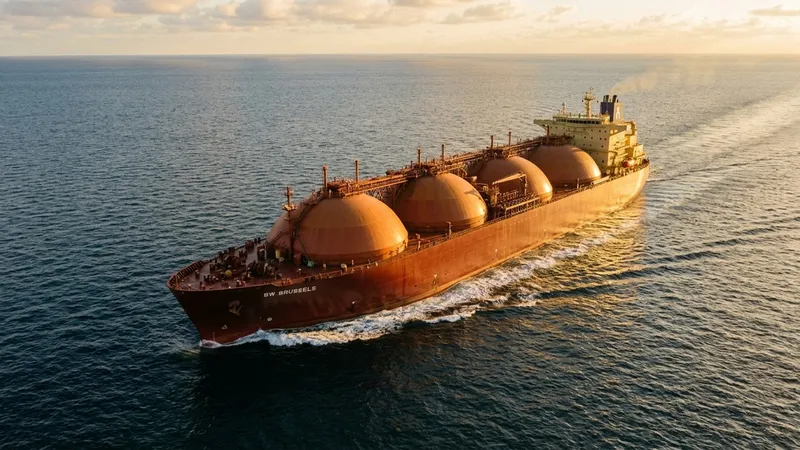
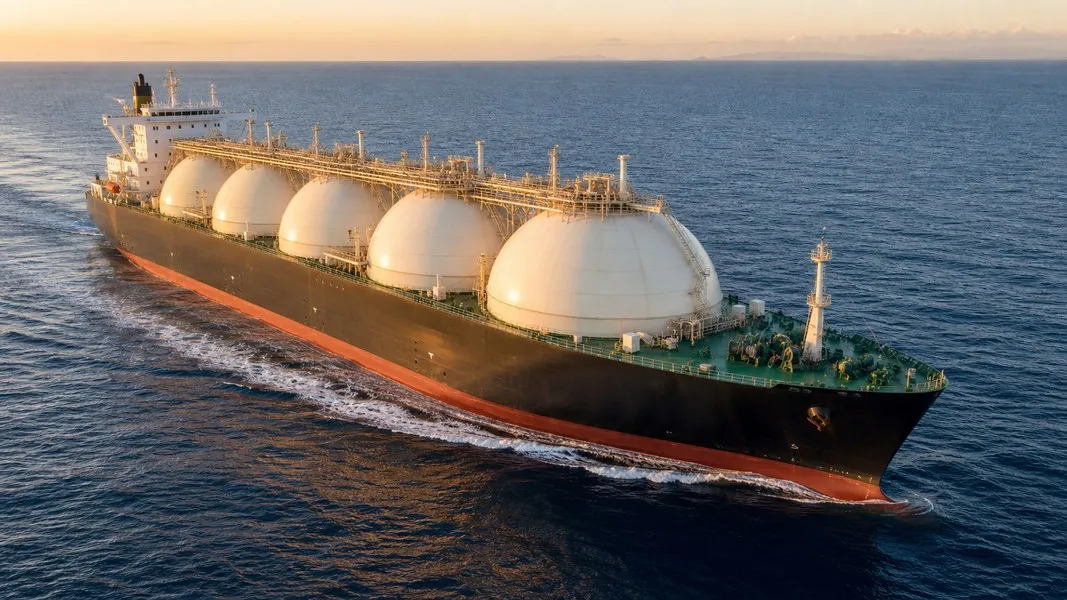
Moss tanks give some LNG carriers their most recognizable appearance: four or five large spheres mounted above the deck, visible from considerable distance at sea or in port. The sphere is the most structurally efficient shape for containing internal pressure, and it handles the stress of thermal cycling well. Moss tanks have a strong safety record across decades of service and are straightforward to inspect visually from outside the vessel. The primary tradeoff is aerodynamic resistance and lower cargo efficiency per meter of hull, since the spheres rise above the deck rather than fitting inside it.
Membrane Tanks
Membrane tanks are the standard for most new LNG carriers built today. Rather than self-supporting spheres, they use a thin metal membrane lining the inside of the ship's insulated hull. The membrane is supported by layers of insulation and the inner hull structure itself. GTT, the French engineering company that developed the two dominant membrane systems, designs its containment technology specifically to keep LNG stable at -163°C during transport. The Mark III and NO96 systems from GTT are the industry benchmark for large LNG carriers. Membrane designs maximize usable cargo volume within a given hull, which is why they dominate newbuild orders. The latest generation of ultra-large LNG carriers uses GTT's NO96 Super+ membrane system, offering improved insulation performance at extreme scales.
Self-Supporting Prismatic (SPB) Tanks
SPB tanks are far less common in the global fleet. They are self-supporting like Moss spheres but shaped as prisms rather than spheres, designed to fit efficiently into specific hull geometries. SPB tanks appear in specialized vessel designs where their shape offers operational or structural advantages, but they account for only a small fraction of active LNG carriers.
How Big Are LNG Carriers?
LNG carrier capacity is measured in cubic meters (m³) of cargo. The fleet spans a wide range of sizes, from small vessels serving regional routes to the largest gas carriers ever constructed.
| Size class | Typical capacity |
|---|---|
| Small-scale LNG carriers | Under 50,000 m³ |
| Conventional LNG carriers | 125,000 to 180,000 m³ |
| Q-Flex | Around 216,000 m³ |
| Q-Max | 260,000 to 271,000 m³ |
The standard workhorse for intercontinental trade today is around 174,000 m³, with a hull approximately 290 meters long. A vessel this size carries enough LNG to heat a large city for weeks. Q-Flex and Q-Max ships were developed specifically for Qatar's massive export program and remain the largest LNG carriers in active service.
The current upper limit reaches approximately 271,000 m³, built into hulls around 344 meters long and 46 meters wide. Stretched end to end, that is longer than three standard football fields. These ships operate on the longest trade routes, moving between Qatar and import terminals in Asia and Europe.
Primo Nautic shows the live AIS position of any active LNG carrier. You can search by vessel name or MMSI number and follow real-time position, speed, heading, and destination, watching one of these extraordinary ships cross an ocean from the convenience of your phone.
Safety on LNG Ships
The phrase "LNG carrier explosion" reflects a widespread concern worth addressing directly. LNG in its liquid form is not explosive. A fire or explosion hazard arises only under a specific sequence of conditions: vapor must escape the containment, mix with air in the correct concentration range, and then encounter an ignition source. The entire design of an LNG carrier is built to interrupt that sequence at every stage.
Containment integrity is the primary safety layer. The tanks are engineered to withstand cryogenic temperatures, thermal cycling, and the mechanical stresses of ocean transit for decades. Emergency shutdown systems halt all cargo operations the moment sensors detect abnormal pressure or flow conditions. Inerting systems replace oxygen in any enclosed space near the cargo with inert gas, eliminating the basic conditions for combustion. Continuous gas detection monitors every cavity throughout the ship.
The behavior of LNG in an accidental spill also differs significantly from oil. Unlike oil tankers, where a spill produces a spreading, persistent liquid hazard on the water surface, spilled LNG evaporates rapidly rather than pooling. This behavior is well documented and forms the basis of the emergency response protocols used at every LNG terminal worldwide.
The global safety record of LNG shipping reflects decades of engineering refinement, crew training, and operational discipline. The industry has transported enormous volumes of LNG over intercontinental distances, and its continued growth, including the ordering of ever-larger vessels, reflects well-founded confidence in the systems and procedures that have been developed and proven over time.
LNG Carriers and Global Energy
LNG carriers make natural gas a globally traded commodity rather than a regional one. The United States exports LNG to more than 30 countries, using vessels that travel between American liquefaction terminals and regasification facilities across Europe and Asia. Qatar, Australia, and Russia are among the other major exporting nations. The primary import markets are in Europe, Japan, South Korea, and China, where LNG fills the gap between domestic production and energy demand.
The Growing LNG Fleet
The global LNG fleet is expanding at a significant pace. European demand surged after 2022 as countries accelerated efforts to reduce dependence on overland pipeline imports. Asian demand continues to grow. Many older LNG carriers are being converted into floating storage and regasification units (FSRUs), which function as portable import terminals anchored offshore. FSRUs can be deployed far faster than onshore terminals, making them one of the most efficient ways for countries to add LNG import capacity in a short timeframe.
Longer-term, LNG is increasingly used as a transitional marine fuel across the broader commercial shipping fleet, not just as a cargo. The emissions advantages of LNG over heavy fuel oil have driven adoption in large container ships, cruise vessels, and bulk carriers. At the same time, the industry faces growing pressure to improve efficiency and reduce the overall carbon footprint of the LNG supply chain.
Primo Nautic lets you track any LNG carrier in real time using AIS data, with AI-generated insights adapted to the reason you are tracking. Whether you are a logistics professional following a specific cargo vessel or a ship enthusiast wanting to identify the tanker you spotted in port, the app turns raw position and voyage data into clear, readable updates.
Conclusion
LNG carriers solve one of maritime engineering's most demanding problems: keeping natural gas in a liquid state at -163°C across thousands of miles of open ocean. They do this through purpose-built containment systems, careful thermal management, and propulsion designs that burn the cargo's own vapor as fuel. From small coastal supply ships under 50,000 m³ to Q-Max vessels stretching 344 meters, the LNG fleet covers an extraordinary range of scale and technical complexity. Understanding how these ships operate gives you a clearer view of how global energy supply moves from the places it is produced to the markets that depend on it.