



LNG Carrier Ships: Types, Sizes, and How They Work
An LNG carrier is a specialized cargo vessel designed to transport liquefied natural gas cooled to approximately -162°C at atmospheric pressure. At that temperature, natural gas shrinks to about 1/600th of its original volume, making ocean transport economical across intercontinental distances. Today, over 600 LNG gas carrier vessels operate globally, connecting exporters in Qatar, Australia, and the United States to importers across Asia and Europe.
This post covers how these vessels work, the two dominant containment systems, the main size classes from small-scale carriers to the massive Q-Max, and what makes them among the safest specialized ships on the water.
Key Numbers: LNG Shipping by the Numbers
The LNG shipping industry has grown into one of the most technically demanding sectors in maritime trade. A few figures put it in perspective:
- 600+ LNG carriers in the global fleet as of 2026
- -162°C is the storage temperature required to keep natural gas liquid
- 600x volume reduction achieved by liquefying natural gas
- 0.10-0.15% daily boil-off rate in modern membrane-type carriers
- 266,000 m³ is the cargo capacity of the largest vessel class, the Q-Max
- 45+ countries now import LNG, up from just a handful in the 1990s
These figures reflect an industry that has scaled rapidly since the first experimental LNG voyage in 1959, when a converted vessel called Methane Pioneer carried a small cargo from Louisiana to the UK.
What Is an LNG Carrier?
Natural gas is the cleanest-burning fossil fuel, but it cannot be pumped through pipelines across oceans. Liquefying it solves that problem. An LNG carrier ship serves as the critical link between export liquefaction terminals and import regasification facilities, where the liquid is warmed back into gas for pipeline distribution.
The first purpose-built commercial LNG carriers entered service in the 1960s, primarily on routes between Algeria and Europe. The industry expanded significantly through the 1970s and 1980s as Japan secured long-term supply contracts from Southeast Asia. Today, LNG is one of the fastest-growing energy commodities in global trade, with over 20 exporting nations supplying more than 45 importing countries.
Unlike oil tankers, which carry liquids at ambient temperatures, LNG carriers must maintain cryogenic conditions throughout the voyage. That requirement drives nearly every design decision on these vessels, from hull shape to propulsion systems.
How LNG Carriers Work
The core engineering challenge is keeping natural gas liquid for weeks at a time on a moving vessel. The solution combines insulated containment tanks, careful pressure management, and a system for handling the small amount of gas that inevitably evaporates.
Boil-off gas (BOG) is the vaporized LNG that forms as heat slowly penetrates the insulation. In older vessels, this gas was simply burned off as fuel for steam turbines. Modern LNG carrier vessels use dual-fuel engines that can run on either LNG boil-off or conventional marine fuel, which improves efficiency significantly. Some carriers also use reliquefaction equipment to convert boil-off back into liquid cargo.
The containment system is the defining technology of any LNG carrier. It must withstand cryogenic temperatures, resist sloshing forces during heavy weather, and maintain structural integrity over a 20-30 year service life. Two systems dominate the global fleet.
Moss-Type vs Membrane-Type Carriers
Moss-Type Carriers
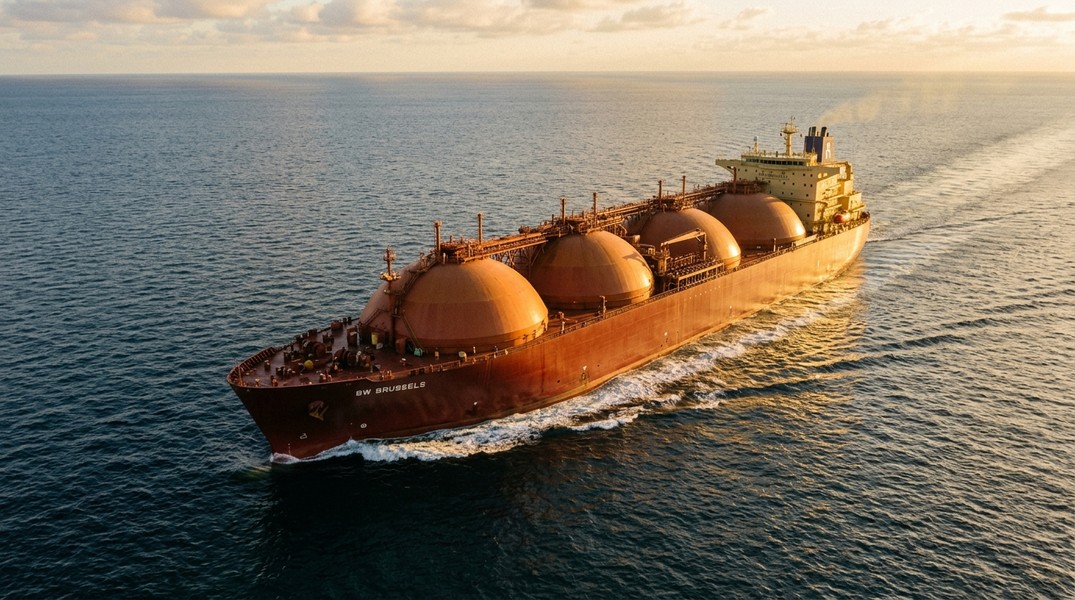
Moss-type carriers use independent spherical aluminum tanks that sit inside the hull, with only the upper portions visible above deck. Each sphere is self-supporting, meaning the cargo weight is carried by a cylindrical skirt connecting the tank to the ship's hull rather than by the hull plating itself.
The visual result is distinctive: large rounded domes protruding from an otherwise conventional hull. This design handles partial cargo loads well because the spherical shape minimizes sloshing stresses. The trade-off is space inefficiency. The spheres occupy roughly 20-30% more hull volume than an equivalent membrane design, which raises construction costs and reduces cargo capacity for a given ship length.
Moss-type vessels made up a significant portion of the older global fleet, but new orders have shifted almost entirely to membrane designs. Today, Moss-type carriers represent approximately 10-15% of the active fleet.
Membrane-Type Carriers
Membrane-type containment systems use a thin layer of corrugated stainless steel (typically 0.7mm thick) backed by insulation panels, with the hull itself providing structural support. The membrane flexes slightly with hull movement, eliminating stress concentrations that could cause cracking.
Membrane designs now account for roughly 85% of new LNG carrier builds. The GTT Mark III system, developed by the French engineering firm Gaztransport & Technigaz, is the most widely used variant. Its lower boil-off rate (around 0.125% per day), higher space efficiency, and lower unit cost per cubic meter of cargo capacity all favor the membrane approach for large-scale trade routes.
The limitation is sensitivity to sloshing in partially loaded conditions. Carriers using membrane tanks must follow loading protocols that restrict partial fills to certain levels to prevent damaging pressure on the membrane from liquid movement.
LNG Carrier Size Classes
The industry uses cargo capacity measured in cubic meters to classify vessels, though size categories have evolved as newbuilds have grown larger.
Small-scale carriers hold between 30,000 and 50,000 m³ of LNG. These vessels serve regional bunkering operations, remote gas supply projects, and routes where large vessels cannot dock. They typically use C-type cylindrical pressure tanks, which are more flexible for multi-gas cargoes and faster loading but less efficient per cubic meter than membrane designs.
Conventional carriers cover the 125,000 to 180,000 m³ range. This category includes the workhorse vessels of long-haul LNG trade. A typical conventional LNG gas carrier in the 180,000 m³ class measures approximately 298 meters in length and 48 meters in beam. China's largest domestically built LNG carrier, launched in 2024, falls into this category at 180,000 m³.
Q-Flex carriers were developed specifically for Qatar's LNG export program, with capacities of 210,000 to 217,000 m³. At around 315 meters in length, they represent a significant step up in scale from conventional vessels. Dual-fuel propulsion and advanced cargo handling equipment were designed into the class from the start.
Q-Max carriers are the largest LNG vessels afloat, with capacities of 260,000 to 266,000 m³. At 345 meters long and 53.5 meters wide, Q-Max vessels are too large to transit the Panama Canal or some receiving terminals, so they operate on specific high-volume routes, primarily from Qatar to major import hubs in Asia and Europe. Their scale achieves significant per-unit transport cost reductions on routes suited to their size.
Global Fleet and Major Trade Routes
The LNG shipping network connects a concentrated group of exporters to a geographically spread set of importers. Qatar operates the world's largest single-country LNG export capacity and controls a substantial portion of Q-Flex and Q-Max tonnage. Australia runs multiple large-scale LNG projects supplying primarily Japan, South Korea, and China. The United States has become a major exporter since its first cargo departed in 2016, with EIA reports showing US LNG now reaching markets in Europe and Asia.
Japan, China, and South Korea are the largest importers by volume, driven by electricity generation and industrial use. The variety of types of ships involved in this trade has grown as the market has diversified, with spot trading now accounting for a larger share of cargoes alongside long-term contracts. According to GIIGNL data, the total number of LNG importing countries reached 48 by 2024, reflecting the fuel's growing role in diversifying national energy mixes.
If you want to track a specific LNG carrier vessel in real time, Primo Nautic lets you search by vessel name, MMSI number, or IMO number and follow its position, speed, and voyage status on a live map. The app translates raw AIS data into readable updates, so you can follow a cargo's progress without needing maritime expertise. Primo Nautic also shows weather conditions at the vessel's current location, useful context when following a laden LNG carrier crossing the Indian Ocean or the North Atlantic.
Safety Record and Regulations
LNG carriers carry an enviable safety record across more than six decades of commercial operation. Several factors contribute to this.
LNG has no flash point in liquid form and cannot ignite unless it vaporizes and reaches a specific concentration in air. If a spill occurs at sea, LNG disperses rapidly rather than spreading as a persistent slick. The cryogenic hazard is still real: contact with liquid at -162°C causes severe cold burns, and uncontrolled evaporation in enclosed spaces creates explosion risk.
Regulatory oversight comes primarily through the IMO's IGC Code, the International Code for the Construction and Equipment of Ships Carrying Liquefied Gases in Bulk. This mandates double-hull construction to protect cargo tanks from collision or grounding damage, emergency shutdown valves on all cargo lines, gas detection systems throughout the vessel, and BOG management equipment meeting defined standards.
Modern LNG carriers are built with multiple independent safety barriers between the cargo and the sea. The inner tank membrane or sphere, intermediate insulation, outer cofferdam spaces, and the ship's double hull all provide redundant containment. Crew training requirements for LNG vessels are also more extensive than for conventional tankers, reflecting the specialized knowledge required to operate cryogenic systems safely.
Conclusion
LNG carriers sit at the intersection of advanced materials engineering, cryogenic chemistry, and global energy logistics. From the spherical domes of Moss-type vessels to the space-efficient membrane tanks that dominate current newbuilds, the technology has evolved to make large-scale LNG transport reliable and cost-effective. The Q-Max class represents the current ceiling of scale, while small-scale carriers are expanding the reach of LNG into markets that larger vessels cannot serve. As global demand for natural gas continues to grow, the LNG carrier fleet will remain one of the most technically specialized segments of the world's merchant fleet.
Most Recent Posts
Discover more articles from our blog.