The Edmund Fitzgerald was a 729-foot Great Lakes ore freighter that sank in a November storm on Lake Superior on 10 November 1975, taking all 29 men aboard with it. Nobody knows for certain why it went down. The U.S. Coast Guard and the National Transportation Safety Board blamed flooding through the cargo hatches, while others point to a shoal near Caribou Island, giant waves, or a hull that broke under the strain.
There was no distress call. The ship simply vanished from the radar of the freighter following it, roughly 17 miles from the shelter of Whitefish Bay. Fifty years on, the wreck still draws thousands of people to memorials, and the questions it left behind are still argued over.
This guide covers what the ship was, how its final voyage unfolded, what the official investigations concluded, and why so many experts disagree with them.
What Was the Edmund Fitzgerald?
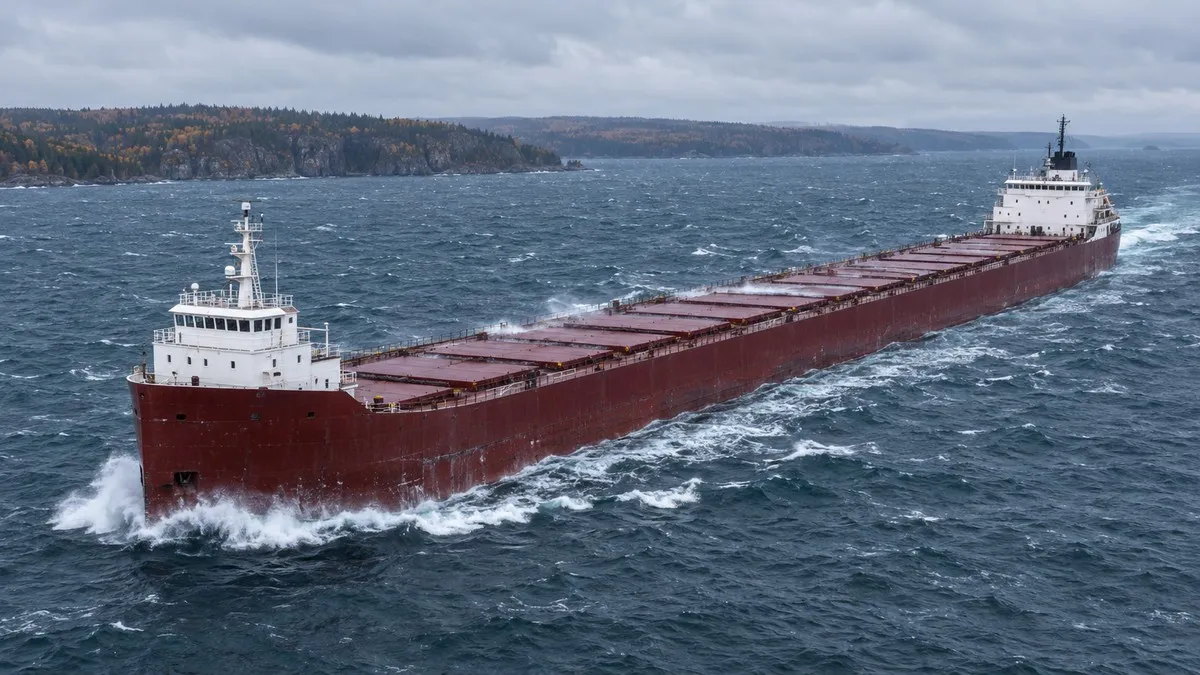
The SS Edmund Fitzgerald was a "straightdecker" bulk carrier, the classic long and narrow design built to haul iron ore through the locks and rivers of the Great Lakes. It was built as Hull 301 at Great Lakes Engineering Works in River Rouge, Michigan, launched in June 1958, and named after the president and chairman of Northwestern Mutual Life Insurance Company, which owned it as an investment.
When it entered service, it was the largest ship on the Great Lakes, a title the Shipwreck Historical Society says it held for 13 years, until 1971. Sailors called it "Big Fitz". By 1975 it had logged over a million miles, the equivalent of 44 trips around the world.
| Specification | Edmund Fitzgerald |
|---|---|
| Length | 729 feet (222 m) |
| Beam | 75 feet |
| Depth | 39 feet |
| Gross tonnage | 13,632 |
| Engine | 7,500 hp steam turbine |
| Usual cargo | Taconite pellets from Minnesota and Wisconsin |
The ship's working life
The Fitzgerald spent its career shuttling taconite, iron ore processed into marble-sized pellets, from the western end of Lake Superior to steel mills around Detroit and Toledo. It usually ran empty on the return leg.
Northwestern Mutual placed the ship under permanent charter to the Columbia Transportation Division of Oglebay Norton Company in Cleveland. Like most lakers of its era, it was designed for the narrow locks rather than the open ocean, which matters later in this story. These are vessels you will not see anywhere else in the world: very long, very thin, and built to squeeze the largest possible cargo through the lock system.
The Final Voyage of the SS Edmund Fitzgerald
On the afternoon of 9 November 1975, the Fitzgerald left the Burlington Northern dock in Superior, Wisconsin, loaded with 26,116 long tons of taconite bound for Zug Island near Detroit. Captain Ernest McSorley, 63, had been a ship's master since 1951 and in command of the Fitzgerald since 1972. He and five of his crew planned to retire at the end of the season.
Soon after departure, the Fitzgerald was joined by the Arthur M. Anderson, which had sailed from Two Harbors, Minnesota. The two freighters stayed in radio contact for the rest of the trip, with the faster Fitzgerald in the lead, between 10 and 15 miles ahead.
A storm builds over Lake Superior
Gale warnings went out at 7 pm on 9 November and were upgraded to storm warnings early the next morning. A fast-moving arctic front and a warm, wet system from the southwest collided over the lake.
McSorley took a more northerly course than usual, along the Canadian shore, where the highlands blunted the wind. That kept the ship out of the recommended shipping lanes along the south shore. At 7 am on 10 November, the Fitzgerald sent its last weather report: 35-knot winds and waves of about ten feet.
Passing Caribou Island
Around 3:15 pm, the Anderson's captain, Jesse "Bernie" Cooper, watched the Fitzgerald round Caribou Island and remarked that it was much closer to Six Fathom Shoal than he would have wanted his own ship to be.
As the afternoon wore on, the Fitzgerald was in trouble. It had a list, had lost both radars, and was taking heavy seas over the deck. The captain radioed: "I have a bad list, lost both radars and am taking heavy seas over the deck. One of the worst seas I've ever been in." The radio beacon at Whitefish Point, which the ship could have used to find its way, was not working. McSorley slowed down and asked the Anderson to help him navigate.
"We are holding our own"
At 7:10 pm, the Anderson warned the Fitzgerald about northbound traffic ahead and asked how it was making out with its problem. The reply was "We are holding our own." Those were the last words anyone heard from the ship.
Minutes later the Fitzgerald disappeared from the Anderson's radar. Repeated calls went unanswered. Searchers, including the Anderson and the William Clay Ford, found only an oil slick, two empty lifeboats and nearly three dozen life jackets that no one had put on.
The Sinking of the Edmund Fitzgerald: What Investigators Found
Two U.S. agencies investigated. The Coast Guard convened a Marine Board of Investigation in Cleveland on 18 November 1975, and the National Transportation Safety Board ran its own analysis alongside it.
The Coast Guard's Marine Board report concluded that the ship sank after its cargo hold flooded through ineffective hatch closures. The Safety Board's 1978 accident report reached a similar verdict: the probable cause was sudden, massive flooding of the cargo hold after one or more hatch covers collapsed.
Why the hatches came under suspicion
The evidence for the hatch theory was partly about the Fitzgerald and partly about the whole fleet. At its last inspection on 31 October 1975, ten days before the sinking, the Coast Guard noted four minor structural defects around the hatches and ordered them repaired.
After the accident, Coast Guard and Safety Board inspectors checked other Great Lakes bulk carriers and found hatch covers that were not weathertight even with the clamps in place and fastened, because many clamps were badly adjusted. Both agencies' structural analyses showed that the standard hatch design would have let significant amounts of water into the hold in the seas the Fitzgerald faced.
How deep the ship was loaded
The NTSB also pointed to load line rules. Amendments in 1969, 1971 and 1973 had allowed Great Lakes ore carriers to load deeper, leaving less hull above the water. Author John U. Bacon has noted that the Fitzgerald sat only about 11 feet out of the water on a good day, which left little margin when waves broke over its deck for hours.
Theories on Why the Edmund Fitzgerald Sank
The official finding has never settled the debate. A ship this size rarely sinks for a single reason, and most serious accounts now treat the theories below as pieces of one chain of events rather than competing answers.
Theory 1: flooding through the hatches
This is the Coast Guard and NTSB position. Its critics argue that a failed hatch cover would have sunk the ship quickly, not after hours of struggle. Bacon, interviewed in a History article, put it bluntly: "If the hatch cover did give in, it would have gone down instantly. It would not have taken four or five hours of struggling along the way."
Theory 2: striking Six Fathom Shoal
Cooper's own observation from the Anderson placed the Fitzgerald close to Six Fathom Shoal north of Caribou Island, where some spots are only about 11 feet deep.
The NTSB report itself acknowledged that the chart in use did not show the full extent of shallow water north of Caribou Island, an area known as North Bank, and after the accident the Coast Guard asked the Canadian Hydrographic Service to resurvey it. Striking bottom could have torn or cracked the hull and let water in slowly, which would fit the list McSorley reported hours before the end. In the pounding seas, the crew may never have felt the impact.
Theory 3: rogue waves and the storm itself
Waves on the Great Lakes behave differently from ocean swells. According to Bacon, they are sharper and arrive much closer together, around 4 to 8 seconds apart compared with 10 to 16 seconds at sea. That leaves a ship less time to recover between blows.
The Coast Guard noted that forecast wave heights are significant wave heights, and the single highest wave can be up to twice that figure. A 2006 storm reexamination by meteorologists recreated the most probable winds and waves of that night. Newer modelling cited by Bacon suggests the crew likely faced two or three 54-foot waves and possibly a 60-foot one. If you want to understand how such outliers form, our guide to how rogue waves form covers the physics.
Theory 4: structural failure
Great Lakes freighters are long and slender, and the Fitzgerald was roughly ten times longer than it was wide. One proposed failure mode is that the ship rode with its bow on one wave crest and its stern on another, leaving the heavy, fully loaded middle unsupported. A hull already weakened by flooding or a grounding could then have snapped. The wreck, found in two pieces, is consistent with this, though it cannot prove the ship broke on the surface rather than when it hit the bottom.
The Edmund Fitzgerald Wreck Today
The wreck lies in Canadian waters about 17 miles north-northwest of Whitefish Point, Michigan, at a depth of about 530 feet. It was positively identified in May 1976 using remotely controlled cameras.
The hull is broken in two. The stern rests upside down, while the heavily damaged bow sits upright nearby, the two pieces roughly 170 feet apart and surrounded by twisted debris. No bodies were ever recovered from the Fitzgerald.
The bell recovered in 1995
The Great Lakes Shipwreck Historical Society ran expeditions to the wreck in 1989, 1994 and 1995. On 4 July 1995, at the request of the crew's families, an expedition raised the ship's 200-pound bronze bell. The expedition was a joint effort with the National Geographic Society, the Canadian Navy, Sony and the Sault Ste. Marie Tribe of Chippewa Indians.
A replica engraved with the names of the 29 men was left on the wreck. The original bell is on display at the Great Lakes Shipwreck Museum at Whitefish Point, where it is rung 29 times every 10 November, once for each crew member, and once more for everyone else lost on the Great Lakes.
A protected grave site
Families of the crew pushed for the wreck to be treated as a grave site. In 2006 Ontario amended its Heritage Act to extend the protected perimeter around the Fitzgerald to 500 meters, and no expedition has visited the site since 1995.
The Wreck of the Edmund Fitzgerald Song
Most people who know the name learned it from Canadian folk singer Gordon Lightfoot. His 1976 ballad, "The Wreck of the Edmund Fitzgerald", turned a regional tragedy into one of the best-known shipwrecks in the world, second only to the Titanic in books, film and media, according to the Shipwreck Historical Society.
The song also mentions the memorial in Detroit. That is the Mariners' Church, whose pastor rang its bell 29 times, once for each of the lost men, the day after the sinking. Lightfoot also changed the lyrics over the years as new evidence moved blame away from the crew's handling of the hatches. When he died on 1 May 2023, the Mariners' Church rang its bell 30 times: 29 for the crew and one for him.
The 50th anniversary in November 2025 showed how strong the pull remains. More than three thousand people attended the daytime memorial at Whitefish Point, and hundreds of thousands watched the evening ceremony online.
What Changed on the Great Lakes After the Fitzgerald
The NTSB recommended a design study for better hatch covers and clamps, and limits on operating in sea states beyond what a vessel can handle. The Coast Guard board pressed for improvements to lifesaving equipment. The disaster pushed improvements in radar, navigational charts and ship-to-shore communication. According to Bacon, not a single major commercial ship has sunk on the Great Lakes since.
Following the lakers today
Ore freighters still make the same run across Lake Superior that the Fitzgerald made. The difference is visibility. Modern freighters broadcast their position over AIS, so anyone ashore can see where a laker is and how fast it is moving.
In Primo Nautic you can search a Great Lakes freighter by name, MMSI or IMO number and follow its live position, speed and course on the map. Primo Nautic also shows the weather at the vessel's exact location, including wind speed and visibility, which on Lake Superior in November is often the most interesting part of the picture. If you watch ships from the Duluth and Superior harbour, our Duluth ship schedule guide explains how to see which lakers are arriving next, and the Ship Enthusiast setting in Primo Nautic adds background on the vessel types you spot.
Conclusion
The Edmund Fitzgerald was the largest ship on the Great Lakes when it was launched and remains the largest ever lost there. It sank on 10 November 1975, about 17 miles from shelter, after hours of fighting a storm with hurricane-force gusts and very large waves.
The official investigations blamed flooding through hatch covers that were not weathertight. Many mariners and historians point instead to a grounding on Six Fathom Shoal, extreme waves, or a long hull that failed under stress, and the likeliest answer combines several of these. What is certain is that the loss put hatch design under scrutiny and pushed changes in charting, radar and communication, and that the 29 men aboard are still remembered every November with a bell that rings once for each of them.