About 1,478 shipping containers were lost at sea in 2025, out of roughly 280 million moved by ship that year. That is around 0.0005 percent of all container movements, according to the World Shipping Council, whose members run about 90 percent of the world's container ship capacity. The figure more than doubled from 2024, and one sinking off India accounted for 43 percent of it.
If you have cargo on a ship, or you have seen a beach covered in debris from a spilled box, the headline number only tells part of the story. Below you will find the year by year figures, the reasons containers go over the side, the worst losses on record, what happens to a container once it hits the water, and the reporting rules that took effect in January 2026.
Key Findings at a Glance
- 1,478 containers were lost in 2025, up from 576 in 2024 and above the recent three-year average.
- One incident, the sinking of MSC Elsa 3 off Kerala, accounted for 640 containers, or about 43 percent of the year's total.
- 2013 remains the worst year on record with 5,578 containers lost; 2023 was the best with 221.
- 128 containers were recovered in 2025, the highest recovery figure since the World Shipping Council started collecting recovery data in 2023.
- Extreme roll is the dominant cause in major incidents: the TopTier research project linked it to 85 percent of the containers lost or damaged across 44 incidents studied.
- Since 1 January 2026, reporting is mandatory. Ships must report every container lost or seen drifting, and flag states pass the numbers to the International Maritime Organization.
How Many Shipping Containers Are Lost at Sea Each Year
The best long-running count comes from the World Shipping Council (WSC), the trade body for container lines. It has surveyed its members since 2011, covering losses back to 2008. Until 2020 it asked for three years of data at a time; since 2021 it reports every year. The council assumes the roughly 10 percent of capacity outside its membership loses containers at the same rate, and scales the total up to cover the whole industry.
The latest edition of the WSC's annual loss report gives these figures for the years it singles out:
| Year | Containers lost | What drove it |
|---|---|---|
| 2013 | 5,578 | MOL Comfort broke in two in the Indian Ocean |
| 2022 | 661 | Out of 250 million transported |
| 2023 | 221 | Lowest year on record |
| 2024 | 576 | Below the 10-year average |
| 2025 | 1,478 | MSC Elsa 3 sinking, 640 boxes |
The averages matter as much as the single years. For the ten years up to 2024, the WSC put the average at 1,274 containers a year. Over the 15 years from 2008 to 2022 it was 1,566. The three-year average for 2022 to 2024 fell to 489, down from 1,061 for 2021 to 2023, which is why 2025 looks like a jump.
Why one bad year skews the average
Container losses are lumpy. A quiet year can see a few hundred boxes go over the side, and then a single casualty adds well over a thousand. The WSC's own reading of 2025 is that isolated large events, not a system-wide decline in safety, drive the swings.
The winter of 2020 to 2021 shows the effect. An unusually high number of incidents in those months pushed the 14-year average for 2008 to 2021 up to 1,629 containers, an 18 percent rise on the average for the period ending in 2019. Even then, the council noted, losses stayed under one thousandth of one percent of the roughly 241 million containers shipped each year.
Why Containers Fall Overboard
The WSC lists the main contributors to 2025's losses as severe weather in the North Atlantic and North Pacific, fire, cargo shift and stack collapse in rough seas, and individual casualties such as groundings and total losses. In most incidents several of these combine, with weather acting as the trigger.
Parametric rolling
The largest single cause is a ship motion most people have never heard of. Parametric rolling is the sudden onset of large, violent side-to-side rolls, and the Transportation Safety Board of Canada describes the conditions that start it as "very common". Modern container ships, with narrow hulls that widen into very large decks, are especially vulnerable.
The TopTier joint industry project, led by the Maritime Research Institute Netherlands with over 40 participants, studied 44 major incidents in which containers were lost or damaged. Extreme roll, synchronous or parametric, was the most likely cause in 24 of them. Measured by the number of containers, it accounted for 85 percent, because one violent roll can collapse several bays of deck stacks at once. The project's model test results come from 232 seakeeping tests on two large container ship designs of 10,000 and 15,000 containers, most of them in quartering seas.
Lashing failure and stack collapse
Containers on deck are held by twist locks at the corners and lashing rods across the stacks. When rolling exceeds what that gear was planned for, the lashings loosen or break and the stack comes down. In September 2026 the Philippine interisland ship Span Asia 39 reported heavy, continuous rolling in rough seas off Batangas; its lashings loosened and 46 empty containers went overboard, followed by one more in the Manila anchorage.
Stack collapse also starts inside the box. The WSC stresses that misdeclared weights or badly packed cargo can make a container unstable in heavy seas, and accurate weight declarations are what stowage and lashing plans are built on. If a box weighs far more than its paperwork says, every calculation built on that number is wrong.
Fire and misdeclared dangerous goods
Ship fires have risen to their highest level in over a decade, according to the WSC, with misdeclared or undeclared dangerous goods named as a leading cause. A fire can destroy containers on board, destabilise the ship and in the worst cases sink it with everything it carries.
That is why the industry has tightened rules on specific cargoes. Since the start of 2026, all charcoal shipments must be declared as dangerous goods under the IMDG Code, after a series of fires caused by poorly handled charcoal. The WSC also launched a Cargo Safety Program in 2025 that screens bookings for high-risk shipments before they are loaded.
Weather on the big ocean routes
Bad weather turns a stowage weakness into a loss. The WSC notes that 2025 did not have more storms than average, but warmer ocean temperatures and more severe, less predictable weather in the North Atlantic and North Pacific made heavy-weather encounters more likely. In the UK alone, two separate incidents during Storm Goretti on the night of 8 January 2026 sent 24 containers into the sea within hours of each other.
The Biggest Container Losses on Record
A handful of casualties account for a large share of all containers ever lost. These are the incidents the published investigations and industry reports name most often:
| Incident | Year | Containers lost | What happened |
|---|---|---|---|
| MOL Comfort | 2013 | Drove that year's 5,578 total | Hull broke in two in the Indian Ocean |
| ONE Apus | 2020 | 1,816 | Stack collapse in the North Pacific |
| Maersk Essen | 2021 | 750 | Parametric rolling a factor |
| MSC Elsa 3 | 2025 | 640 | Listed and sank off Kochi, India |
ONE Apus and Maersk Essen both appear in the Canadian safety board's list of container losses linked to parametric rolling. The run of losses in late 2020 and early 2021 is what triggered the TopTier project.
MSC Elsa 3 off Kerala
MSC Elsa 3 developed a severe starboard list on 24 May 2025 while sailing from Vizhinjam to Kochi, about 30 nautical miles southwest of Kochi port. It sank and came to rest at roughly 60 metres. India's Directorate General of Shipping reported the ship was carrying about 367 tonnes of heavy fuel oil and 64 tonnes of diesel, along with 13 containers of calcium carbide classed as dangerous goods and 65 to 70 containers of plastic pellets.
By 1 June, 59 containers had washed up along a 120 km stretch of the Kerala coast. A month later, response teams were still recovering bags of plastic pellets from a container that drifted near Alappuzha, as the Directorate's situation reports record. One casualty supplied 43 percent of the world's lost containers that year, and its cleanup was still running a month later.
What Happens to Containers Lost at Sea
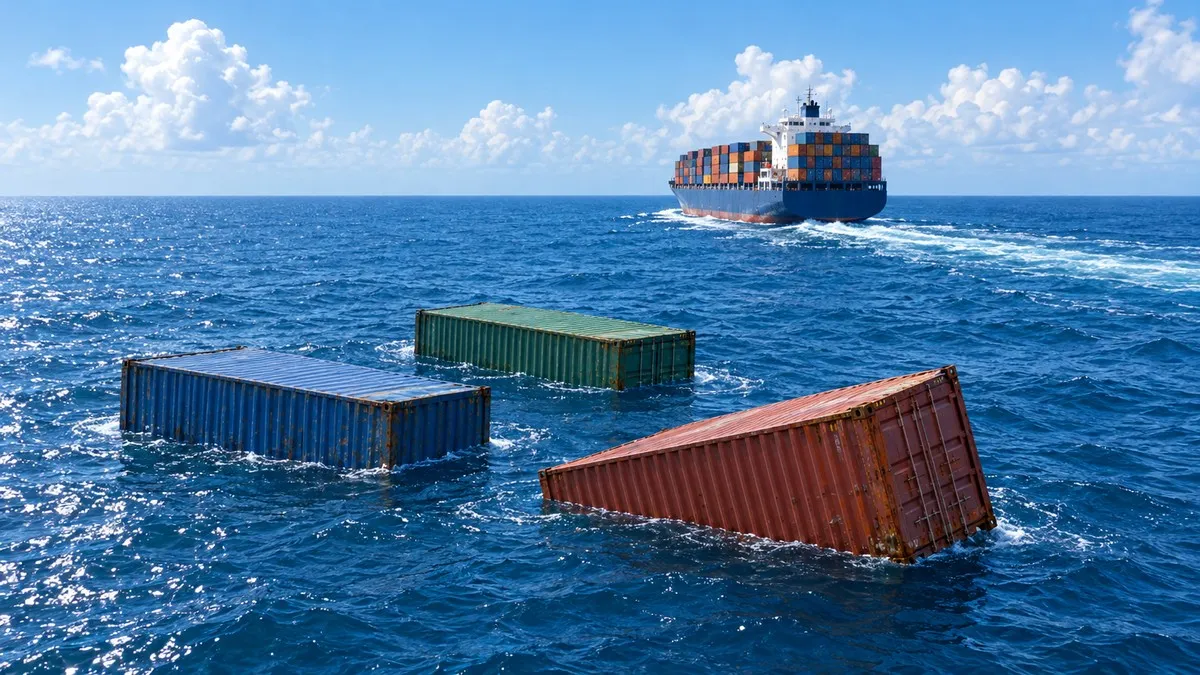
Most people picture a lost container bobbing on the surface for weeks. Some do. Many sink almost at once.
How long a lost container floats
There is no single answer, because it depends on the cargo, the container type and how badly the box is damaged when it hits the water. The International Spill Control Organization explains that containers are not truly watertight, so most eventually sink. Containers that fall from the top of a large ocean-going ship often go down almost immediately after impact.
The exceptions are the dangerous ones. A box packed with light, buoyant cargo can float for years, even when it is holed and waterlogged. Refrigerated containers are built tighter to hold their atmosphere, and one may stay afloat until waves break it up. A container drifting just at or below the surface is close to invisible to a small boat, which is why the Philippine Coast Guard issued a navigation warning for a busy shipping lane after the Span Asia 39 loss.
On the seabed
Containers that sink become part of the seafloor. In 2004 researchers at the Monterey Bay Aquarium Research Institute found one of 15 containers lost from the ship Med Taipei, resting at about 1,260 metres and filled with over a thousand steel-belted tyres.
By 2013, the MBARI container study showed it covered in animals usually found on rock outcrops, which are rare on that muddy stretch of seabed. The scientists also found mild changes in the sediment and in the animals living close to it, likely because bottom currents speed up around the box and wash finer sediment away.
Are lost shipping containers recovered
Rarely, but more often than before. In 2024 the WSC recorded two recovered containers; in 2025 it recorded 128, the most since it began tracking recoveries. The council credits better response coordination after incidents. Close to shore the odds rise further: off Kerala, dozens of boxes from MSC Elsa 3 washed onto beaches, where crews could lift them by crane and truck them to port.
New Rules: Mandatory Reporting From 2026
Before 2026 there was no mandatory international reporting of lost containers, and the WSC's survey was the closest thing to an official count. That changed on 1 January 2026, when amendments to SOLAS Chapter V, regulations 31 and 32, adopted at the IMO's Maritime Safety Committee in its 108th session, entered into force.
The rules require:
- The ship's master to report any container lost overboard without delay to ships nearby, the nearest coastal state and the ship's flag state.
- Reports of containers observed drifting at sea, not only those a ship loses itself.
- Flag states to pass the figures on to the International Maritime Organization.
The aim is faster warnings to other ships, quicker response to drifting boxes and better data on where and why losses happen. The WSC says it will keep publishing its own survey alongside the official figures so the long-term series stays comparable.
What This Means If Your Cargo Is on Board
For a single importer the odds are tiny, but they are not zero, and the WSC names the North Pacific and North Atlantic as the routes where heavy weather did the most damage in 2025. When a ship runs into a storm, confirming which boxes went over the side takes time, and the ship's own movements are often the first thing you can see.
That is where having your own view of the ship helps. Primo Nautic shows a vessel's live position, speed, course and the weather at its exact location, so you can see when a ship has slowed or altered course in a storm rather than waiting for an email. Its Cargo Shipment tracking purpose keeps the updates precise and logistics-focused, and delay notifications tell you when the arrival estimate slips.
If a box is lost, the claim runs through your cargo insurance, which is the strongest argument for arranging cover before the goods leave the port. The size and shape of modern container ships are what make them vulnerable to parametric rolling, and the biggest of them are covered in our guide to the largest container ships, so it is worth knowing what kind of vessel your cargo is booked on. Primo Nautic lets you look any ship up by name, IMO number or MMSI before it sails.
Conclusion
Shipping containers lost at sea are rare against the scale of trade: 1,478 out of roughly 280 million in 2025, and an average of around 1,274 a year over the decade to 2024. The yearly totals swing widely because a single casualty, such as MOL Comfort in 2013 or MSC Elsa 3 in 2025, can outweigh every other incident combined.
Extreme roll in heavy weather is behind most of the containers lost in major incidents, with lashing failure, misdeclared cargo and fire making things worse. Once overboard, most containers sink, some drift for months or even years as a hazard to small boats, and only a small number are recovered. From 2026 every loss must be reported, which should finally give a complete, official count of how many boxes the sea takes each year.