


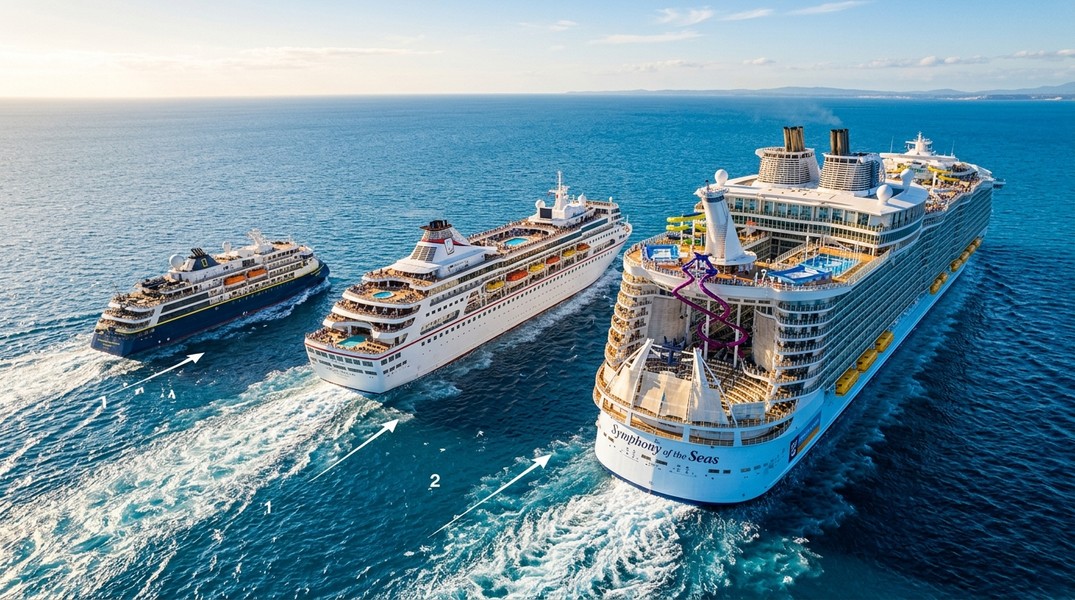
Cruise Ship Sizes Ranked: From Small to World's Largest
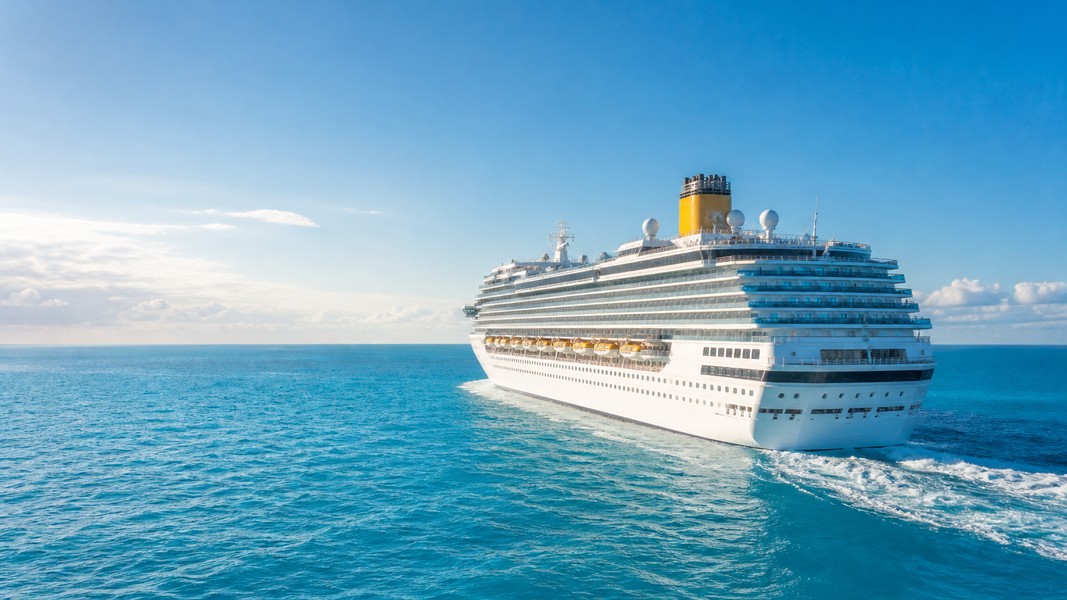
Cruise ships are measured by gross tonnage, not weight. Three ships share the title of largest in the world today, all Royal Caribbean Icon class: Icon of the Seas, Star of the Seas and Legend of the Seas, each registering 248,663 gross tons and carrying 5,610 passengers at double occupancy, or up to 7,600 when every berth is filled. That is more than five times the internal volume of the Titanic. Cruise ship size determines what amenities fit on board, which ports a ship can enter, and how passengers experience the voyage.
This guide covers everything about cruise ship size: what the measurements mean, how ships are classified, what an average cruise ship actually measures, the world's largest vessels ranked by gross tonnage, and how fleet sizes vary across Carnival, Royal Caribbean, Disney, and Norwegian.
How Cruise Ship Size Is Measured
Gross tonnage (GT) is the primary unit for comparing cruise ship sizes. It measures a ship's total enclosed internal volume rather than its weight: one gross ton equals 100 cubic feet of enclosed space. A ship with 100,000 GT has 10 million cubic feet of interior volume. The higher the GT, the more space available for passenger cabins, restaurants, pools, theaters, and everything else.
Length overall (LOA), measured in meters from bow to stern, tells you how physically long a ship is. This matters for port access: many historic ports and narrow channels cannot accommodate ships over 300 metres. A ship can be relatively short but high in gross tonnage if it has many decks stacked above the waterline.
Passenger capacity is where most published comparisons go wrong. Cruise lines quote two different numbers, and they are far apart. Double occupancy assumes two people per cabin and is the figure the industry uses for planning and for berth statistics. Maximum capacity counts the third and fourth berths in family cabins. Icon of the Seas is 5,610 at double occupancy and 7,600 at maximum, a gap of nearly 2,000 people on the same ship. When a comparison table mixes the two, the rankings stop meaning anything, so check which figure a source is quoting before trusting it.
What Is the Average Cruise Ship Size?
The headline ships are not representative of the fleet. Across the roughly 300 ocean cruise ships in service worldwide, the average sits close to 90,000 GT with around 2,000 passengers at double occupancy and a length near 250 metres. That is a mid-size to large vessel by the classes below, not a mega-ship.
The average is pulled in two directions. A long tail of small expedition and river-style vessels under 20,000 GT drags it down, while a few dozen ultra-mega ships above 200,000 GT pull it up. The median ship is smaller than the average for exactly that reason. If you board a cruise ship at random rather than choosing one, the odds are you are boarding something in the 70,000 to 120,000 GT range carrying 2,000 to 3,000 people, with a handful of pools, four or five dining venues and a main theatre.
Average size has grown steadily. In the mid-1990s few cruise ships exceeded 50,000 GT. The typical newbuild ordered today is roughly three times that, and the largest are five times larger again.
Cruise Ship Size Classes
The industry uses a loosely defined set of size categories, with gross tonnage as the dividing line:
Small/boutique ships (under 30,000 GT) carry between 100 and 700 passengers and prioritize intimate experiences. These vessels reach ports that larger ships cannot, including remote islands, expedition destinations, and historic harbors with shallow channels. Celebrity Flora, designed for Galapagos sailings, registers around 5,739 GT.
Mid-size ships (30,000 to 80,000 GT) represent the classic cruise ship of earlier decades. They offer solid amenities without the scale of modern mega-ships. Passengers tend to find embarkation and disembarkation faster, and the ships often call at a wider range of ports.
Large ships (80,000 to 130,000 GT) include many popular vessels from the 1990s and 2000s, when this size category set the standard for what a major cruise line offered. Multiple dining venues, several pools, entertainment theaters, and spa facilities became standard at this size.
Mega-ships (130,000 to 225,000 GT) define the modern mainstream fleet. Ships in this range, including MSC World Europa at 215,863 GT and Carnival Celebration at 183,521 GT, carry between 4,000 and 7,000 passengers at maximum capacity and feature waterslides, specialty restaurants, large-scale entertainment, and entire themed deck areas.
Ultra-mega ships (225,000+ GT) are a category dominated almost entirely by Royal Caribbean. Only a handful of ships currently qualify, all of them from the Oasis and Icon classes.
The World's Largest Cruise Ships
Royal Caribbean holds nine of the top ten positions. The company has spent two decades building progressively larger ships, and its Icon-class vessels now sit at the top by a considerable margin. Because the three Icon-class ships are built to the same specification, they are listed at identical tonnage and share first place rather than ranking against each other.
| Rank | Ship | Line | Gross Tonnage | Length (m) | Capacity (double) |
|---|---|---|---|---|---|
| 1= | Icon of the Seas | Royal Caribbean | 248,663 | 365 | 5,610 |
| 1= | Star of the Seas | Royal Caribbean | 248,663 | 365 | 5,610 |
| 1= | Legend of the Seas | Royal Caribbean | 248,663 | 365 | 5,610 |
| 4 | Utopia of the Seas | Royal Caribbean | 236,860 | 362 | 5,668 |
| 5 | Wonder of the Seas | Royal Caribbean | 236,857 | 362 | 5,734 |
| 6 | Symphony of the Seas | Royal Caribbean | 228,081 | 361 | 5,518 |
| 7 | Harmony of the Seas | Royal Caribbean | 226,963 | 362 | 5,479 |
| 8 | Oasis of the Seas | Royal Caribbean | 226,838 | 362 | 5,400 |
| 9 | Allure of the Seas | Royal Caribbean | 225,282 | 360 | 5,400 |
| 10 | MSC World America | MSC Cruises | 216,638 | 333 | 5,406 |
The Icon class is the largest cruise ship design ever built, at 248,663 gross tons across 20 decks divided into eight neighborhoods, each with its own theme and set of attractions. Icon of the Seas opened the class in January 2024. Star of the Seas followed in August 2025, and Legend of the Seas took her maiden voyage on 4 July 2026. A fourth sister, Hero of the Seas, is due in 2027. If you want to see exactly where any of these ships are right now, Primo Nautic shows live AIS positions for the entire Royal Caribbean fleet alongside real-time weather at the vessel's location.
MSC Cruises is the strongest challenger to Royal Caribbean's scale and the only other line inside the top ten. MSC World America entered service in April 2025 at 216,638 GT, with MSC World Europa at 215,863 GT and MSC World Asia joining the class in 2026. Just outside the ranking sits Disney Adventure at 208,108 GT, the largest ship Disney has ever operated.
Note that older published rankings often quote Icon of the Seas at 250,800 GT. That was the pre-delivery estimate Royal Caribbean marketed before the ship was measured; the registered figure on her certificates is 248,663 GT, and the same applies to her sisters.
Carnival Fleet: Sizes Compared
Carnival Cruise Line's fleet spans 71,909 GT at the smaller end to 183,521 GT at the top. The largest Carnival ships belong to the Excel class, which introduced roller coasters, Sky Zone trampolining, and the "Bolt" slide to cruise ships. Carnival Celebration, at 183,521 GT, is currently the line's largest vessel, with sister ships Mardi Gras and Jubilee closely matched in tonnage.
If you're deciding which Carnival ship to sail, the Excel class ships offer the widest range of onboard activities. Smaller ships in the fleet, those under 100,000 GT, offer a noticeably more compact experience with fewer dining and entertainment options, but often call at ports the larger ships skip.
Primo Nautic lets you search any Carnival vessel by name and track its real-time position, which is useful when you're planning to meet a ship at port or following a family member's voyage. The app shows current speed, heading, and ETA alongside an AI-generated update tailored to why you're tracking.
Royal Caribbean Fleet by Size
Royal Caribbean's fleet divides cleanly into classes. The Icon class (248,663 GT) is the company's newest and largest, with Icon, Star and Legend of the Seas all in service and Hero of the Seas following in 2027. The Oasis class (225,000-236,860 GT) includes Utopia, Wonder, Symphony, Harmony, Oasis, and Allure, all in the global top nine. Below these sit the Quantum class (around 168,000 GT) and the Freedom and Voyager classes, which range from roughly 137,000 to 160,000 GT.
The practical difference between a Quantum-class ship and an Oasis-class ship is significant for passengers. Oasis and Icon class vessels have neighborhoods and full theme-park-scale attractions; Quantum class offers a more traditional cruise experience at a size that still qualifies as a mega-ship.
You can track any Royal Caribbean ship live using AIS data, including its current position, speed, and port schedule, whether you're meeting someone on board or simply curious about where the world's largest ships are right now.
Disney and Norwegian Cruise Line
Disney's fleet was mid-to-large by industry standards until very recently. Disney Wish, launched in 2022, registers around 144,000 GT, and the older Dream and Fantasy sit near 130,000 GT. That changed with Disney Adventure, which took her maiden voyage on 10 March 2026 at 208,108 GT and around 6,700 passengers, sailing from Singapore. She is comfortably the largest ship Disney has ever operated and puts the line within reach of the top ten for the first time. The rest of the Disney fleet remains built for families at between 2,500 and 4,000 passengers, with tighter itineraries and sailings that tend to sell out far in advance.
Norwegian Cruise Line's newest ships belong to the Prima Plus class. Norwegian Aqua and Norwegian Luna are among the line's longest vessels at around 322 metres. The Prima-class ships sit in the 142,000-143,000 GT range, placing them firmly in the mega-ship category while remaining more approachable than the ultra-mega Oasis and Icon class vessels.
Titanic vs a Modern Cruise Ship
The RMS Titanic registered approximately 46,000 gross tons and measured 269 metres in length according to historical records. It could carry around 2,400 passengers and crew combined. When it launched in 1912, it was the largest ship afloat and was considered an engineering marvel of its age.
An Icon-class ship is more than five times larger than the Titanic by gross tonnage. At 248,663 GT, it has roughly 5.4 times the interior volume. Its 365-metre length is 96 metres longer than Titanic's. It carries more than twice as many passengers at double occupancy, and over three times as many when every berth is sold.
Wonder of the Seas, sitting fifth in the world rankings, would still dwarf the Titanic at 236,857 GT. Even the smallest of Royal Caribbean's Oasis-class ships, Allure of the Seas at 225,282 GT, is nearly five times the Titanic's tonnage.
The comparison between Titanic and modern vessels is one of the most searched cruise topics for good reason. Titanic looms large in popular imagination as the definitive "big ship," but today's vessels have long since made it look modest by comparison. Cruise ships are not the largest vessels afloat, though: the biggest boxships carry far more volume again, as the guide to the largest container ships sets out.
Does Ship Size Matter for Passengers?
Size shapes the kind of holiday you have on board, not just the number of amenities available. On an ultra-mega ship, you can go an entire day without seeing the same stretch of deck twice. The sheer variety of dining, entertainment, and activity options is unmatched. Families with children, in particular, benefit from the scale: there are more kids' clubs, more pools, and more dedicated activity areas.
The downsides are real too. Larger ships can feel anonymous, with queues for popular restaurants, crowded pools at peak hours, and less opportunity for the personalized service that smaller vessels offer. Embarkation and disembarkation from ships carrying 6,000 passengers takes longer than boarding a 700-person boutique vessel.
Port access is one of the more overlooked differences. Small and mid-size ships can call at ports that mega-ships simply cannot enter due to draught depth, channel width, or berth length. Croatia's Hvar, Alaska's Tracy Arm Fjord, and many Greek island ports are accessible only to smaller vessels.
On rough seas, size is less of a factor than you might expect. Modern stabilizers and stabilizing systems work across all ship sizes. What matters more is route: North Atlantic crossings in winter are rough regardless of ship size; Caribbean sailings in summer tend to be calm. The same goes for speed, since a bigger hull is not automatically a faster one, as the breakdown of how fast cruise ships actually go explains.
For most people researching cruise ships, the right question isn't "what's the biggest ship?" but "what size fits how I want to travel?" You can explore the full range of ship types and categories in the broader guide to understand how cruise ships fit within the wider commercial fleet.
Conclusion
Cruise ship size is measured in gross tonnage, which captures total internal volume rather than weight. The world's largest ships today sit in the 216,000 to 248,663 GT range, led by the three Icon-class sisters that share first place. Royal Caribbean holds nine of the top ten, with MSC Cruises as the nearest challenger and Disney Adventure now close behind. Modern mega-ships are between four and five times the volume of the Titanic, while the average cruise ship in service is closer to 90,000 GT. Size affects amenities, port access, and the overall feel of a voyage: bigger isn't always better, depending on what kind of experience you're looking for.
Most Recent Posts
Discover more articles from our blog.