A cruise ship passenger overboard is rare: about 19 people a year went over the side of ocean cruise ships between 2009 and 2019, passengers and crew together, while the number of cruisers kept climbing to a record 37.3 million in 2025. Most cases are intentional or reckless rather than accidental, and only about one in four ends in a live rescue.
Those numbers rarely make it into the headlines that follow each incident. If you have a cruise booked, or someone you love is at sea right now, the data gives you something the news does not: proportion. This post walks through how often it happens, why, what the crew does in the first minutes, and what the law requires ships to carry.
Key Findings at a Glance
The figures below come from an industry incident report written for Cruise Lines International Association (CLIA), testimony to the US Senate by researcher Ross Klein, and US federal law.
- 212 overboard incidents were recorded on cruise ships from 2009 to 2019, an average of 19 a year, with 170 deaths and 48 people rescued alive.
- 28.2 per cent of those incidents ended in a rescue, so most people who go overboard do not survive.
- About two thirds of the deaths were passengers: 117 passengers and 53 crew members died over the eleven years.
- The rate per bed fell while the fleet grew by two thirds, to 64 per cent of its 2009 level by 2019.
- Railings must stand at least 42 inches above the deck on ships covered by US law.
- Nobody counts the detection systems: CLIA does not track how many ships carry automatic overboard detection.
How Often a Cruise Ship Passenger Goes Overboard
The most detailed public record is a 2020 report by G. P. Wild for CLIA, covering every operational incident the authors could identify from 2009 to 2019. It counts passengers and crew together, because "man overboard" is the maritime term for anyone who ends up in the water, whoever they are and whatever the cause.
Over those eleven years the yearly count moved between 12 and 25, with no clear upward trend even as ships got bigger and more numerous.
| Year | Overboard incidents | Deaths | Rescued alive |
|---|---|---|---|
| 2009 | 23 | 19 | 6 |
| 2010 | 22 | 16 | 6 |
| 2011 | 22 | 19 | 3 |
| 2012 | 17 | 13 | 5 |
| 2013 | 12 | 13 | 0 |
| 2014 | 18 | 15 | 3 |
| 2015 | 24 | 17 | 7 |
| 2016 | 12 | 11 | 1 |
| 2017 | 14 | 11 | 3 |
| 2018 | 23 | 19 | 5 |
| 2019 | 25 | 17 | 9 |
| Total | 212 | 170 | 48 |
The report notes that the columns do not always add up, because some incidents involved more than one person. That is why 2013 shows 13 deaths from 12 incidents.
The rate per passenger is falling
Raw counts hide the growth of the fleet. Active lower berths, the industry's measure of beds on board, rose from 349,900 in 2009 to 588,381 in 2019. Divided by that capacity, the overboard rate in 2019 was 0.00004 incidents per berth, which the CLIA report puts at 64 per cent of the 2009 figure.
The ships carried far more people at the end of the decade, and roughly the same number went overboard.
Counts since 2000
Researcher Ross Klein, who has collected reports of cruise incidents since 1995 on his Cruise Junkie site, keeps a running list that covers a longer period. Figures from that list for 2000 to the end of August 2026 put the total at 443, as reported by The Independent, against roughly 32 million people who cruise in a typical year. Cruise blogger Emma Le Teace, quoted in the same piece, puts the chance of falling overboard at around one in 1.4 million.
How Many People Fall Off Cruise Ships Each Year Today
There is no public annual count after 2019 built the same way as the CLIA table. The pandemic stopped most sailing in 2020 and 2021, and passenger numbers then climbed fast, from 20.4 million in 2022 to 31.1 million in 2023, 34.6 million in 2024 and 37.3 million in 2025, according to CLIA's passenger reports.
What does exist is a federal reporting duty. Under the Cruise Vessel Security and Safety Act of 2010, the US Department of Transportation must publish, at least quarterly, the number of people alleged to have gone overboard from cruise ships that embark or disembark passengers in the United States, sorted by cruise line. Those figures cover US voyages only, so they cannot be read as a global total.
The honest summary: every source that counts consistently lands between roughly 12 and 25 a year across the global fleet, and the Cruise Junkie total of 443 since 2000 works out to about 17 a year.
Why People Go Overboard From Cruise Ships
The CLIA report states that, in discussions with the authors, cruise line representatives said every case whose cause was established after investigation turned out to be an intentional or reckless act. In some cases the motive could never be determined.
Klein's 2013 testimony to the US Senate gives the most detailed breakdown, based on 201 reports from passenger ships since 1995. In his Senate testimony he reported that 73.8 per cent of the people were male, and 91.4 per cent went overboard from a cruise ship rather than a ferry.
What the case records show
Klein stresses that the data is limited, and some causes are recorded only where they could be shown. Of the 201 cases, 11 per cent were confirmed suicides, all indications pointed to murder in 3.3 per cent, alcohol was a factor in at least 6.2 per cent, a fight with a partner preceded 7.1 per cent, and 2.4 per cent followed a large loss in the casino. Only 9.5 per cent were witnessed and confirmed as a fall.
He also warns that cruise lines often describe a passenger as having fallen or jumped even when nobody can confirm it, so the true share of each cause is uncertain. In two cases he knew of, the person had been bending over the railing to be sick.
Why the railing height matters
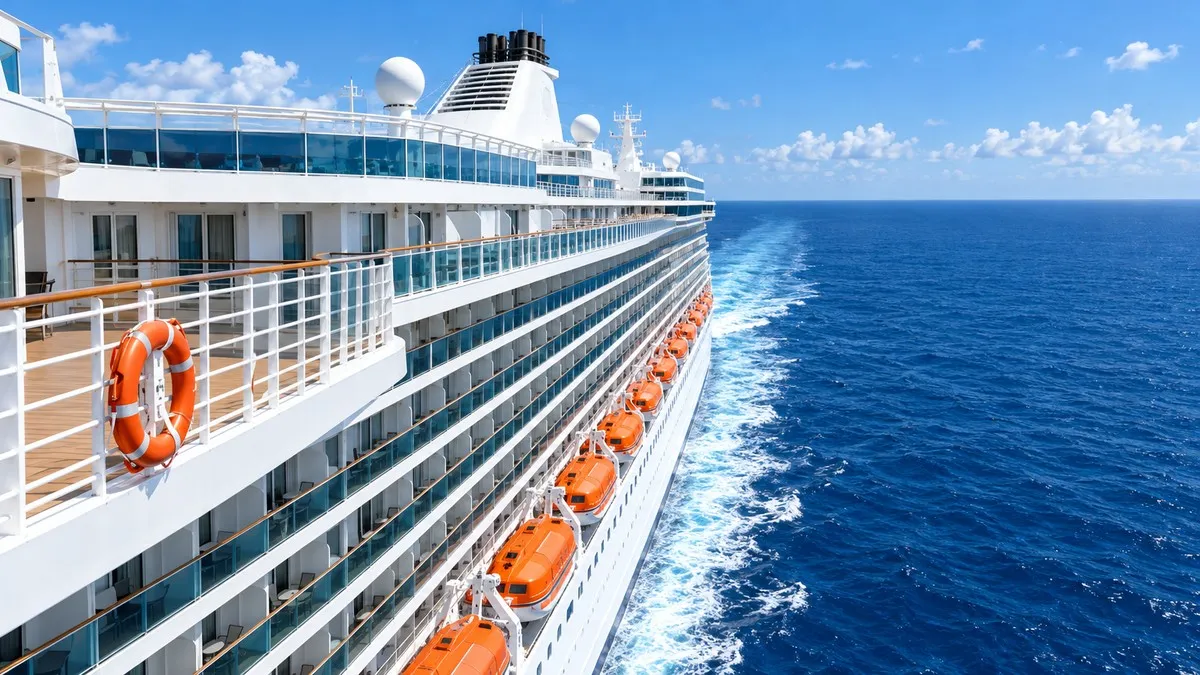
On a modern cruise ship, falling overboard by accident usually means first getting on top of or over a railing. US law sets the bar: 46 U.S.C. 3507 requires ship rails at least 42 inches above the cabin deck on vessels covered by the act.
Klein points out that the original 2007 draft of the law asked for 54 inches, a foot higher, and argues that the taller rail would have done more to stop falls. Climbing, sitting on a rail, or leaning far over it after drinking are the situations that turn a 42 inch barrier into a short step.
Passengers, Crew and Who Is at Risk
Crew members are part of the count, and they are not a small part. In the CLIA figures, 53 of the 170 deaths from 2009 to 2019 were crew, close to a third of the total.
Klein's data adds an age profile: the men averaged just under 39 and the women just over 42. That is a little younger than the average cruiser, who was 46.7 in 2025 according to CLIA, but close enough that the people involved look much like the cruising public rather than a separate group.
What Happens When a Cruise Ship Passenger Goes Overboard
Cruise lines follow a set sequence, and the first minutes decide most outcomes. Industry site Cruise Hive describes the response in six steps, and the core of it is the same across major lines.
The alarm is raised first, by a witness, a crew member, or a sensor. Anyone who sees the fall should shout, throw a life ring and keep the person in sight. The bridge is then told, an officer presses the man overboard button to log the ship's exact position, and a coded call goes out over the public address system, usually "Oscar, Oscar, Oscar", taken from the international signal flags.
Turning a ship the size of a town
The ship slows and turns back toward the logged position. A large cruise ship can travel a mile or more before it can turn safely, so guests may feel the ship heel or slow sharply. The crew alerts the coast guard or navy in the area, and nearby vessels, other cruise ships, cargo ships and fishing boats among them, join the search.
While the ship turns, security staff review CCTV to confirm where and when the person went over, which narrows the search area. If someone is reported missing rather than seen falling, the crew may run a full headcount of passengers and crew. A search can last several hours.
Why being seen matters most
Klein notes that many of the live rescues in his data came from cases where the fall was seen and reported to officers at once. A person who goes over unseen is searched for only once someone reports them missing, and by then the ship may be miles from the spot.
Cruise Ship Overboard Survival Rate
The CLIA figures give a survival rate of 28.2 per cent across 212 incidents, with 48 people rescued alive. Klein's older dataset puts the share rescued alive at 16.7 per cent. Both point the same way: most people who go overboard from a cruise ship do not survive.
The reasons are physical. Cruise Hive lists the height of the deck, injuries from the fall, water temperature, weather, the person's fitness and swimming ability, and the speed of the rescue as the factors that decide survival.
Water temperature and time
Survival time in the water falls steeply as the water cools. A widely used chart from Minnesota Sea Grant gives a person without flotation 1 to 2 hours before exhaustion or unconsciousness in water of 50 to 60°F, and 7 to 12 hours in water of 70 to 80°F. The National Center for Cold Water Safety calls survival charts like this misleading, because cold shock can cause drowning in the first minute or two, long before those times apply, so they are best read as upper limits.
Warm water buys time, cold water takes it away, and in both the clock starts only when someone raises the alarm.
Overboard Detection Systems: The Law and the Reality
The 2010 US law asked for more than cameras at first. The draft required technology "for detecting passengers who have fallen overboard"; the final text requires technology "that can be used for capturing images of passengers or detecting passengers who have fallen overboard, to the extent that such technology is available".
The word "or" is the difference. Recorded CCTV satisfies the law, and Klein argues that footage reviewed only after someone is reported missing does little to save a life. A case USA Today examined in January 2026 shows what is at stake: a five year old fell into the sea, and alarms did not go off until her father jumped in after her.
What automatic detection does
Automatic systems watch the ship's sides and raise an alarm the moment a body falls past. The international standard for them, ISO 21195:2020, covers systems that work without the person wearing or carrying any device. A 2024 review of the field in the Journal of Marine Science and Engineering summarises its requirements: coverage of the whole periphery of the ship out to at least eight metres, and images or video for an operator to verify within five seconds of the alarm.
One commercial system, MOBtronic from MARSS, combines thermal cameras with radar, its managing director Frederik Giepmans told USA Today. He said three of the 11 new cruise ships launched in 2025 were fitted with it.
Nobody has the full count
CLIA told USA Today that it does not track how many vessels carry overboard detection, and many operators do not disclose it. Disney Cruise Line said the technology is available on its ships. For a passenger choosing a ship, the only reliable answer is to ask the line directly.
How to Stay Safe on Deck and on Your Balcony
The data points to a short list of behaviours behind most accidental cases. Each of them involves the railing.
- Never sit on, stand on or climb a railing, on an open deck or on your balcony, whatever the photo opportunity.
- Keep your weight behind the rail after drinking, and step inside rather than leaning over the side if you feel sick.
- Watch children near balconies and open decks, and keep furniture where nobody can use it to climb.
- If you see someone fall, shout "man overboard", throw the nearest life ring, point at the person and keep pointing until a crew member takes over.
That last step is the one that changes outcomes. A person seen going over is a person the ship can turn back for straight away.
Following a Ship From Home
When a cruise ship reports someone overboard, the people waiting at home want to know what their own ship is doing. That wait is hard, especially for parents of grown children on board or relatives of crew who work at sea.
Primo Nautic tracks any cruise ship in real time from AIS data, showing its position, speed, course and navigation status on a live map. A ship that slows, stops or turns back sharply shows that change in its AIS track. Our guide to AIS tracking explains what those signals can and cannot tell you.
With the Loved One on Cruise purpose, Primo Nautic turns that data into calm, plain language updates on the voyage, along with live weather and sea conditions at the ship's location and arrival alerts. It cannot tell you who is on board or what happened, and nothing replaces the cruise line's own information. For the full picture of following a voyage, see how families track a cruise ship.
Conclusion
People going overboard from cruise ships is a real but rare event: about 19 a year across the global fleet between 2009 and 2019, against tens of millions of passengers, with the rate per berth falling as ships grew. Most cases investigated turned out to be intentional or reckless, and Klein's records show alcohol, arguments with partners and leaning over railings recurring among the known causes.
Survival is the hard part of the data. Only 28 per cent of incidents in the CLIA record ended in a rescue, and many of the cases that end well are ones someone saw. US law demands 42 inch railings and image or detection technology, but automatic overboard detection is still not universal, and nobody publishes how many ships carry it. Staying behind the rail, and raising the alarm at once if someone goes over, are the two things that change the numbers.