
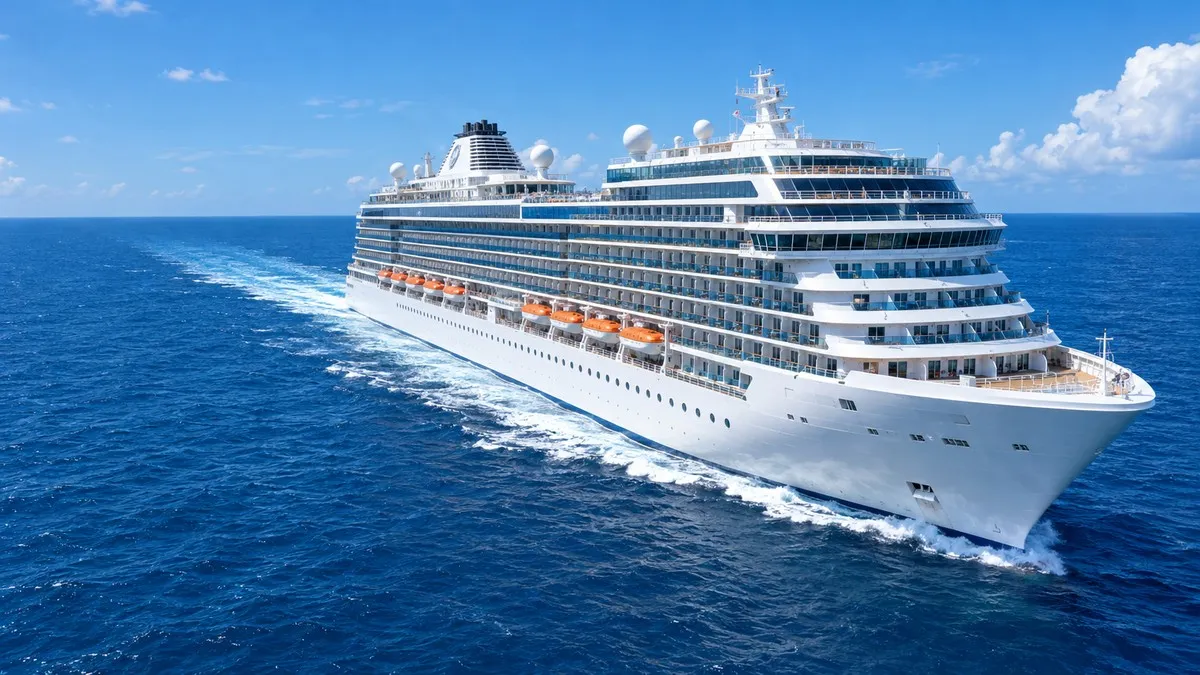
Cruise ship cabins come in four main categories: inside cabins with no window, oceanview cabins with a sealed window or porthole, balcony cabins with a private veranda, and suites with separate living space and extra perks. Most fall between roughly 120 and 220 square feet, and the category decides the light, the view and the price far more than the floor area does.
There is also a fifth kind that never appears in a brochure. Behind locked doors on the lowest decks, the crew who run the ship sleep in cabins that are smaller, usually windowless and almost always shared. This guide covers both sides of the hull: what each passenger cabin type gets you, which locations ride the smoothest, and what life looks like in the cabins your waiter, cabin steward or engineer goes home to after a shift.
Cruise Ship Cabins: The Four Main Categories
Every major line sorts its rooms, which most lines call staterooms, into the same four families. The names change from brand to brand, and each family splits into dozens of price grades by deck and position, but the basic choice is always the same.
Inside cabins
An inside cabin sits in the middle of the ship with no window at all, which makes it the cheapest category on almost every sailing. On Carnival ships, interior cabins run from about 155 to 185 square feet, according to a cabin guide from Cruise.Blog, which also notes that an inside cabin on Norwegian Encore measures just 135 square feet.
The missing window is the trade. With the lights off, an inside cabin stays completely dark at any hour of the day.
Oceanview cabins
An oceanview cabin, sometimes called an outside cabin, adds a picture window or a porthole. The window does not open, so you get daylight and a view without fresh air. In size these cabins sit close to inside cabins; the difference is the outlook, not the floor plan.
Balcony cabins
A balcony cabin has floor-to-ceiling glass doors that open onto a private veranda. On many ships the room itself is similar in size to an inside cabin, and the balcony adds the extra space. Carnival balcony cabins measure around 185 square feet inside with a balcony of about 35 square feet, while standard balcony cabins on Celebrity Eclipse are 192 square feet with 53-square-foot balconies.
Balconies have taken over modern ship design. Of the 1,279 ocean-view cabins on Celebrity Eclipse, 1,205 have balconies, which is 85 percent of every cabin on the ship, according to the Cruise Critic review. Icon of the Seas carries 1,815 balcony staterooms.
Suites
Suites add a separate living area, a larger balcony and an array of perks that vary by line, such as concierge help with restaurant reservations. Sizes range widely. Royal Caribbean lists its largest suite, the Royal Loft on Oasis-class ships, at up to 2,766 square feet for nine guests, and the biggest suites at sea reach about 5,000 square feet.
Several lines now group their top suites into a "ship within a ship," a private area set apart from the rest of the vessel. Norwegian calls it The Haven and MSC calls it the Yacht Club.
How Big Are Cabins on a Cruise Ship?
Cabin sizes vary by line, ship class and grade, so treat any single number as a starting point. These are the figures published by the lines or by reviewers who measured them.
| Cabin type | Typical size | Example |
|---|---|---|
| Inside | 119 to 220 sq ft | Carnival 155 to 185 sq ft, Norwegian Encore 135 sq ft |
| Oceanview | 122 to 220 sq ft | Similar to inside, plus a sealed window |
| Balcony | 138 to 198 sq ft, plus a 35 to 55 sq ft balcony | Celebrity Eclipse 192 sq ft plus 53 sq ft |
| Suite | About 400 sq ft and up, to 5,000 sq ft | Norwegian Spirit 414 to 605 sq ft, Royal Loft up to 2,766 sq ft |
On older and smaller ships, inside cabins can outnumber balconies by a wide margin. Some of Carnival's older ships have fewer than 110 standard balcony cabins, while the newest mega ships are built mostly around them. If a balcony matters to you, the ship's age tells you a lot about your odds of getting one.
Accessible cabins are usually larger. Royal Caribbean's accessible staterooms range from 159 to 298 square feet, with a five-foot turning radius in the sleeping area and the bathroom.
Special Cabin Types Worth Knowing
Beyond the four families, lines have invented a handful of hybrids. They are worth knowing because they often sell for less than the category they imitate.
Virtual balcony cabins are inside cabins with a screen in place of a window that shows the view outside. Royal Caribbean sells them as their own inside grade on ships such as Anthem of the Seas.
Cove balconies sit on lower decks, closer to the waterline, rather than high along the side of the ship. Disney and Carnival both use them, and Carnival has added them to every new ship since its Dream class.
Solo cabins are built for one guest. Norwegian's Studio cabins are the best-known version, and other lines offer single inside or single balcony cabins on selected ships. Not every ship has them, so a solo traveler should check the ship, not just the line.
Guarantee and Obstructed-View Cabins
A guarantee cabin, often shown as GTY, is a booking where you pick the category and the line picks the room. Norwegian's own wording is typical: a Guarantee Balcony "guarantees you'll receive a Balcony stateroom or better," but the room may be on any deck, and the view from the balcony may be fully or partially obstructed.
The upside is price and the chance of an upgrade. The downside is that you give up every say in location. Reviewers on Royal Caribbean Blog advise first-time cruisers to avoid guarantee cabins, and Cruise.Blog warns that you could land next to the nightclub or a crew elevator shaft.
Obstructed-view cabins are sold at a discount for a reason. A fully obstructed view usually means a lifeboat or a piece of machinery sits directly outside your window or level with your balcony railing. If you book one, look up the exact cabin number on a deck plan and in passenger photos before you pay.
Best Cabins on a Cruise Ship for a Smooth Ride
If you worry about motion, location beats category. The middle of the ship moves the least, because it acts like the hull's balance point, and the forward and aft ends swing the most. Lower decks also move less than higher ones.
That is why the most repeated advice from experienced cruisers is a midship cabin on a low deck. Royal Caribbean Blog, after testing every cabin category, recommends a midship interior stateroom on a lower deck to anyone prone to queasiness, while noting that nothing is guaranteed. In the same swell, a midship inside cabin on a low deck is likely to feel calmer than a forward balcony high up.
Noise is the other half of a good night. Check what sits above and below your cabin on the deck plan, because a cabin under a nightclub or beside a crew service area can be loud long after the passenger decks go quiet. For the medical side of feeling unwell at sea, see our guide to seasickness on a cruise.
Weather matters as much as the cabin. Before you sail, or while a family member is on board, Primo Nautic shows the live wind, visibility and sea state at the ship's exact position, so you know whether a rough night is coming rather than guessing from the port forecast.
Cruise Ship Crew Cabins: Where the Crew Sleeps
Almost none of a cruise ship's crew sleep anywhere a passenger will ever see. Crew live in their own area of the ship, reached through crew-only stairways and a long working corridor low in the hull that crew nicknamed the I-95.
Below the waterline, by design
On cargo ships, international labour law keeps crew sleeping rooms above the load line. Passenger ships are the exception. The Maritime Labour Convention, 2006, the treaty that sets minimum living standards for seafarers, lets a flag state approve crew sleeping rooms below the load line on passenger ships, as long as lighting and ventilation are adequate and the rooms are never directly beneath working alleyways, according to Standard A3.1.
That exception is what frees the upper decks for paying guests. It is also why so many crew cabins have no window and why a porthole is a status symbol on the crew decks.
Cruise ship crew cabin size and roommates
A former cruise employee writing in Business Insider put the average crew cabin at about 120 square feet, typically with no window and with a roommate. Most hold bunk beds, a small wardrobe for each person, a desk, a television and one compact bathroom.
The legal floor is tight. On passenger ships, the convention sets a minimum of 7.5 square metres for a room shared by two crew members who are not officers, 11.5 square metres for three and 14.5 square metres for four. Four crew members can legally share about 156 square feet, about the size of the smallest Carnival interior cabin built for two passengers.
The same rules require a separate berth for every seafarer, at least 198 by 80 centimetres, headroom of at least 203 centimetres, and separate sleeping rooms for men and women.
Officers and ratings live differently
Rank decides almost everything about a crew cabin. Entry-level crew usually share a bunk cabin with one to three roommates. Supervisors and some staff, such as entertainers, may get a cabin to themselves.
Officers get single cabins, often with a porthole or window, a full-size bed and a private bathroom, and senior officers get larger rooms with a sitting area. The captain's quarters are unlike any other cabin on the crew decks. The rank ladder behind those cabins is laid out in our guide to the roles on board.
Life around the crew cabin
The cabin is only where crew sleep. Around it sit a crew mess, a crew bar, a small gym and an open deck set aside for crew, on some ships at the bow and on most above the passenger sun deck. For the length of a contract, these spaces are home.
What Crew Cabins Mean for Families at Home
If someone you love works on a cruise ship, a shared windowless cabin and a long shift pattern mean they may not be free when you expect. Shifts run at all hours, and a roommate sleeping off a night shift means a phone call from the cabin is not always possible.
Knowing where the ship is fills that gap. With the Loved One Working at Sea purpose, Primo Nautic turns the ship's live AIS position into plain updates about where the vessel is, the weather around it and when it is due in the next port, so you can time a call for the day the ship is alongside.
Choosing a Cruise Ship Cabin: Key Takeaways
Cruise ship cabins divide into inside, oceanview, balcony and suite, and the category changes the light and the outlook far more than the floor area, which stays in the 120 to 220 square foot range for most non-suite rooms. Balconies now dominate new ships, while older ships still lean on inside cabins.
Location matters more than category for comfort: midship and low decks move the least, and the deck plan above and below your cabin decides how well you sleep. Guarantee and obstructed-view cabins trade choice for price.
Below the passenger decks, crew live in cabins of about 120 square feet, usually shared and often below the waterline, under minimums set by the Maritime Labour Convention. Rank decides who gets a window, a roommate or a cabin of their own.