
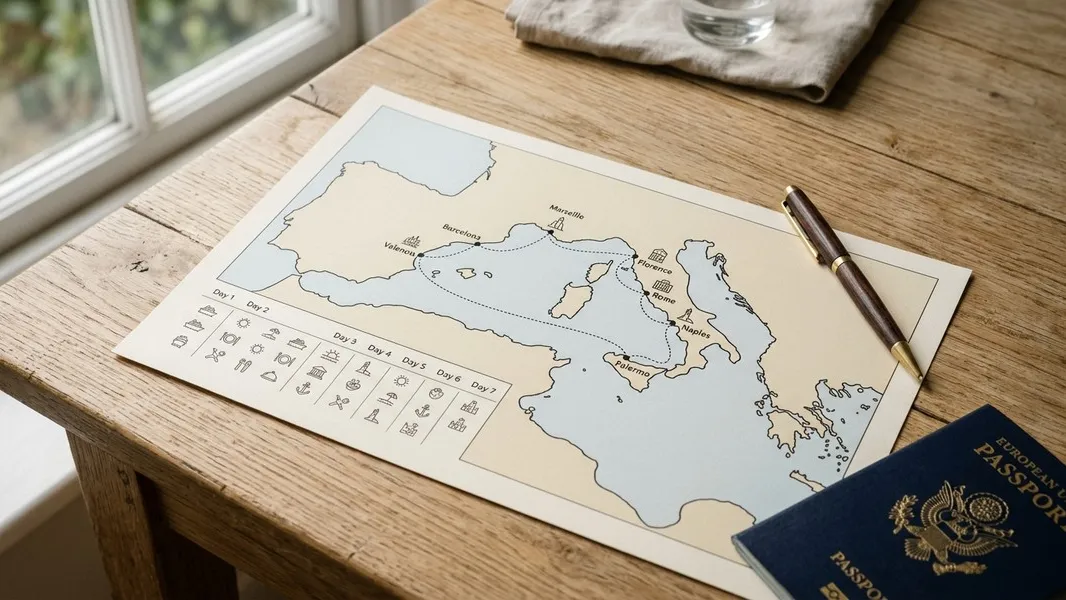
A cruise itinerary change can arrive as a brief email a few days before departure or as an onboard announcement mid-voyage. Either way, the reaction is the same: confusion, disappointment, and a scramble to figure out what it means for your plans. Every major cruise line, including Carnival, Royal Caribbean, Disney, and MSC, modifies itineraries regularly, and passengers are rarely prepared for how it works.
Understanding why a cruise itinerary change happens, what you are actually entitled to, and how to track the ship's real position can save you a lot of frustration. Here is what every passenger and their family should know before boarding.
Why Cruise Itineraries Change
Cruise lines retain the legal right to modify routes at any time for any reason. That clause appears in every passenger contract, and it is not just fine print. Real disruptions happen constantly across all vessel classes.
Mechanical issues are a leading cause. In April 2026, the Carnival Spirit adjusted its Bahamas itinerary due to in-service work: Bimini was cancelled entirely, and Celebration Key was rescheduled with different port hours. The cruise line stated directly that "the safety of the ship and everyone aboard is always the top priority." Propulsion system maintenance, in particular, can reduce a ship's safe cruising speed, which compresses the entire voyage schedule and forces ports to be dropped or reshuffled.
Weather is the other consistently disruptive factor. Hurricanes, named storms, and severe sea conditions force Caribbean and Atlantic routes to shift with little warning. Royal Caribbean, MSC, and Disney have all rerouted ships when storm systems made original ports unsafe. Royal Caribbean monitors developing weather systems up to a week in advance and adjusts routing before conditions become critical.
Geopolitical events have become a growing source of itinerary disruptions as well. Sustained instability in the Red Sea led MSC to reroute the MSC Opera entirely, substituting Canary Islands sailings for planned Middle East itineraries throughout 2024 and 2025. Princess Cruise Line reported air travel disruptions affecting specific itineraries in the same region, giving affected passengers flexible options.
Fleet redeployments and commercial logistics complete the picture. Royal Caribbean cancelled 20 Freedom of the Seas sailings scheduled between May and September 2027 due to fleet repositioning. Carnival similarly cancelled 11 Firenze sailings ahead of that ship's redeployment. These decisions reflect booking demand, drydock scheduling, and port agreements, none of which are visible to passengers until a notification arrives.
How Common Are Itinerary Changes?
No public statistics quantify exactly how often cruise itineraries are modified across the industry. What is clear from documented examples is that the frequency is higher than most passengers assume. Weather-related changes are nearly seasonal in the Caribbean; geopolitical reroutes have spiked sharply since 2023; mechanical adjustments happen on both new and older vessels throughout the year.
Treating an unchanged itinerary as the baseline expectation sets passengers up for disappointment. A more useful approach is to treat the published itinerary as the intended route and build contingency awareness into any port-specific plans, particularly independently booked shore excursions.
How Cruise Lines Notify Passengers
Official communication about a cruise itinerary change comes primarily by email. When the Carnival Spirit adjusted its April 2026 sailing, passengers received direct notification with updated port times, the name of the cancelled port, and a clear explanation of what excursion refunds would be processed.
Read the full email before reacting. Some notifications arrive weeks before departure; others come 24 to 72 hours out. If any port-day flights, hotel stays, or private tours depend on the original schedule, treat the email as a trigger for immediate action rather than background reading.
Cruise line mobile apps push notifications as well, but email remains the most complete and reliable source for the specifics of the change. Do not rely on social media or informal forums for accurate information about your particular sailing.
What You Are Owed When an Itinerary Changes
Compensation depends on the nature and scale of the disruption. A minor port reschedule with adjusted hours typically comes with an apology. A cancelled port, particularly one that affects a significant portion of the voyage, usually includes an onboard credit.
When Carnival cancelled Bimini from the Spirit's April sailing, the cruise line added $100 USD onboard credit per stateroom. Shore excursions booked through Carnival for the cancelled port were automatically refunded to passengers' onboard Sail & Sign accounts. Excursions for the rescheduled Celebration Key stop were moved to the new date without requiring passenger action.
For larger disruptions, such as full sailing cancellations or geopolitical reroutes, more significant remedies are typically offered. Princess Cruise Line gave affected passengers the option to rebook on a future departure or receive a full refund after their Middle East itinerary was impacted.
What is generally not available: cash reimbursement for a single port swap, recovery of independently booked excursion costs at a cancelled port, or travel insurance coverage when the disruption is linked to armed conflict or war. Most insurance policies explicitly exclude claims tied to these events. Standard illness or injury coverage usually remains in place, but verify your specific policy before departure rather than assuming it applies to itinerary disruptions.
Understanding what a port of call involves and how scheduled port time is structured can help you assess how significant any modification actually is. Not all changes are equal; a reduced port stay at a minor stop carries very different implications than losing an embarkation day at a primary destination.
Independently Booked Excursions: The Gap in Coverage
Passengers who book shore excursions outside the cruise line carry a different risk exposure. When Carnival cancels a port, it refunds its own excursions automatically. Privately booked tours are the passenger's responsibility to cancel, rebook, or write off.
Private operators vary significantly in their cancellation policies. Many offer full or partial refunds up to 48 or 72 hours before the scheduled tour. Inside that window, you may lose the full amount. If you have planned high-cost private excursions at multiple ports, review each operator's cancellation terms before departure and keep contact information readily accessible during the voyage.
This is not a reason to avoid independent excursions, which often offer more flexibility and better value than cruise line options. It is a reason to plan for the possibility that any given port may not happen.
Tracking Your Ship When the Route Shifts
Official emails are the starting point for information, but they are not always timely. When disruptions happen at sea, onboard announcements often precede any digital notification to family members on shore. For passengers already aboard a ship with a shifting itinerary, and for families waiting for news, real-time vessel tracking provides an independent layer of visibility.
Tracking a cruise ship in real time works through AIS data, the same automatic identification system that commercial vessels use to broadcast their position, speed, and heading continuously. During the Carnival Spirit's modified April sailing, satellite tracking data confirmed the ship's actual dock location independently of any cruise line communication.
Primo Nautic draws on live AIS data to show any vessel's current position on an interactive map, alongside AI-generated updates adapted to why you are tracking. For a family following a loved one on a cruise, the app provides context-focused insights rather than raw coordinates, covering the ship's location, estimated arrival times, and weather conditions at sea. When an itinerary changes mid-voyage, that real-time position data tells you where the ship actually is, not where it was supposed to be.
For families of cruise passengers, this kind of independent visibility is most valuable when conditions are unstable. A weather reroute or an unexpected mechanical stop can shift a ship's location by hundreds of miles. Knowing the vessel's actual position in those moments replaces uncertainty with specific, verifiable information.
Primo Nautic's smart notifications can alert you to arrivals, departures, and significant delays, so you do not need to check the map continuously. The dual ETA system, which compares the captain's reported arrival time against an AI-calculated route estimate, gives an additional signal when something has changed from the planned schedule.
What To Do When Your Itinerary Changes
When a cruise itinerary change notification arrives, a few steps taken quickly can prevent larger problems:
- Read the full communication carefully and note which ports are cancelled, rescheduled, or modified, and what compensation the cruise line is offering
- Cancel or rebook any independently arranged excursions for affected ports as soon as possible, contacting each operator directly
- Contact your airline immediately if any flights were booked around specific port-day schedules that have shifted
If the modification is significant and you want to explore alternatives before accepting it, contact the cruise line's customer service line directly. Larger disruptions sometimes come with rebooking options that are not prominently advertised in the initial email.
Continue monitoring the ship's position throughout the voyage, particularly during weather events or when geopolitical conditions in the region are active. Real-time tracking provides an ongoing check against what the official itinerary says and what is actually happening on the water.
Conclusion
Cruise itinerary changes are an accepted reality of ocean travel, built into every passenger contract and driven by factors that range from mechanical maintenance to hurricane tracks. Passengers who understand the most common causes, know what compensation to expect, and have a way to verify the ship's actual position are far better positioned to respond without disruption to their broader travel plans. The voyage itself rarely suffers for a port change; what passengers lose is the certainty of the original plan, and that is precisely where real-time tracking and clear preparation make the difference.