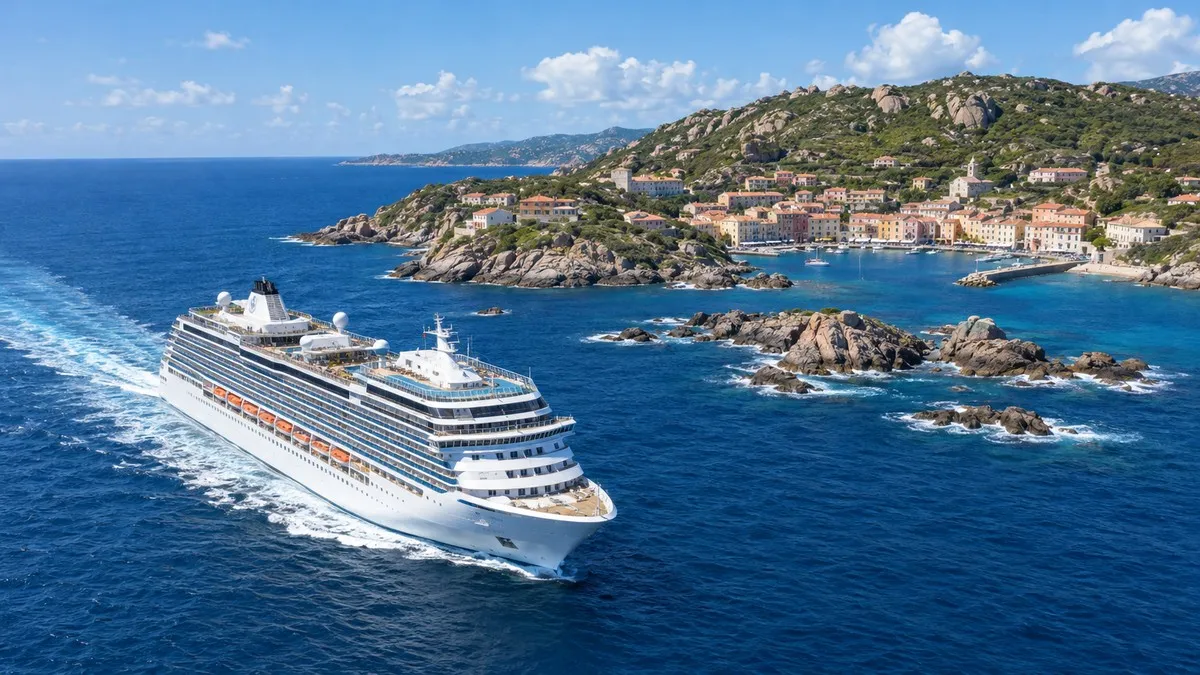
The Costa Concordia capsized because its captain steered the ship, with 4,229 people on board, close to the island of Giglio at night and at 15.5 knots, and it struck the Scole rocks at 21:45 on 13 January 2012. Flooding knocked out power and steering, the order to abandon ship came 69 minutes later, and 32 people died.
Most retellings stop at the captain who left early. The official investigation tells a longer story: a voyage plan changed before the ship left port, a bridge team that never slowed down, an emergency generator that quit within a minute, and a muster that never properly happened. Each of those failures fed a rule that now applies on every cruise you board.
What Happened to the Costa Concordia
The Costa Concordia left Civitavecchia, the port for Rome, at 19:18 on Friday 13 January 2012, bound for Savona on a week-long Mediterranean cruise. On board were 3,206 passengers and 1,023 crew members, according to a close-out memo from US safety investigators who assisted the Italian inquiry.
Weather played no part. The NTSB recorded east-northeasterly winds of 17 knots and seas of about 4 feet, and the Italian investigators described the conditions as favourable.
The route change made before departure
Before the ship sailed, the master told the navigation officer to change the voyage plan so the ship would pass close to Giglio. Under the revised plan, the Concordia was to leave its west-northwest course of 279 degrees at about 21:39 and turn north toward the island. The BBC described the close pass, ordered by Captain Francesco Schettino, as a "salute" to the island.
At 21:19 the first officer called the master, as instructed, to report the approach. The master reached the bridge at 21:34 and had the steering switched to manual. Between 21:37 and 21:38 he was on the phone with someone ashore, asking how close the ship could safely pass the shoreline.
21:45 at the Scole rocks
The bridge team made several course corrections to the north, but nobody ordered the ship to slow down. The master began giving large rudder orders only at 21:44, when the shoreline was already close.
At 21:45 the Concordia's port quarter struck the rocks at Le Scole, just south of the entrance to Giglio's harbour. The impact cut the ship's speed to 8.3 knots and opened five watertight compartments to the sea.
Why the Costa Concordia Capsized: Four Root Causes
Italy's Marine Casualties Investigative Body published its investigation report in May 2013. It splits the disaster into two halves: the navigation that put the ship on the rocks, and the emergency response that turned a grounding into a mass-casualty event. Four causes stand out.
1. A passage planned at an unsafe distance
The report states that the master planned to pass at an unsafe distance from the coast, at night, at high speed, along a poorly lit stretch of shore. It puts the speed at 15.5 knots.
The danger was recognised so late that the attempt to avoid the rocks was useless. A cruise ship of this size cannot stop or turn sharply in the space that was left, so the decisive error came minutes before impact, when the course and speed were still being set.
2. A bridge team that kept the speed
The NTSB memo notes that the bridge team made a series of northerly course corrections and never ordered a reduction in speed. The master had taken the con himself and moved the steering to manual, while his attention was split by a phone call ashore.
The Italian report adds a telling detail. Two general drills held on board in December 2011, under the same master, simulated an abandon ship after a fire, and both were handled correctly. The crew knew the procedures; the procedures were not followed on the night.
3. Flooding that took out power and steering
Water entering the five damaged compartments caused a complete loss of main electrical power and propulsion. The bridge team closed the watertight doors, but the emergency generator ran for less than a minute before stopping, according to the NTSB.
The Italian investigators describe the same generator as working "in a discontinuous way" and unable to supply what the emergency needed. The rudder stayed jammed hard to starboard. With no power, no propulsion and no steering, only emergency batteries kept some lighting and internal communications alive.
4. An emergency declared too late
At 22:22 the captain had the coastguard told the ship had suffered a "failure" and needed tugs, the BBC reported from the official timeline. The general emergency alarm sounded at 22:33. By 22:48 the ship had settled on the rocky seabed, tilted by more than 30 degrees.
The order to abandon ship came at 22:54, 69 minutes after the impact. The Italian report says it was not preceded by an effective general emergency alarm, and several passengers testified that they never caught the announcement. The investigators concluded that the master's failure to declare the emergency promptly, his failure to activate the muster list and his leaving the ship with people still aboard could have caused the 32 deaths.
How Many People Died on the Costa Concordia
Thirty-two people died in the Costa Concordia disaster: 27 passengers and 5 crew members, according to the NTSB. Another 20 people were seriously injured and 137 suffered minor injuries.
The first lifeboats were lowered at 22:55 and reached the shore with passengers at about 23:10. The angle of the ship hampered the evacuation, and the heel grew to about 40 degrees around midnight and reached 80 degrees during the rescue. Search and rescue drew in 25 patrol boats, 14 vessels, 4 tugs and 8 helicopters.
By 06:17 the next morning, rescuers had brought 4,194 people to safety on Giglio, and three more were rescued on 15 January. Two people were still missing when the Italian report was written, and Britannica records that the bodies of all 32 victims were eventually recovered.
What Happened to the Captain of the Costa Concordia
The master and his officers left the bridge at about 23:20, with one officer staying behind to coordinate. At 00:34 Schettino told the search and rescue authorities that he was in a lifeboat with other officers, while passengers and crew were still on board.
Schettino later claimed he fell off the ship and landed in a lifeboat, and he refused a coast guard order to return to the vessel and oversee the evacuation. He went on trial in 2013 for manslaughter, causing the shipwreck and abandoning ship. In 2015 he was found guilty and sentenced to 16 years in prison, and after his appeals failed he began serving the sentence in 2017.
Is Schettino still in prison?
He is serving the sentence at Rebibbia prison in Rome. In early 2025 he applied for a day-release regime that would have let him leave prison for work, then withdrew the request in April 2025, as news agency ANSA reported, because he could not secure a suitable work placement. His lawyer said he might apply again.
Five other people connected with the ship and its operator, Costa Crociere, settled their cases through plea agreements, and none of them served prison time. The company paid a corporate fine of 1 million euros and reached separate settlements with passengers and families.
Raising the Wreck: Parbuckling and the Tow to Genoa
Insurers declared the Costa Concordia a constructive total loss, and Costa chose to remove the wreck in one piece. Titan Salvage of the US and the Italian subsea firm Micoperi won the contract, and around 400 specialists, including about 100 divers, worked on the project while 11 measurement systems tracked the hull's stability.
The ship was rotated upright in a parbuckling operation that finished in the early hours of 17 September 2013. A diver working on the salvage, Israel Franco Moreno, cut his leg on a piece of metal underwater in February 2014 and later died of his injuries.
On 14 July 2014 the hull, wrapped in steel sponsons, rose two metres off the seabed. It left Giglio on 23 July under tow, escorted by a 14-vessel convoy, and covered 280 kilometres in five days to reach Genoa's Pra-Voltri port on 27 July for dismantling. Cruise Critic puts the cost of the whole operation at about 2 billion US dollars.
What Changed After the Costa Concordia Disaster
The Concordia capsized a short distance from Giglio's harbour, in moderate weather, with a crew that had drilled correctly a month earlier. That combination made it hard to blame anything but procedure, and the rules that followed target procedure directly.
Muster before the ship sails
The most visible change is the passenger muster. The International Maritime Organization amended SOLAS regulation III/19 in 2013 in the wake of the Concordia, and the new rule took effect on 1 January 2015. Newly embarked passengers on voyages longer than 24 hours must now muster before departure or immediately upon it.
Before 2015, the muster only had to happen within 24 hours of embarkation. A passenger who boarded at Civitavecchia that evening could legally have sailed for most of a day before a drill, and the Concordia hit the rocks less than two and a half hours out of port. The amendment also requires a safety announcement over the public address system whenever new passengers embark; posters and videos may supplement it but cannot replace it.
Bridge access, voyage planning and lifejackets
The IMO also recommended measures on access to the bridge, harmonised bridge navigation procedures, voyage planning for any deviation from the planned route, and extra lifejackets placed near muster stations. Each one maps to something the investigation found: a phone call ashore during the approach, a route changed for a salute, and a muster that never properly happened.
Cruise lines added their own rules on top, including standardised emergency instructions and securing heavy objects on board. If you want the wider picture of how rare such events are today, our guide to cruise ship accident risks puts the numbers in context.
What the Concordia Means for Your Next Cruise
The investigators could rebuild the Concordia's final hour minute by minute partly because the ship broadcast its position, course and speed over AIS. The BBC's reconstruction used automatic positioning data, and the Italian investigators quoted AIS positions, including the ship's course of 302 degrees and speed of 15.8 knots at 21:00, in their findings.
The same AIS signal is public, and Primo Nautic reads it when you follow a ship by name, MMSI or IMO number: live position, speed, course and navigation status. If you want to understand what those fields mean, our explainer on how AIS tracking works walks through them.
For a family ashore, the useful part is not the raw data but what it says about the trip. With the Loved One on Cruise purpose, Primo Nautic turns those readings into plain updates on progress, weather at the ship's location and the arrival time, comparing the captain's reported ETA with its own route-based estimate and flagging a delay.
On board, the lessons of the Concordia come down to a few habits:
- Attend the muster in person and walk the route from your cabin to your station.
- Note where the lifejackets for your cabin are kept and whether extra ones are stored near your muster station.
- Treat any announcement about a "technical problem" as a cue to know where your group is and how you would reach your station.
Lessons From the Costa Concordia
The Costa Concordia capsized after a planned sail-past brought it too close to Giglio, at night, at 15.5 knots, with a bridge team that never slowed down. The grounding destroyed power and steering, and a 69-minute delay before the abandon ship order turned a survivable accident into one that killed 32 people.
The captain is serving a 16-year sentence, the wreck was raised and scrapped in Genoa, and the rules changed. Passengers now muster before or as the ship departs, bridges are harder to distract, and route changes need a plan. The most practical takeaway is the simplest one: the muster is no longer a formality you can skip, because the Concordia showed what happens when nobody knows where to go.