



Car Carrier Ships: How Ro-Ro Vessels Transport New Cars
You might have seen those cars being loaded on ships to be transported someplace only God knows where. But with their bulky and massive sizes, did you ever wonder how Car Carrier Ships work in the first place? How do they even transport those vehicles from one point to another?
This article aims to give you a glimpse into ships that carry vehicles. What? Ships carrying vehicles?! Yes, and don't worry because we will help you discover why these vessels are often dubbed as the unsung heroes of vehicle transport in the modern day!
Defining Car Carrier Ships
Before we delve any further, let us define carrier ships. An auto carrier ship is precisely as its name suggests: it's a ship that carries autos, vehicles, cars, or whatever you choose to call it. However, Car Carrier Ships are further broken down into several other types.
Car carrier ships, or simply car carriers, are also often referred to as RoRo ships, which can be written as Ro-Ro vessels or ships.
RoRo means Roll-On/Roll-Off. Based on this, you can deduce that a RoRo vessel is a ship specifically designed and built for carrying and transporting wheeled cargo.
However, RoRo ships are not exclusively intended to transport vehicles. They can also carry anything else that could be rolled on and off ships, such as, but not limited to, vans, buses, trucks, and sometimes, even military tanks.
Car carrier ships, unlike other cargo ships, don't use or require derricks or cranes to load and unload cargo. Based on their RoRo name, the vehicles only need to be driven off and onto the ship with the help of ramps.
RO-RO Ship vs. Car Carrier Ship: What's the Difference?
The terms are often used interchangeably, but there is a meaningful distinction. RO-RO (Roll-on/Roll-off) ships is a broad category covering any vessel designed for wheeled cargo (including ferries, military transport ships, and vehicles mixed with containers). The defining feature is the ramp system: cargo drives on and off, no cranes needed.
Car carrier ships, specifically the Pure Car Carrier (PCC) and Pure Car and Truck Carrier (PCTC) subtypes, are a specialized class of RO-RO vessel optimized exclusively for finished vehicles. They feature adjustable internal decks that can be repositioned to accommodate different vehicle heights: passenger cars on the higher decks, SUVs and trucks on decks with more clearance. The result is maximum vehicle density per voyage.
All modern car carriers are RO-RO vessels, but not all RO-RO vessels are car carriers. A ferry carrying passengers and their cars is a RO-RO ship, but it is not a car carrier in the industry sense.
Quick Glimpse into the History of Car Carrier Ships
Way before the industry hailed pure Car Carrier Ships as the norm, bulk carriers were responsible for transporting cars and other vehicles for long-haul purposes. These bulk carriers handled unloading and loading with the cranes and derricks found onboard. These vessels also featured portable car platforms.
However, the rising global demand for cars from other manufacturers and countries resulted in a completely different solution, thus paving the way for the birth of purpose-built car carrier ships.
Whether you believe it or not, all of these only happened during the 1950s, during the time of development of the ships that were mainly intended for vehicle transport by sea. These ships are fitted with additional decks to the vessel's design. The first-ever bow door on a RoRo vessel was seen on the Aniara, which launched in 1963.
Numerous innovations followed shortly afterward, including 12 decks with enough room for over 6,000 cars.
How Car Carrier Ships Work
Ships carrying cars and other wheeled vehicles have numerous distinct features that allow their safe, secure, and efficient cargo transport from one point to another.
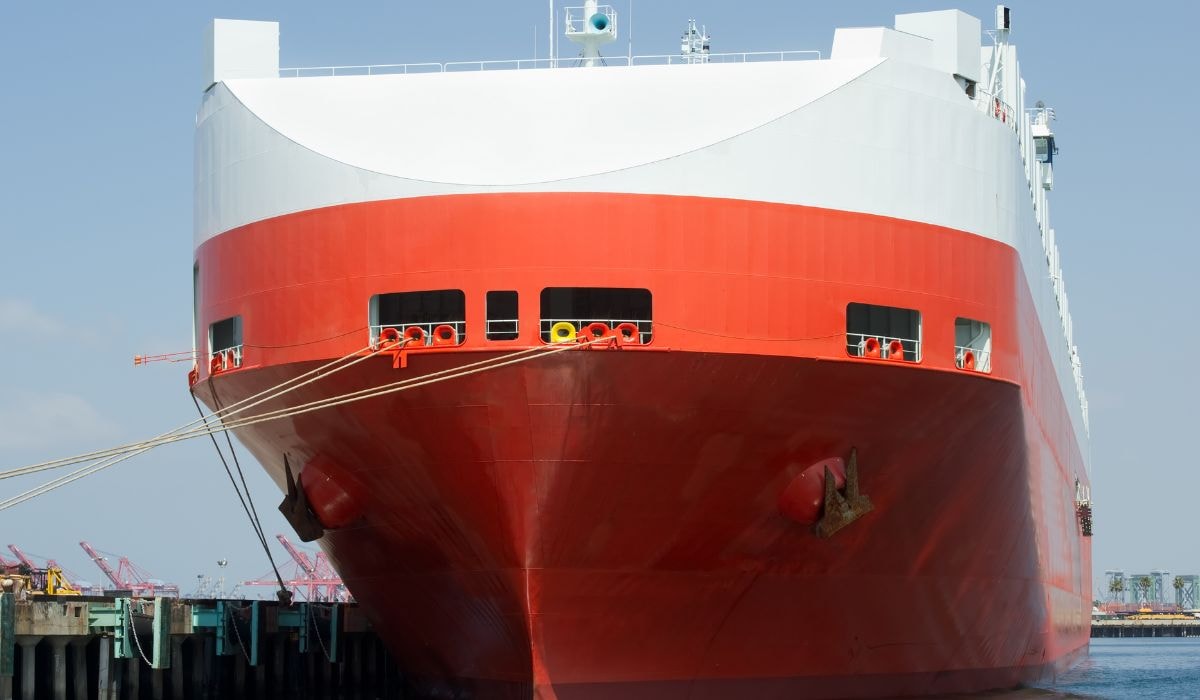
Car Carrier Ships have an open and flat deck with both the bow and stern fitted with ramps. As you might already know, the bow is the front part of the vessel, while the stern is the rear end.
These ramps allow the easy driving or rolling of cars as well as other vehicles off and onto the vessel at the last part and beginning of the trip.
For this reason, Car Carrier Ships are expected to have strong decks to support the weight of vehicles passing through them.
Just like other container and cargo ships traveling the seas and oceans of the world, Car Carrier Ships are also mandated to have several essential safety features. Some of these include the fire bulkheads that divide the decks into compartments and the sprinkler systems intended to put out fires that may break out and spread.
Bulkheads are upright walls or partitions in the hull of a ship. It subdivides the vessel's interior into fireproof or watertight sections. If an accident occurs, the bulkheads cut down the extent to which the fire or seawater can damage or flood the ship.
Types of Car Carrier Ships
As mentioned, Car Carrier Ships are categorized as RoRo ships, subdivided into pure car carriers (PCC) and pure car truck carriers (PCTC).
But there are still many other types out there, which include the following:
Container Ships and RoRo Ships (ConRo)
These vessels are a combination of traditional container ships and RoRo ships. These are designed to carry wheeled cargo and shipping containers alike.
General Cargo and RoRo Ships (GenRo)
These vessels are a combination of RoRo ships and regular cargo ships. In general, their capacity and size are smaller than those of ConRo ships, and as you might have already guessed, they carry both wheeled and general cargo.
Pure Car Carriers (PCC)
Pure car carriers exclusively transport cars, often new vehicles, to their intended destination market. An excellent example is Japanese cars meant to be sold in the United States.
Pure Car Truck Carriers (PCTC)
Pure car truck carriers transport any four-wheeled vehicle from point A to point B. These vehicles could be new trucks, cars, plant machinery, and tractors.
RoPax Ships
These ships are responsible for transporting cars and smaller vehicles while having enough room onboard for human passengers. You're correct if you think it sounds like the industry term for ferries. RoPax ships are ferries.
How Much Can a Car Carrier Ship Hold?
Capacity is measured in CEU (Car Equivalent Units), which is the space needed to transport one standard passenger car. Modern large car carriers hold over 9,000 CEU per voyage, meaning a single ship can move more than nine thousand vehicles in one crossing.
To put that in perspective, a major vehicle port like Baltimore or Bremerhaven handles thousands of car carrier arrivals per year. Each ship that docks could be offloading an entire model year's worth of vehicles for a regional dealer network.
The largest car carrier ships also feature adjustable decks: internal horizontal platforms that can be raised or lowered to fit different vehicle heights. A deck configured for compact cars can be repositioned with hydraulic systems to accommodate SUVs or pickup trucks. This flexibility is what makes the PCTC type so dominant in modern vehicle shipping.
How to Load and Unload Car Carrier Ships
As expected, unloading and loading the cargo of Car Carrier Ships should be carried out in an orderly and efficient manner to ensure the safety of the operations, prevent any damage to the cargo, and guarantee speedy port turnaround time. Time, after all, is money, especially in this industry.
The following is a general overview of the steps involved in loading and unloading Car Carrier Ships:
- The auto carrier ship will arrive at the port and dock at its pre-determined terminal.
- A team of drivers is ready at the terminal and waiting for the ship. The same team also prepares the cars and the remaining vehicles that will be loaded.
- The ramps of the auto carrier ship will be lowered at one point to allow the vehicles to be driven on board.
- Lashings will be used to secure the vehicles.
- After loading all the vehicles, the ramps will now be raised. The vessel will then leave the port and journey to its intended destination.
The steps involved in the process will be reversed once the auto carrier ship has arrived at its destination port.
Lowering the exit ramps will allow the vehicles to be driven off the vessel. They will undergo inspection for damage, and once it's verified that everything is excellent, the vehicles will be turned over to the consignee, agent, or client.
Important note: Non-running vehicles (cars that cannot be driven under their own power) cannot use standard RO-RO loading. These must be transported in containers or on specialized flat-rack carriers instead.
The Economic Scale of Car Carrier Shipping
The numbers behind car carrier shipping are significant. China produced 26.1 million vehicles in 2023, many of which were exported by sea. The global automotive logistics market is valued at approximately $298 billion in 2026 and is projected to reach $386 billion by 2031, growing at roughly 5.4% annually.
Sea transport holds a major share of this market, and car carrier capacity has struggled to keep up with rising Chinese vehicle exports in recent years, particularly as Chinese EV manufacturers like BYD expand aggressively into European and Southeast Asian markets.
The shipping routes are well-established: Japan and South Korea to North America; Germany to the Middle East and Asia; China to Europe via the Suez Canal. Major port hubs include Bremerhaven (Germany), Baltimore (USA), Zeebrugge (Belgium), and Nagoya (Japan).
Interested in tracking car carrier ships and other vessel types in real time? Tools like vessel tracker apps use live AIS data to show ship positions, routes, and port arrivals across all vessel types. You can also compare the best MarineTraffic alternatives for ship tracking on mobile and desktop.
Environmental Pressures on the Car Carrier Industry
Car carrier ships face increasing scrutiny on environmental grounds. Like all commercial shipping, they contribute to greenhouse gas emissions; transportation accounts for roughly 25% of total EU emissions. Ro-Ro vessels also carry risks specific to their cargo: vehicle batteries (especially EV lithium-ion packs) present fire hazards that are difficult to manage on enclosed multi-deck ships.
In response, leading Japanese shipping company MOL is developing ammonia-fueled vessels and deploying Wind Challenger rigid sail systems to cut emissions on its car carrier fleet. Decarbonization of car carrier shipping is expected to accelerate as IMO emissions rules tighten through 2030.
Hull fouling (the buildup of marine organisms on ship hulls) is another concern. Invasive species can attach to hulls during port calls and be transported to new environments. Tighter hull cleaning regulations, including capture-system requirements in Norway and Australia, are creating new operational requirements for ship operators.
The Role of Car Carrier Ships in the Supply Chain
Although several countries worldwide have noticed a slight decline in car ownership, mainly due to the pandemic, researchers have estimated that the total stock of vehicles will increase from approximately 800 million in 2002 to over 2 billion units by 2030.
Thus, it won't be too much to say that carrier ships are an integral link in the world's supply chain and a critical component of the merchant fleet. Thanks to these ships, vehicle supplies are steady and constantly available to cater to the needs of consumers, businesses, and organizations.
For a broader look at how different ship types serve the global supply chain, see our guide to types of ships and what each one carries.
Most Recent Posts
Discover more articles from our blog.