A bulk carrier is a ship designed to transport large quantities of unpackaged dry cargo, typically raw materials like iron ore, coal, grain, and bauxite. Unlike container ships that stack standardized boxes, bulk carriers load commodities directly into open cargo holds through gravity-fed systems or specialized equipment. According to BIMCO data, they represent roughly one-third of the world's merchant fleet by deadweight tonnage, making them one of the most common ship types at sea.
This guide covers how bulk carriers work, the main size classes from Handysize to Valemax, what they carry, and how to track one in real time.
What Is a Bulk Carrier Ship?
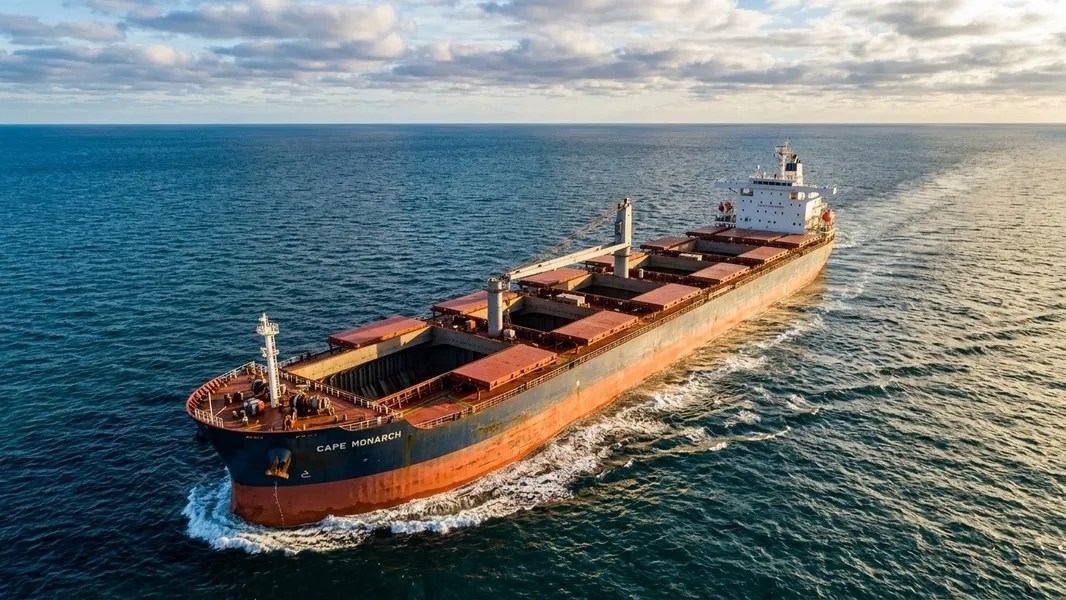
A bulk carrier's defining feature is its large, open cargo hatches that allow dry commodities to flow directly into the holds. There are no container grids, no specialized tanks, and no complex internal compartmentalization. The design prioritizes maximum cargo volume above everything else.
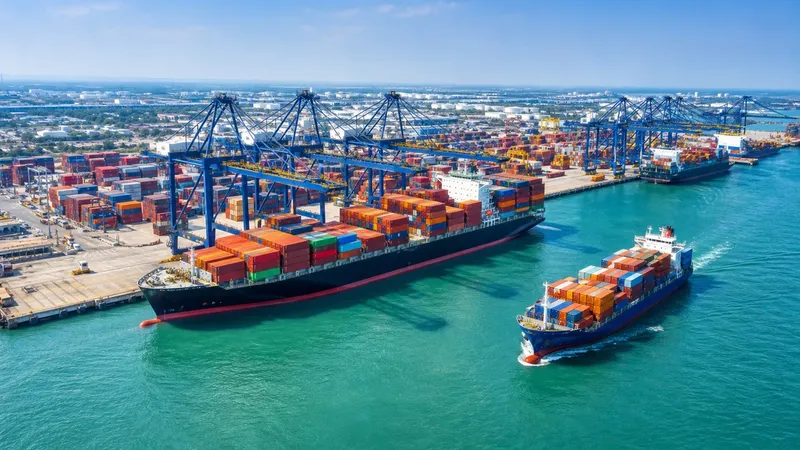
This sets bulk carriers apart from other cargo ship types. Container ships use cellular grids and vertical lifting systems to organize standardized boxes. Tankers pump liquids into subdivided tank cells. General cargo vessels handle mixed freight in packaged form. Bulk carriers do none of this. A commodity like coal or grain is simply poured into the hold in bulk.
One important design feature: bulk carriers have larger ballast tanks than most other ship types. When empty, the ship's center of gravity shifts high enough to become unstable in rough seas. To compensate, the crew floods the ballast tanks with seawater during empty legs of the voyage. This is why a bulk carrier crossing an ocean without cargo still sits noticeably low in the water.
Types of Bulk Carrier Ships by Size Class
The bulk carrier fleet is divided into distinct size classes, each built for specific trade routes and port infrastructure. The larger the vessel, the fewer ports it can access, but the lower the cost per ton of cargo moved.
Handysize (Up to 40,000 DWT)
Handysize vessels measure roughly 150 to 180 meters in length with a draft of 9 to 11 meters. Their compact dimensions let them access smaller, underdeveloped ports that larger ships cannot reach. This makes them well-suited for regional trade, cement deliveries, and fertilizer shipments to facilities with limited quay depth or berth length.
Handymax and Supramax (40,000 to 60,000 DWT)
This segment is among the most popular in the global fleet. A defining feature of Supramax vessels is their integrated onboard cranes, which allow them to load and unload cargo without relying on port infrastructure. That self-sufficiency makes them valuable for routes connecting smaller regional hubs in Asia, Africa, and South America where dedicated bulk terminals are scarce.
Panamax (50,000 to 80,000 DWT)
Panamax vessels are sized to fit the original Panama Canal lock dimensions, giving them access to routes between the Pacific and Atlantic Oceans. This geographic flexibility makes them a core part of coal and grain transport, and the segment continues to grow as Canal traffic through the expanded locks increases.
Post-Panamax and Neo-Panamax (80,000 to 120,000 DWT)
Post-Panamax vessels exceed the original Canal dimensions but can transit the expanded locks opened in 2016. Carrying significantly more cargo per voyage than a Panamax ship, they offer better economies of scale while retaining access to the Panama route.
Capesize (120,000 to 200,000 DWT)
Capesize ships dominate the long-haul iron ore and coal trades. Too large for the Panama Canal, they route around Cape Horn or through the Suez Canal. These vessels connect major exporters in Australia and Brazil with importing centers in China, Japan, and Europe, and they are the workhorses of the raw materials that feed steel production globally.
Valemax (200,000 to 400,000+ DWT)
Valemax vessels are the largest bulk carriers in operation, built almost entirely around the iron ore route between Brazil and China. A single ship of this class can carry over 400,000 tons of iron ore in one voyage, making intercontinental bulk shipping viable at a cost per ton that smaller vessels cannot match.
What Do Bulk Carriers Actually Carry?
Bulk carriers move the raw commodities that industrial economies depend on: iron ore for steel, coal for energy and manufacturing, grain for food, and bauxite for aluminum production.
Grain is the largest segment by commodity type. Wheat, corn, soybeans, and rice flow from exporters in the United States, Brazil, Argentina, and Ukraine toward food importers worldwide. Seasonal harvest cycles and global population growth keep this trade consistent throughout the year, sustaining demand for Handymax and Panamax vessels in particular.
Iron ore is the other dominant cargo, moving in enormous volumes from mining operations in Australia and Brazil toward steel mills in China. China is by far the world's largest iron ore importer, and this single trade lane drives most of the demand for Capesize and Valemax vessels. According to World Steel, steel output in Asia alone exceeds a billion tonnes annually, underpinning a continuous flow of bulk ore across the Pacific and Indian Oceans.
Coal travels along similar routes, from Australian and Indonesian mines toward Asian power plants and European utilities. Some bulk carriers also carry bauxite, fertilizers, and cement, though these are typically handled by smaller vessels given the more fragmented demand pattern.
It is worth noting that the same vessel rarely moves between different commodities without a hold cleaning process. Transitioning from coal to grain requires a thorough inspection to meet food safety standards. Cargo history, vessel age, and regional regulations all factor into what a bulk carrier can carry on its next voyage.
How Loading and Unloading Works
Loading a bulk carrier is typically straightforward. Shore facilities positioned at elevation pour the commodity into the holds by gravity through conveyor systems. The ship opens its hatches, positions itself at the berth, and material flows in continuously. A large Capesize loading iron ore at a purpose-built export terminal can complete the process in a matter of days.
Unloading is considerably more complex. Unlike container operations where each box is lifted out individually, loose bulk cargo must be scooped, vacuumed, or conveyed out of deep open holds. Grab buckets can lift material effectively but are slower and cause cumulative damage to hull surfaces through repeated contact.
Modern solutions address this directly. Many bulk carriers built since the 1970s feature an integrated onboard conveyor system: one belt runs beneath the cargo holds, receiving material through hopper doors in the hull bottom; a second belt carries it up to deck level; a third conveys it along a discharge boom that swings outboard to deposit cargo ashore. This system achieves far higher discharge rates than grab buckets and lets the ship serve ports that lack dedicated unloading infrastructure.
Supramax vessels with onboard cranes offer a middle ground. They handle their own cargo operations using ship-mounted cranes, eliminating dependence on port equipment entirely. For routes to smaller or developing ports, this self-sufficiency is a significant commercial advantage.
Major Global Trade Routes
The bulk carrier network follows predictable corridors shaped by where resources are extracted and where they are consumed.
The iron ore route between Brazil and Australia on one end and China on the other is the single most important corridor in bulk shipping. Mining giants Vale, BHP, and Rio Tinto drive the majority of this trade, and the Valemax class was built almost entirely to serve it. The sheer tonnage involved makes this lane the primary driver of Capesize demand worldwide.
Coal moves from Australia, Indonesia, South Africa, and Colombia toward Asian power plants and European utilities. Seasonal variations in energy demand create some fluctuation in volume, but the underlying flows remain consistent. North Asian importers, particularly Japan and South Korea, maintain long-term coal supply agreements that support steady vessel utilization.
Grain routes follow the agricultural calendar. U.S. Gulf Coast and Pacific Northwest terminals, Brazilian ports at Santos and Paranaguá, and Argentine facilities in Rosario export wheat, corn, and soybeans through much of the year. Vessels frequently reposition between hemispheres to follow harvest cycles, with South American exports peaking in the first half of the year and North American exports picking up in the second half.
How to Track a Bulk Carrier Live
Understanding the basics of AIS tracking is the foundation for following any vessel, including bulk carriers. The International Maritime Organization requires all commercial vessels to carry AIS transponders, which continuously broadcast position, speed, course, and destination. Terrestrial receivers and satellites collect this data, creating a live picture of maritime traffic across the globe.
When you search for a bulk carrier on a tracking platform, you can see its current position on a map, its heading and speed, the filed destination and estimated arrival time, and recent port calls that reveal what trade lane the vessel operates on. Vessel type, size class, and cargo (when reported) give context to where the ship sits in the broader supply chain.
Primo Nautic transforms this raw AIS data into context-aware updates tailored to why you are tracking a vessel. For cargo monitors following a dry bulk shipment, the app formats updates as logistics-focused information, including delay detection and arrival confidence scoring based on actual route progress versus the captain's reported ETA. For enthusiasts, tracking a Capesize crossing the Indian Ocean or a Supramax navigating through the Strait of Malacca brings global commodity flows into direct, observable focus.
To find a specific bulk carrier, you can search by vessel name, MMSI number, or IMO identification number within Primo Nautic or any AIS-based tracking platform. You can read more about what an MMSI number is and how to use it to locate ships anywhere on the ocean.
Conclusion
Bulk carriers are among the least visible ships at sea, but they carry the commodities that industrial civilization depends on. Iron ore for steel, coal for power, grain for food: these cargoes move in enormous volumes across predictable global trade routes on vessels ranging from compact Handysize ships to the 400,000-tonne Valemax class.
Understanding the size classes, what each type carries, and how loading and discharge work gives you a practical lens for interpreting bulk trade news. When you see headlines about iron ore prices or grain export volumes, you now have a clear picture of the physical reality behind those numbers: massive vessels repositioning between continents, loading at purpose-built terminals, and moving raw materials toward the factories and ports that keep economies running.