




Wind
Wind in general
Wind refers to the horizontal and vertical movements of air. In the maritime industry, the speed of air currents is measured in nautical miles. (1kt = 1 Nm/h, 1Nm = 1852m). 1 kt = 0514 m/s or 1 m/s = 1.944 kt. The Beaufort scale is also used for the measurement of wind strength. The direction of the horizontal movement is expressed by using the names of the sides of the world in a way that indicates the direction from which the wind blows.
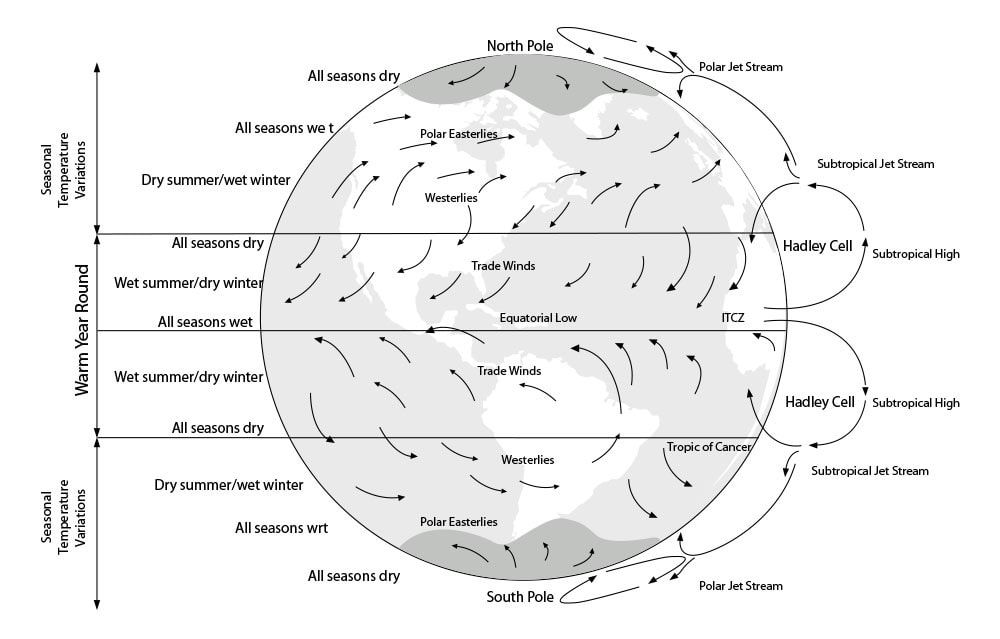
The wind rose displays the direction of a particular wind, together with the corresponding speeds. The consequences of air circulation are the following winds: trade winds (global or permanent winds), monsoons (seasonal) and local winds. Trade winds and monsoons occur in tropical areas. The local winds are mostly caused by the uneven warming of the Earth's surface which lead to daily differences in atmospheric pressure (sea - land; valley - hill). Swirl or rotating winds are special kinds of wind (tornado and strong wind).
Wind direction depends on the direction of the baric gradient, and its strength (speed) on the value of that gradient. If the real direction is compared to the direction of the gradient on the synoptic map in the nature, it is evident that the direction is closer to the isobar course than to the gradient. The causes of this are Coriolis force - the rotation of the Earth, centrifugal force (circular isobars), the friction of air particles (internal - the friction of air particles that takes place in the air mass; external - about the Earth's surface). Gradient force is a fundamental force that causes the movement of air and occurs because of the difference in pressures. Its direction flows from high to low pressure and is vertical onto the isobaric surface. Coriolis force acts vertically to every object in movement, and in doing so does not change speed. On the southern hemisphere it turns the object to the left, and on the northern to the right. The friction force more or less disables the mode of movement of wind.
Under normal circumstances in nature, gradient wind with friction causes a positive rotation in a cyclone. A negative rotation occurs when that same gradient wind with friction happens in an anticyclone. Gradient wind in a cyclone with a negative rotation causes a strong whirling motion of small scale (tornado, strong wind). If we look at the daily changes, it is evident that these shifts are very obvious.
The wind blows mainly from the Sun and as the Sun somehow seemingly moves along the firmament from East to West, the wind also changes its direction. In the morning, these are weak eastern winds, around noon southern, and in the evening weak western winds. As the direction of the wind changes, so does the wind speed with various types of winds divided into marine and continental. Marine type is weaker during the day, and stronger at night, while with the continental type, the largest wind speed occurs around noon and decreases in the evening.
Permanent winds

The winds that blow continually throughout the year are called Permanent Winds. They also blow uniformly in a particular direction. There are types of permanent winds:
- Trade Winds - These are permanent winds that flow from east-to-west. They flow in the Earth's equatorial region (between 30°N and 30°S latitudes). They are named trade because ships have taken advantage of them to assist their journeys between Europe and the Americas throughout history.
- Easterlies - It is a predominating wind blowing from the east. Both the trade winds in equatorial regions and the prevailing winds in the polar areas are easterlies.
- Westerlies - These are permanent winds that flow from the west towards the east. These winds flow in the Earth's middle latitudes between 30 and 60 degrees. They are also referred to as anti-trades, since these winds originate from the high-pressure areas in the horse latitudes and flow towards the poles and direct extratropical cyclones in this general manner.
Seasonal winds

Seasonal winds are shifts of air repetitively and predictably steered by changes in large-scale weather patterns. Seasonal winds appear in numerous locations throughout the world. The name of a specific seasonal wind and the latent forces that drive those winds are determined by the unique geographic location.
One of the most recognized seasonal winds are monsoons. Even though they are often wrongly identified as rainstorms, they are a seasonal wind. A monsoon is a wind in low-latitude climates that changes direction seasonally between winter and summer. Monsoons generally blow from the land in winter (the dry phase - cool, dry air), and from water to the land in summer (the wet phase - warm, moist air), bringing about a drastic change in the precipitation and temperature of the area hit by the monsoon.
Local winds
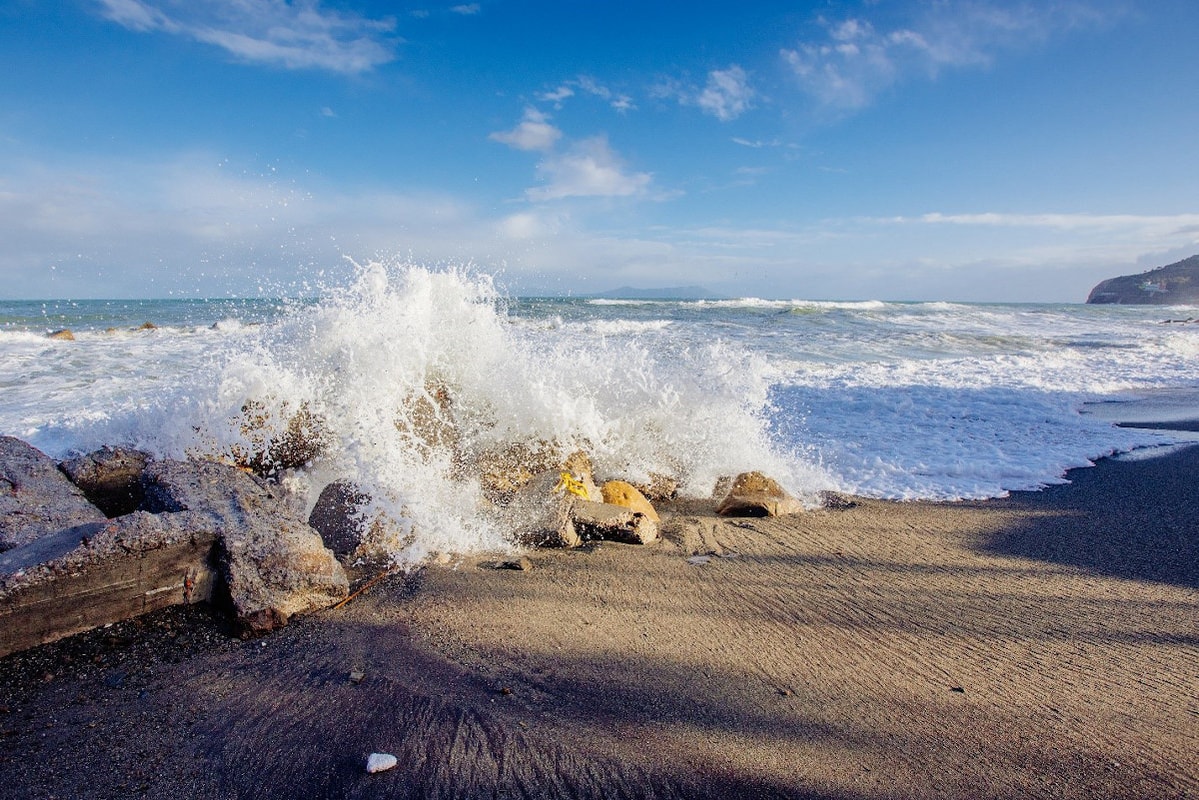
A local wind is a predictable circulation of air that happens during specific periods of the day or year in a limited area. Examples of such winds include sea and land breezes.
- Land breeze - a wind that flows from the land towards the sea. It often blows at night.
- Sea breeze - a wind that flows from the sea or a large body of water towards land. Sea breeze occurs because of the differences in air pressure generated by the differing heat capacities of water and dry land.
- Anabatic winds - These winds are occurred at higher point on a slope and are driven by warmer temperatures on the surface of a mountain slope than the encompassing air column.
- Katabatic winds - opposed to anabatic winds, katabatic winds are downslope air currents created when the surface of the mountain is colder than the encompassing air and creates a downslope wind.
- Foehn winds - or föhn wind is a dry, warm, downslope wind that develops in the lee (downwind side) of a mountain range.
Wind measurement
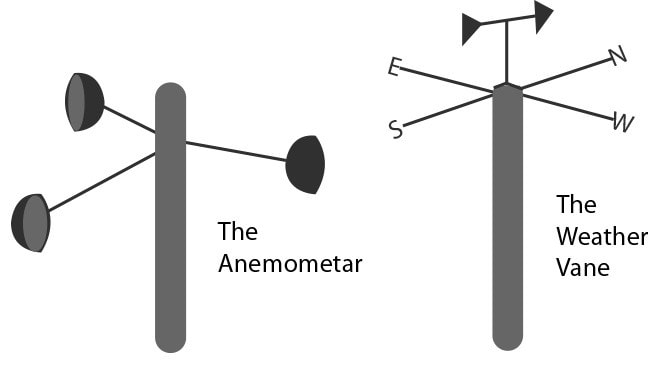
Weathercock or vane is a horizontal rod that is attached to the top of the vertical axle around which it turns, and it represents the easiest way of determining the direction of the wind. On one side, it has a counterweight, and on the other side an aileron, so due to the action of the wind, an arrow sets in the direction from which the wind blows.
Anemometer is used to measure the wind speed and can be electrical or mechanical; permanent or portable. Wind speed can also be measured as the difference between static and dynamic pressure in Prandtl (or Pitot) tubes.
Continuous wind speed and direction are recorded by the anemograph. Anemograph is also the name for the record of time changes of the wind.
If there are no measuring instruments, the strength of the wind can be estimated by using Beaufort charts, so that we estimate the effect of the wind in the horizon of the observer. There are usually 12 degrees (with a maximum of 17). Degrees from 13 - 17 are used only in special cases, usually when it comes to tropical cyclones. Such extended chart is only used in Taiwan and China, while the worldwide organization still defines the scale as having 12 degrees. The enlarged scale is not recommended.