



Firefighting principles and fire classification
Introduction
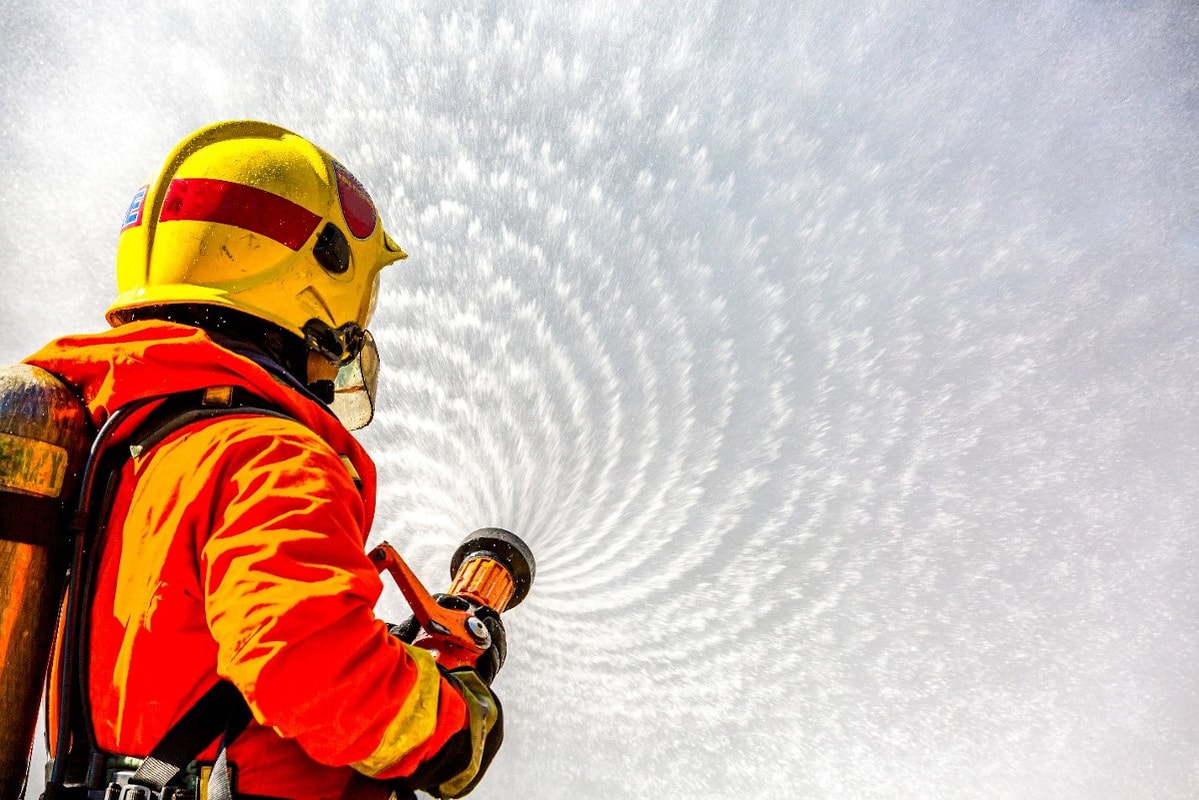
Most fires can be extinguished by removing one or more of the basic combustion conditions, that is, by:
- cooling
- separation
- suffocation
- directly effecting the chemical process
When the substance is cooled by a fire extinguishing agent, its temperature drops to a value lower than the flash point, the combustion process stops, and the fire is extinguished. Cooling: The burning substance is brought into contact with a medium whose temperature is noticeably lower. During contact, heat from the burned substance is transferred to the extinguishing agent. It warms up and most often changes its state (evaporates). Solids are usually quenched by cooling (with water).
Separation is the removal of a combustible substance (which has not yet begun to burn) from a burned area/space. This can be done by interruption of the fuel supply (closing of the valve), fencing of the burned area (forest fires), removal of material, dilution of fuel substance, etc. Separation reduces the fuel mass/substance and thus shortens the combustion and allows the burning mass to burn out.
Suffocation prevents oxygen from entering the fire. The burned substance is covered with some inert gas (which does not support combustion), a non-combustible liquid, or some solid, bulk material. The most suitable material for choking is one that can also cool the fuel substance (water, foam). Otherwise, the suffocated substance may re-ignite after the fire has been extinguished, as its temperature (flash point) has not been sufficiently lowered.
Anti-catalytic action slows down the chemical processes. This action is carried out by inhibition (the burnt-out space is injected with an agent which, due to the influence of heat, decomposes to its constituents of which at least one prevents the chemical reaction of combining the fuel with oxygen - burning) and intoxication (oxygen-binding agent is inserted into the burnt-out space thus reducing its amount and preventing/slowing oxidation - burning).
Fires are primarily classified based on the aggregate state of their fuel substance. This classification enables the determination of the most appropriate fire extinguisher. According to the ISO standard (in accordance with the National Fire Protection Association - NFPA-10) fires can be divided into:
- Class A: fires of solids (organic origin) which produce flames and embers during burning
- Class B: fires of liquid substances, or solids releasing flammable liquids
- Class C: gas fires
- Class D: flammable metal fires
- Class E: electrical fires (installations) and fires of substances near the source of electricity.