
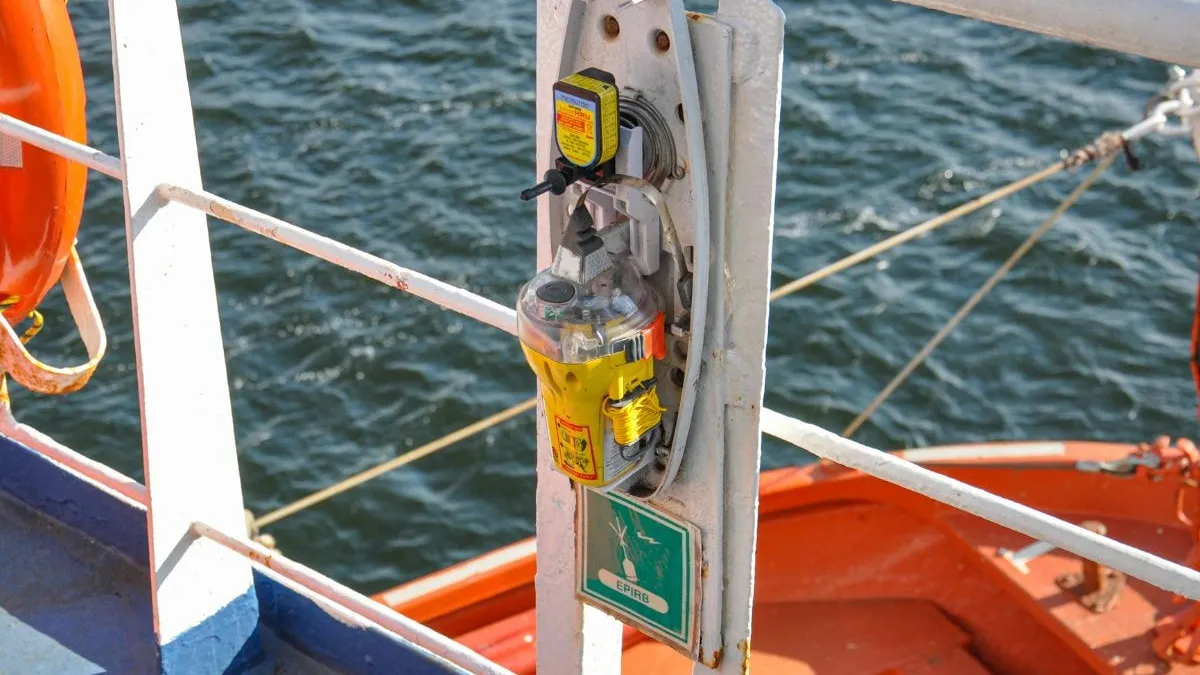
Have you ever wondered how lives are saved during emergencies at sea? This is where the EPIRB comes to the rescue.
EPIRB, short for Emergency Position Indicating Radio Beacon, is a special device that alerts search and rescue (SAR) services during sea emergencies. This tracking equipment transmits signals on specific bands to determine the location of a ship, life raft, lifeboat, or people in distress.
These devices are installed on ships and other vessels after registration with the national search and rescue authorities after they are registered to that boat. This registration allows faster identification of false alerts and ensures speedy rescue operations during emergencies.
The EPIRB is the secondary means of alerting distress, meaning that distress comes much later in the methods used to alert SAR forces.
Every ship is mandated to carry one EPIRB, while registered boats and other water vessels must have two EPIRBs.
3 Types of EPIRB
EPIRB comes in three different types, which include the following:
- COSPAS-SARSAT
The EPIRBs under the system of COSPAS-SARSAT are applicable for all areas of the sea and work on the 121.5 MHz and 406.025 MHz bands.
- INMARSAT
This particular EPIRB works on the 1.6 GHz bands and applies to sea areas A3, A2, and A1.
- VHF CH 70
It is an EPIRB that applies exclusively to sea area A1 and works on the 156.525 MHz band.
EPIRBs and How They Work
The EPIRB device features two radio transmitters, 0.25 and 5 watts each. Each transmitter operates at 406 MHz, the standard global frequency that often signals distress.
The radio transmitter with 5 watts synchronizes with a GOES weather satellite that goes around the earth in geosynchronous orbit.
Meanwhile, the COSPAS-SARSAT is a global search and rescue system based on a satellite founded by the United States, Canada, France, and Russia to detect emergency radio beacons.
Thanks to the benefits of 406 MHz beacons and the downsides of their 121.5 counterparts, the International COSPAS-SARSAT Program halted the satellite processing of the 121.5 MHz beacons on February 1, 2009.
For apparent reasons, the FAA and National Oceanic and Atmospheric Administration (NOAA) encouraged the switch to the 406 MHz beacons.
However, aircraft can still use the Emergency Locator Transmitter, and alerts from these devices wouldn’t be acted upon except when two more independent non-satellite devices or sources confirmed them.
EPIRBs transmit signals to the satellite. These signals consist of encrypted identification numbers in digital code, which contain details such as the ship’s identification, the nature of distress, the position, the date of the event, and emergency contacts.
Every beacon has a unique identifier number (UIN) programmed at the factor. The UIN is a 15-digit combination of numbers and letters that forms the beacon’s unique identity. It is indicated on a white label outside the beacon. The UIN is also often called the Hex ID.
The ground stations or satellite receiving units called the Local User Terminal calculate the casualty’s position with the help of the Doppler Shift. This is the change in wavelength or frequency of a wave or a different periodic event for the observer that moves relative to the source.
The LUT passes on the digital message to the Mission Rescue Co-Ordination Center (MRCC). The MRCC is in charge of the search and rescue operations, which includes monitoring the rescue mission while it is being carried out.
If a GPS receiver is incompatible with the EPIRB, the geosynchronous satellite orbiting the Earth can choose just the radio’s emitted signals. In this case, the owner’s identity or the transmitter’s location cannot be deduced.
The satellites can only choose trace elements of these signals. They can also provide a rough idea of the EPIRB’s location. According to global standards, a 406 MHz signal is considered a signal of distress or emergency.
The signal can help find the transmitter’s location even at 3 miles. People or vessels in distress can be identified if the EPIRB is registered.
When the emitter transmits 121.5 MHz signals, the concerned party or rescuers can reach the lost vessel or people even at a 15-mile distance. An EPIRB containing a GPS receiver can help further magnify or improve the accuracy of finding the target.
Using EPIRBs
EPIRBs should be activated so that the beacon owner can emit signals. Category II EPIRBs: this can be done by simply pushing the unit’s button. It can also happen automatically when and if the device and water come into close contact through a hydrostatic release.
This particular device is called the hydrostatic EPIRB. Its quality is why sailors consider it the best option, thanks to its automatic activation once the vessel or ship is involved in an accident and ends up in deep waters.
It is important to remember that EPIRBs can only operate when activated, which can only happen if they emerge from the specific bracket where it is located. As mentioned earlier, it can happen automatically or manually.
The device also operates on batteries, which is a big help since power is the first thing to be affected during a calamity. It uses a 12-volt battery with a 48-hour transmitting capacity. The battery normally requires replacement every two to five years; in this case, the correct replacement battery is required.
How to Test EPIRBS
EPIRBS must undergo testing once every month to make sure that they operate correctly. The following are the steps to follow to perform this procedure:
- Press and release the EPIRB’s test button.
- Wait for the EPIRB’s red lamp to flash once.
- The red light and the strobe must flash a few times within 30 seconds of pressing the test button.
- The EPIRB will turn off after 60 seconds of operation.
EPIRBs vs. Personal Locator Beacons (PLBs)
Personal Locator Beacons (PLBs) are EPIRBs, but this time, they are for individual identities. These devices signal distress for individuals far from emergency services. They function similarly to EPIRBs and transmit at 406.25 MHz on the COSPAS-SARSAT satellite system. Compared to EPIRBs, PLBs are more minor and work globally at sea and on land.
PLBs must be stored in a safe location on the vessel, either in a spot that can be accessed easily or inside a ditch bag. Some of these beacons are equipped with strobe lights, which can be activated automatically or manually.
After activation, PLBs transmit for at least 24 hours. EPIRBs, on the other hand, have a battery life of at least double or 48 hours. EPIRBs are registered to vessels, while PLBs are registered to individuals.
EPIRBs and False Alerts
Someone onboard can always activate an EPIRB by mistake, sending false alarms. When an EPIRB is wrongly activated, the closest coast station or Rescue Coordination Center (RCC) should be informed immediately and the event canceled.
Cancellation intimation should be sent to the suitable authority. The ship’s agent or owner must also be informed.
How to Maintain EPIRBs
Like any other device, EPIRBs also require care and maintenance. Here are a few tips to keep these devices working optimally:
- The battery onboard should be changed or replaced if facilities are available. It can also be sent to the servicing agent if none are available.
- If an EPIRB is used during an emergency, it should be returned for its battery to be changed by the authorized service agent.
- When the HRU is already past its expiry date, it must get a replacement. The expiry date, two years in the future, must also be marked on it.
- It is recommended that the EPIRB be kept clean using a dry cloth now and then.
- If the EPIRB doesn’t meet the standards during the monthly inspections, it should be sent back to the supplier or the service agent.
- The EPIRB must undergo visual checking for signs of defects like cracks.
- The battery’s expiration date must also be checked to cover both the immediate and at least the next voyage.
- The EPIRB’s lanyard must be adequately packed inside its container, and loose ends must not dangle around.
- The switches should be inspected with care during cleaning.
Wrapping It Up
The EPIRB is undoubtedly among the most crucial pieces of emergency equipment found onboard, especially during emergencies, as it helps save lives. Thus, considerable time must be allotted to testing, maintenance, and care of these devices so that they function at their best if a distressful situation occurs.