



Bunker Fuel Explained: Types, Prices and Rules at Sea
Bunker fuel is the fuel oil that ocean-going ships burn in their main engines and generators, loaded into onboard tanks through a process called bunkering. Most of it is heavy residual oil left over from refining crude, blended today to meet strict limits on sulphur. If a container ship, tanker or bulk carrier is moving, it is almost certainly burning some form of bunker fuel.
The topic sounds technical, but it touches anyone who ships cargo, follows a vessel or wonders why freight rates jump. Fuel is one of the largest costs of running a ship, and in 2026 its price swung harder than it had in years. This guide covers what bunker fuel is, the main grades, the rules behind them, how bunkering works, and what moves the price.
What Is Bunker Fuel?
The name comes from the age of steam. Ships stored coal in compartments called bunkers, and stokers shovelled it into the boiler furnaces by hand. The Titanic alone needed over 600 tons of coal a day, fed by 176 firemen working around the clock. When oil replaced coal, the word stayed, and "bunkers" became the shipping term for whatever fuel a vessel carries for its own propulsion.
Today the term covers a family of marine fuels rather than one product. At one end sits heavy fuel oil, a thick residue that has to be heated before it will flow. At the other sits marine gas oil, a lighter distillate close to road diesel. Most ships burn something in between, and many carry two or more grades on board so they can switch depending on where they sail.
You will also see the phrases "fuel bunker" and "bunker fuel oil" in trade press. They mean the same thing: fuel bought for the ship's own engines, as opposed to oil carried as cargo in a tanker's holds.
The Main Types of Bunker Fuel
Bunker grades are defined mostly by two properties: viscosity, which decides how the fuel is stored and pumped, and sulphur content, which decides where a ship may legally burn it. The grades you will meet most often are these:
| Grade | What it is | Sulphur | Where it is used |
|---|---|---|---|
| HSFO (IFO 380) | Heavy residual fuel oil | Above 0.50% | Only on ships fitted with scrubbers |
| VLSFO | Blended low sulphur fuel oil | Up to 0.50% | The global default since 2020 |
| MGO / MDO | Distillate marine gas or diesel oil | Up to 0.10% for ECA grades | Emission control areas, auxiliary engines |
| LNG | Liquefied natural gas | Near zero | Dual-fuel ships, a growing share of new builds |
| Biofuel blends | VLSFO or HSFO mixed with bio components | Depends on the blend | Operators cutting carbon intensity |
Heavy fuel oil and scrubbers
High sulphur fuel oil, often sold as IFO 380 after its viscosity rating, is the cheapest grade per ton. Since 2020 a ship may only burn it outside emission control areas if it has an exhaust gas cleaning system, known as a scrubber, that washes sulphur out of the exhaust. That is why the price gap between HSFO and compliant fuel matters so much to owners who invested in scrubbers.
VLSFO and marine gas oil
Very low sulphur fuel oil is the workhorse of the modern fleet. It is a blend engineered to stay at or under 0.50% sulphur, and it replaced heavy fuel oil almost overnight for most ships without scrubbers. Marine gas oil is cleaner and more expensive, and ships switch to it before entering the waters where the strictest limits apply.
How IMO Rules Shaped Modern Bunker Fuel
The single biggest change to bunker fuel in decades came from regulation, not engineering. Under MARPOL Annex VI, the International Maritime Organization cut the global sulphur cap in steps: 4.50% before 2012, 3.50% from 2012, and then 0.50% from 1 January 2020. The IMO describes the last step, known as IMO 2020, as a measure with significant benefits for human health and the environment.
Inside designated emission control areas, or ECAs, the limit is far lower at 0.10%, a level in force since 2015. The ECA map keeps growing. The Mediterranean officially became a sulphur control area on 1 May 2025, which means every ship crossing it now burns distillate or compliant low sulphur fuel, or runs a scrubber.
For ship operators, these rules turned fuel choice into a compliance decision rather than just a cost decision. A vessel on a route from Asia to Northern Europe may burn VLSFO across the Indian Ocean, then switch to gas oil before reaching the North Sea. Every change is recorded, and every delivery comes with a bunker delivery note that states the sulphur content of what was pumped aboard.
How Bunkering Works
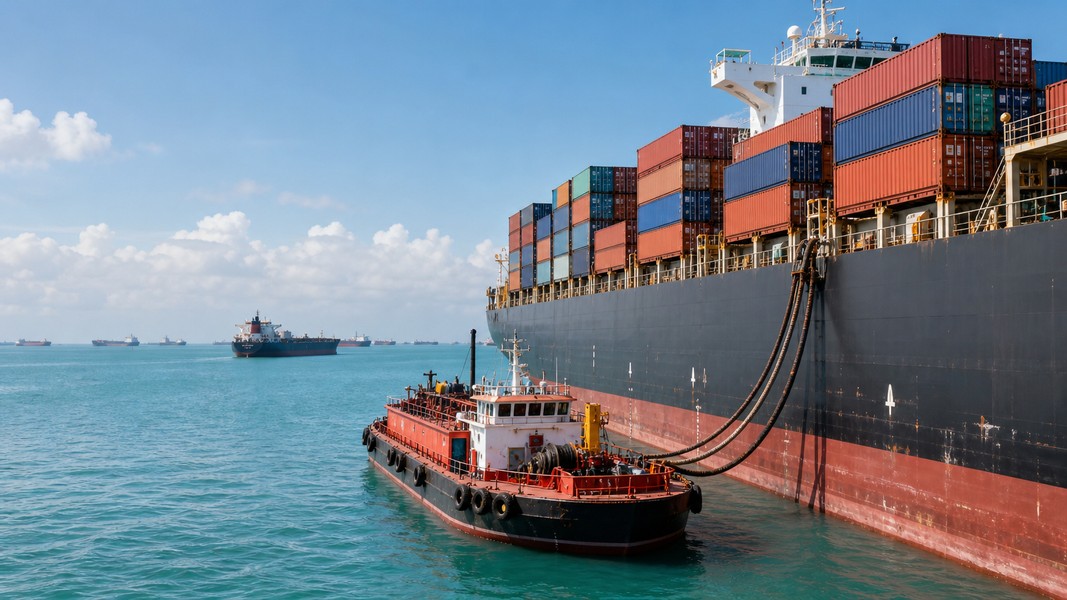
Bunkering is the act of refuelling a ship, and it rarely happens at a fuel dock the way a car fills up. In most major ports, a bunker barge comes alongside the vessel while it sits at anchor or at the berth, and fuel is pumped across through hoses. Large hubs also offer pipeline deliveries at the terminal, and some operators arrange ship-to-ship transfers offshore.
A typical bunkering operation follows a set sequence:
- The ship's chief engineer confirms the grade, quantity and tank plan with the supplier.
- The barge moors alongside, hoses are connected, and samples are drawn during the transfer.
- The quantity is measured, in Singapore by mandatory mass flow meters, and the bunker delivery note is signed.
- Retained samples are kept on board in case the fuel later proves off specification.
The world's biggest bunkering hubs
Singapore dominates the business. According to data from the Maritime and Port Authority of Singapore reported by Ship & Bunker, the port sold a record 56.20 million tonnes of marine fuel in 2025, up 3.2% on the previous record in 2024. Calls for bunkers rose 2.6% to 42,603, and bio-blended fuel sales jumped 55.6% to 1.36 million tonnes. Rotterdam and Fujairah are the other names you will hear most often.
Because ships refuel where fuel is cheap and plentiful, bunkering shapes routes. A ship may add a short call at Singapore purely to take on fuel, which shows up in its track as an unexplained stop near the anchorage.
What Drives Bunker Fuel Prices
Bunker prices are quoted in US dollars per metric ton and follow crude oil closely, with each port and grade trading at its own level. The spread between grades matters as much as the headline number, because it decides whether a scrubber pays for itself and how painful a switch to gas oil becomes.
For most of 2025 the market was calm. Ship & Bunker data puts the average Singapore VLSFO price at 507.5 dollars per ton in 2025, down from 610 dollars in 2024. That changed abruptly in early 2026.
The 2026 price shock
When the Iran war disrupted tanker traffic through the Strait of Hormuz, oil prices surged and bunker fuel followed. Researchers at the St. Louis Fed measured the jump: the average VLSFO price rose from 518 dollars per ton in February 2026 to 901 dollars across March to May, an increase of 74%.
Their analysis also showed how unevenly that shock landed. On a typical 21-day China to US West Coast voyage, fuel cost per 20-foot container rose from about 155 to 269 dollars on ships up to five years old, and from about 360 to 626 dollars on ships older than 20 years. Size mattered just as much. Post-Panamax vessels went from roughly 98 to 171 dollars per container, while small feeder ships went from 365 to 635 dollars.
The lesson is that the same fuel price hits a modern mega ship and an old feeder very differently. It is one reason carriers keep ordering the largest container ships they can fill.
Why Bunker Fuel Matters for Your Cargo
If you import goods by sea, bunker fuel reaches you through surcharges. Carriers pass fuel costs on through a bunker adjustment factor, usually called BAF, which is reset as fuel prices move. The St. Louis Fed estimated that the 2026 increase alone was worth about 228 dollars per 40-foot container for newer ships and about 532 dollars for the oldest, equal to roughly 12% and 28% of the Drewry World Container Index in February 2026.
Fuel prices also change how ships sail. When fuel is expensive, carriers slow their vessels down to burn less per day, a practice known as slow steaming. Slower sailing stretches transit times and pushes arrival dates back, even when nothing has gone wrong on the voyage.
That is where tracking the ship itself helps. A carrier portal tells you a planned date, while the vessel's live speed tells you whether that date is realistic. Primo Nautic shows each ship's current speed and course alongside two arrival estimates, the captain's reported ETA and a calculated route ETA, so a vessel quietly slow steaming shows up before your booking status changes.
What Comes After Oil-Based Bunkers
The fuel mix is starting to shift. LNG is the most established alternative, burned by dual-fuel engines that can also run on conventional oil, and methanol and ammonia ships are entering the fleet. You can read more about the engine side in our overview of dual-fuel ship engines.
Regulation will decide how fast that shift happens. The IMO Net-Zero Framework, approved in April 2025, would combine a global fuel standard with a price on greenhouse gas emissions for ships over 5,000 gross tonnage, which produce over 85% of shipping's emissions. According to the IMO's own FAQ, fuels with a greenhouse gas intensity of 19.0 gCO2eq/MJ or less, 80% below today's average of 93.3, would count as zero or near-zero.
A decision due in October
Adoption has stalled once already. In October 2025, member states voted 57 to 49, with 21 abstentions, to adjourn the decision for a year, and the session is due to reconvene in October 2026. Whatever the outcome, VLSFO and its blends will remain the main bunker fuel for the ships at sea today, because a vessel's engines are chosen for a working life measured in decades.
For enthusiasts, the fuel a ship burns is often visible in its design. LNG carriers and dual-fuel container ships carry large insulated tanks, and some cruise ships now advertise LNG propulsion openly. With Primo Nautic you can look up a vessel by name or IMO number and follow its route, which is an easy way to spot how often a ship calls at the big bunkering hubs.
Conclusion
Bunker fuel is the lifeblood of merchant shipping, and its story is mostly one of rules and prices. The name survives from coal bunkers on steamships, while the fuel itself has shifted from high sulphur residue to very low sulphur blends under IMO 2020, with gas oil required in emission control areas that now include the Mediterranean.
Singapore remains the centre of the trade, selling a record 56.20 million tonnes in 2025. Prices follow crude oil, and the 74% jump in early 2026 showed how quickly fuel costs spread into freight surcharges and slower sailings, hitting older and smaller ships hardest. The next change will come from the IMO Net-Zero Framework, whose fate is due to be decided in October 2026.
Most Recent Posts
Discover more articles from our blog.