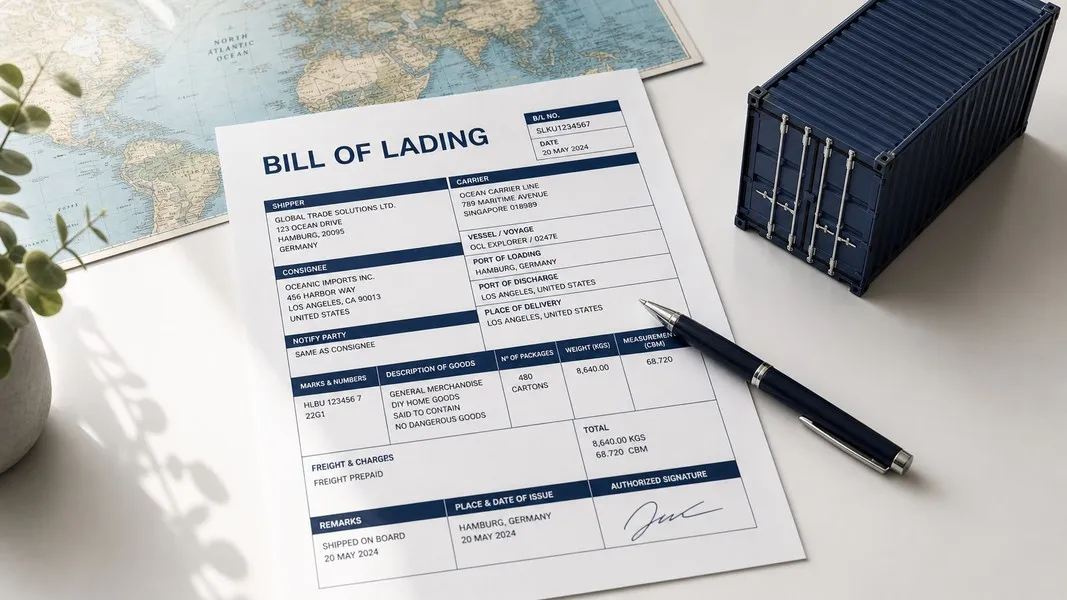
A bill of lading is a legal document issued by the carrier that serves as a receipt for your cargo, evidence of the contract of carriage, and, when negotiable, a document of title that controls who can claim the shipment at destination. Every ocean freight shipment, from a single container to a full vessel load, travels with a bill of lading.
If you've received one and aren't sure what it means, or if you're trying to use the reference numbers on it to track a shipment, this guide covers what a bill of lading contains, how to use it for tracking, and where carrier portals leave you in the dark.
What a Bill of Lading Is Used For
The bill of lading serves three distinct legal purposes, which is why it matters so much in international trade.
First, it's a receipt of goods. When the shipping line loads your cargo onto a vessel, they issue a "shipped on board" BL confirming what they received and its apparent condition. A clean bill of lading means no damage was noted. A claused or dirty BL records visible issues at the time of loading, which matters for insurance and payment disputes downstream.
Second, the BL is evidence of the contract of carriage. It documents the agreed route, the liability terms, and the freight conditions between the shipper and the carrier. These terms bind the shipping line to move your goods from the port of loading to the port of discharge.
Third, for negotiable BLs, it functions as a document of title. Whoever holds the original endorsed BL can claim the cargo at destination. As BIMCO notes, this makes the BL useful in trade finance: banks can hold it as security against a letter of credit, and ownership can transfer while the ship is still at sea simply by endorsing the document and passing it to a new party.
The Main Types of Bills of Lading
Not all BLs work the same way. The type issued for your shipment determines how cargo is released at destination and whether the document can be traded.
A straight bill of lading names one specific consignee and cannot be transferred. It's used when goods are already paid for or moving within a corporate group where title transfer isn't needed.
An order bill of lading is made out "to order" of the shipper or a bank. Because it's negotiable, it can be endorsed and transferred, which makes it standard in letter-of-credit transactions where payment and cargo release need to be linked.
A sea waybill is non-negotiable and not a document of title. No original needs to be presented at the destination port; the carrier releases cargo to the named consignee based on identity alone. This is faster for trusted trade flows where control over the title isn't the priority.
A telex release is what happens when a shipper surrenders original BLs at the port of origin and the carrier instructs its destination agent to release cargo without requiring paper originals. It's used when originals would arrive after the vessel, causing costly port delays and demurrage charges.
What's on a Bill of Lading
Understanding the fields on a BL matters most for tracking purposes. These are the key ones:
- BL number: The carrier's unique reference for this shipment. This is what you enter into carrier portals to get status updates.
- Vessel name and voyage number: The exact ship carrying your container and its scheduled rotation. This is the critical link between your BL and live vessel tracking.
- Port of loading and port of discharge: The seaports where your cargo is loaded onto and discharged from the vessel.
- Container number and seal number: The physical box ID and security seal, used to confirm your container's integrity on arrival.
- Consignee and notify party: The party authorized to receive the cargo, and any additional contacts to inform when the vessel approaches.
- Commodity description: What's being shipped, in what quantity, at what weight, and in what packaging.
The vessel name and voyage number are the fields most shippers overlook. They're not just for documentation; they're the identifier that connects your shipment to a specific, trackable ship.
How Carrier BL Tracking Works
Most shipping lines offer cargo tracking through their web portals when you enter the BL number. You get milestone updates: cargo received at origin, loaded on vessel, departed port, arrived at port of discharge, discharged, available for pickup.
This is genuinely useful for container ship tracking at the level of confirmed port events. It tells you the container is on board, arrived, or ready. The updates come from actual terminal and customs systems, so they're reliable when they appear.
For routine shipments between trusted partners, carrier portal tracking is often enough. Where it falls short is on longer ocean legs and on voyages where schedule accuracy matters.
What Carrier Tracking Doesn't Show You
Once your container is loaded and the vessel departs, the BL status typically freezes at "departed" until the ship arrives at the next port. On a transpacific route, that can mean several days with no update. During that window, you have no information about the vessel's actual position, whether it's running on schedule, or what conditions it's encountering.
Carrier tracking is built around port events, not vessel movement. This creates a practical problem for importers who need to schedule warehouse staff, book customs appointments, or notify buyers of an arrival window. A static ETA from the BL is an estimate based on the planned schedule. It doesn't adjust as the voyage unfolds.
Roughly 80-90% of world trade by volume moves by sea, according to UNCTAD. With that much cargo at sea at any given time, the visibility gap during the ocean leg is a significant operational problem for shippers managing tight delivery windows.
Vessel tracking apps address this by using IMO-mandated AIS transponders, which commercial ships use to continuously broadcast their position, speed, and navigation status. This data updates every few minutes, giving you continuous visibility rather than waiting for port events. Primo Nautic uses that AIS data to show a vessel's current position, calculated ETA based on actual speed and course, and live weather conditions at the ship's location.
From BL to Live Vessel Tracking
Here's where the vessel name and voyage number on your BL become the most useful fields on the document. They identify exactly which ship is carrying your container, which means you can find it in any AIS-based tracking app.
The process is straightforward. Find the vessel name on your BL, then search for that vessel by name in a tracking app. Within seconds, you can see its live position on a map. For an importer waiting on a shipment through Maersk container tracking, for example, this means seeing not just that the vessel departed Hamburg, but where it currently is in the North Sea, how fast it's moving, and what the weather looks like on that route.
Primo Nautic layers AI-generated context on top of raw AIS data: weather at the vessel's exact location, a dual ETA that compares the carrier's scheduled arrival against what the ship's actual movement suggests, and alerts when a vessel slows, diverts, or enters unusual conditions. This combination of BL-based carrier data and live vessel intelligence gives shippers a complete picture of where their cargo is and when it will realistically arrive.
The workflow is simple: use the BL number in the carrier portal for official milestone tracking, and use the vessel name from the BL in a tracking app for real-time visibility between those milestones.
Common Bill of Lading Mistakes That Affect Tracking
A few errors consistently cause tracking failures or cargo release delays.
Entering the wrong reference number is more common than it sounds. The BL number, the booking number, and the container number are three different identifiers that serve different purposes. Using the booking number where the portal expects the BL number returns no results. Check which reference the carrier's system requires before assuming the shipment is missing from the database.
An incorrect vessel name on the BL causes tracking to fail entirely. If the vessel was changed after the BL was issued and the amendment wasn't processed, you may be searching for a ship that never carried your container. Always compare the vessel name on your BL against the booking confirmation or shipping advice if you have any doubt.
A late-arriving original BL creates cascading delays at the destination. If the original reaches the port after the vessel does, the consignee can't take delivery while the container sits in the terminal accumulating demurrage. Requesting a telex release before the vessel sails avoids this, but the request must be coordinated between shipper, freight forwarder, and carrier before the cut-off.
Incorrect consignee details block customs clearance. Carriers release cargo to the party named on the BL; a discrepancy in spelling or address requires an amendment, which takes time and usually incurs a fee. When the consignee is a bank under a letter of credit, even minor differences can trigger a rejected presentation and delay payment.
What to Verify Before Your Vessel Departs
The best time to catch BL errors is before the ship sails, when amendments are still straightforward.
Check that the vessel name and voyage number on your BL match your booking confirmation. If a vessel change or additional transshipment was added to your routing, the BL should reflect the update. A BL showing the original vessel when your container is actually on a substitute creates immediate tracking confusion.
Confirm the BL number format works in the carrier's portal. Some carriers include a letter prefix; entering only the numeric portion returns no results. Test the reference against the portal before the vessel departs so you know the tracking number is correct.
Verify that the consignee name and address are exactly right, including any entity name differences between the BL and the letter of credit or commercial invoice. Banks and customs authorities compare documents precisely.
If you're working with a freight forwarder, confirm whether you'll receive a house bill of lading or a master bill of lading. Only one of those references will work in the carrier's official tracking portal, and mixing them up leads to failed searches.
Conclusion
A bill of lading is the foundational document in ocean freight. It proves the carrier received your goods, defines the terms of carriage, and for negotiable BLs, controls who can claim the cargo at destination. Its most useful fields for a shipper are the BL number for carrier portal tracking and the vessel name for live vessel tracking.
Carrier portals give you milestone data tied to port events. AIS-based vessel trackers give you continuous visibility on what the ship is actually doing between those events. Using both in combination gives you the most accurate picture of where your cargo is and when it will actually arrive.