




Helicopter assistance
Helicopter operations at sea
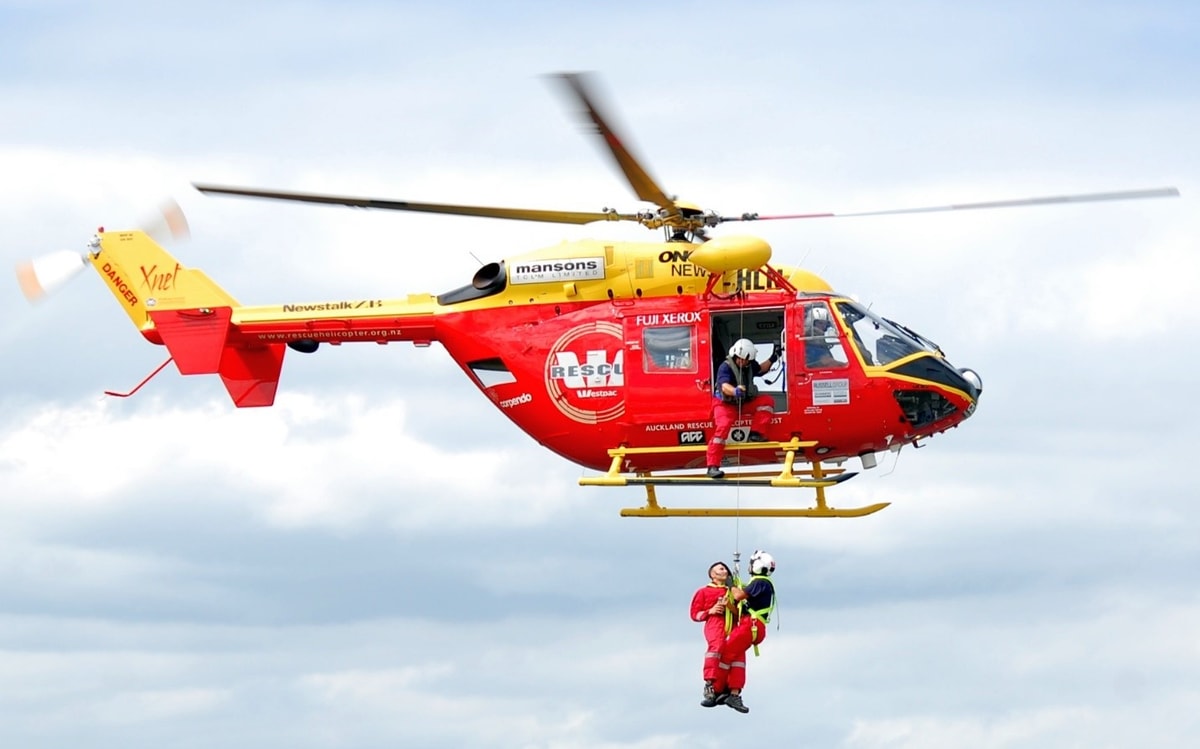
Aircraft are rarely used for rescue, but helicopters are a very good rescue tool. They can lift people from boats/rafts or even directly from the sea. They often transport rescued persons from lifeboats to the mainland.
When lifting people off a ship by helicopter, there helicopter-ship radio connection must exist. The radar antenna has to be switched off! When a helicopter is approaching the ship, the ship gives him information about the position, course, speed, weather, encounter time, mode of identification, etc. Communication mainly takes place at the aviation hazard frequency (121.5 MHz) or at the marine hazard frequency (156.8 MHz).
Lifting is handled by a technician, not a pilot. The helicopter approaches the stationary ship with the wind and the pilot's side facing the ship. If the ship is sailing, the helicopter approaches from the stern. The deck area should be cleared of all moving parts and other obstructions and marked with a yellow circle 5 m in diameter. At night the deck should be illuminated with floodlights. All persons involved in the lifting operation must wear lifejackets.
Special equipment such as a belt, basket, net, stretcher or seat is used to lift people into a helicopter or transport them but do not go inside the helicopter itself.
The belt is the most commonly used piece of equipment (fast, easy, safe). Lifting is managed by only one person! The person uses his body to signal whether everything is ready or not. If everything is not ready - hands are placed horizontally, thumbs down. Ready - raised arms and thumbs up. Pull up!