




Human relations on board
Transparent communication and cooperation

Good interpersonal relations are the basis of transparent communication and cooperation between the ship and the company. Some past experiences have taught us that the lack of open communication and cooperation within a shipping organization is directly related to external factors, specifically towards the shipping companies.
In the organization of the operation of ships and shipowners, the elements of coordination and extended responsibilities must undoubtedly be represented, which enables greater autonomy of the ship and its crew, and thus making the company unable to neglect their interests.
Basic requirements for teamwork

The very focus on contributing to collaborative work sets four basic requirements for the effectiveness of interpersonal relationships:
- communication
- teamwork
- personal development
- the development of others
Communication has been the focus of executives for the past twenty or more years. In the business of all major institutions, including maritime organizations and ships, people deal with communication issues extensively. The results have been generally very poor so far, no better than the situation of twenty or thirty years ago, when we first became aware of the lack of proper communication in modern organizations.
Teams are a relatively small group of people, of different profiles and personalities, who, in certain circumstances, find themselves in the same place and have a common goal, and it up to everyone in the team to make joint decisions. Within the team, everyone is equal, and the basis of teamwork is strong and open communication and complete independence of each individual member.
Self-development of an individual depends largely on the attention he/she is willing to give to it. One wonders about the contribution he can make to achieve the goals of his organization, basically wondering what kind of self-development he needs, what kind of knowledge and qualifications he needs to make the necessary contribution, what forces to employ and what standards he should set.
A manager who focuses on contributing stimulates others in their development, whether it be high-ranking employees or his colleagues. He does not set personal standards, but rather those that result from the requirements of the task being performed. At the same time, this is needed to achieve perfection, to strive for better, to set ambitious goals, to carry out work that will succeed.
People evolve according to the requirements they set for themselves, according to what they consider to be an achievement and an accomplishment. If they put small demands before themselves, they will lag behind in development. If they set high goals for themselves, they will develop in their domain the work they do.
Social structure and status
Social life takes place according to certain rules and patterns. This arrangement of society is called social structure. Through social structure, we participate in social life. Social structure is the ordering of social life, the course of social life according to certain rules and patterns.
Social structure:
- directs
- regulates
- limits
The most important elements of social structure are:
- social status
- social roles
- social groups
- social institutions
Modern societies cannot be imagined without many different institutions.
Institutions are systems of norms of values of social positions, organizational activities that enable members of society to achieve vital social goals.
Each social system is based on:
- values,
- standards
- roles
- Values are ideas on what to do and what to strive for.
- Group norms are norms that group members adopt as actual behaviour. They may or may not be in accordance with formally prescribed ones.
- Roles are the required or prescribed ways of behaving and carrying out work in specific workplaces or positions.
- The social structure is the orderliness of social life, by the occurrence of social life according to certain rules and patterns.
- Social status is a place an individual has in a social structure that refers to the category of people who perform similar functions. It is not the same as an occupation. An individual, in principle, has more than one social position (seafarer, neighbour, father, family, relative, son). Social positions are not only different but also differently ranked.
- Social status is a valued social position in a certain way. People with similar statuses most often hang out, have a similar mindset and a similar lifestyle.
- The social role is a set of norms, i.e. culturally and socially defined rights and obligations that relate to a social position.
Relationships on board
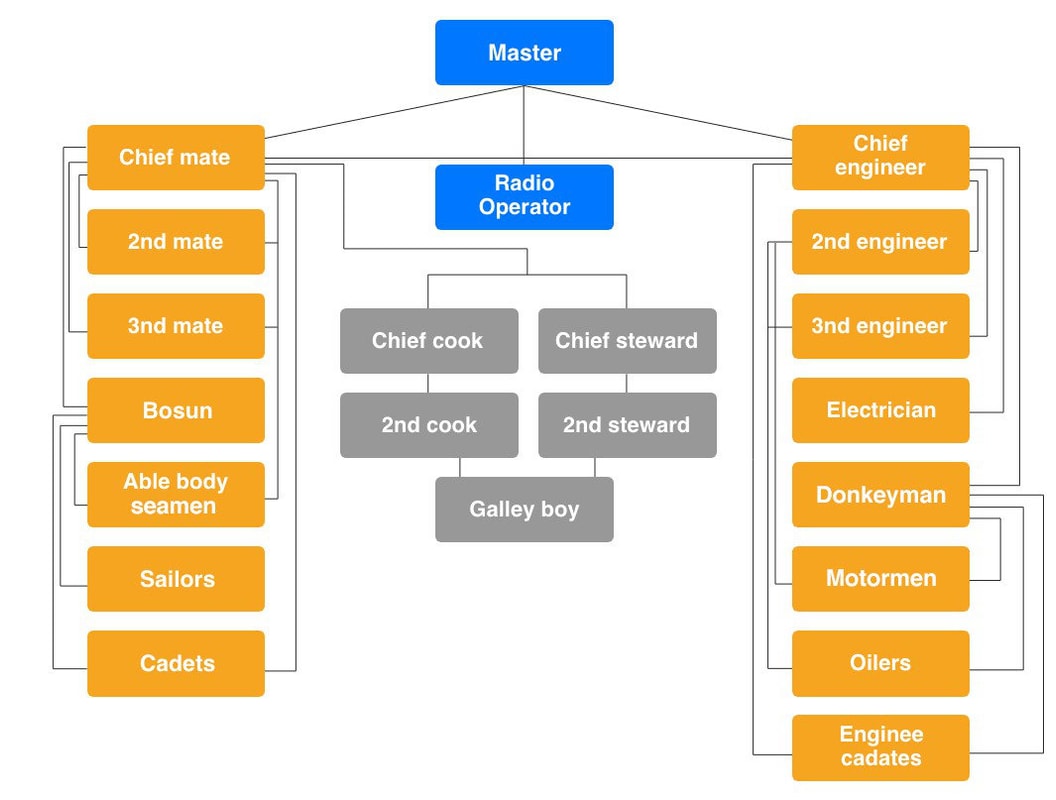
Relationships on board are governed by a hierarchy of commanding and executing roles within the ship. At the top of that hierarchy is the ship's master. Within the hierarchy there are three rounds of command and execution:
- gathered around the deck officer and the duty officer
- gathered around the machine manager
- gathered around the white staff or chef.
From a crew standpoint, the impetus for workflows comes from the first deck officer and the duty officer (most often the deck leader).
The ship's organization is integrated by the commander. He is the representative of the management of the company. Commanders tend to be in a compromising position between management and crew as they are often in a situation of division between their duties and people. They must look for good work and discipline on the one hand, and on the other hand understand the difficulties of the crew.
Commanders are third parties to the tension between management and crew, so most commanders rank their roles by weight:
- the role of organizers and supervisors
- the role of educators and counsellors
- the role of nautical experts.
There is a lesser hierarchy between officers and cooperation is more common. Cooperation exists between:
- deck staff
- machine personnel
- command bridge
- engine room.
Sometimes there are misunderstandings and clashes between the bridge and the engine room, but without cooperation, the ship's system would not be able to function.
Commanders believe that the best co-operation is on boarding and disembarking, poorer in maintaining the ship, and the poorest in operating the machine.
The reason for the lower cooperation between deck staff and machine personnel is that machinists think that everyone else is a layman for their job and that they have nothing to do in their domain which is wrong since their job does not have a technical side only.