


Atmosphere
Solar radiation
The sun is the closest star to us. Thermonuclear reactions create energy on it, which it emits into space. It is divided into corpuscular energy or particle radiation (0.2% of total energy) and electromagnetic wave energy (99.8%) which we call solar radiation. Corpuscular energy is variable. The Earth is protected from the radiation of particles by its magnetic field. Occurrence of aurora is a collision of solar radiation particles with atoms in the upper layers of the atmosphere. The most important part of solar radiation for meteorology is in the range of 0.2 to 4 mm, so solar radiation is said to be short wavelength. We divide it into ultraviolet (UV), visible (0.4 to 0.76 mm) and infrared part of the spectrum, i.e. thermal radiation.
Atmosphere: The Earths gas mantle
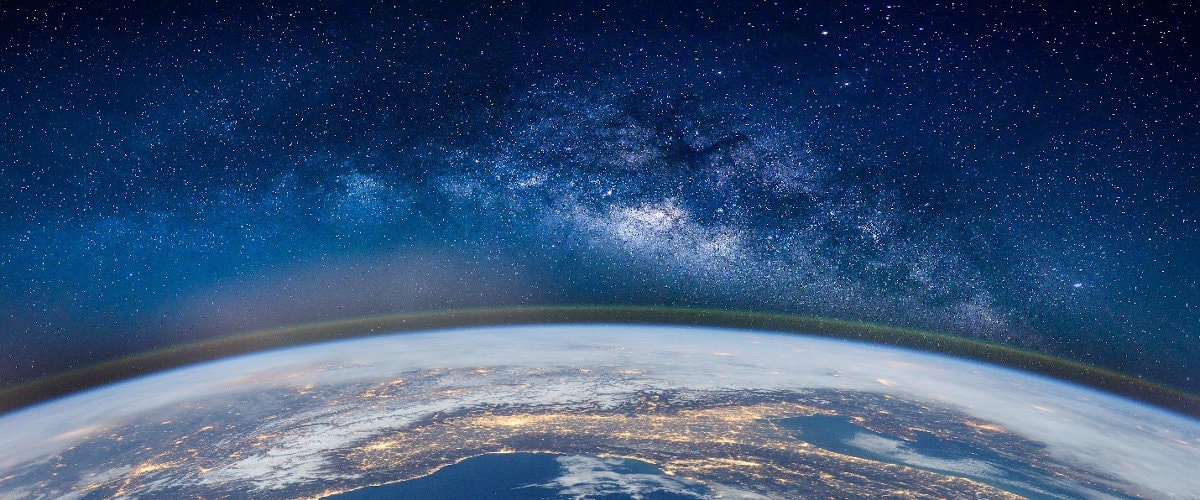
It protects the Earth from UV radiation, dangerous cosmic rays, overheating during the day and cooling at night, etc. The majority of the atmosphere is in the first 10 km, about 99% of the total mass of the atmosphere is in the lower layer up to a height of 30-35 km. Its mass is a million times less than the mass of the solid part of the Earth and 250 times less than the water envelope.
- Homosphere - the lower part of the atmosphere (up to 95 km), in which the ratio of basic gases is constant.
- Heterosphere - above the homosphere, where gas ratios are no longer constant.
Atmosphere composition
The Earth's atmosphere is composed of the following molecules: nitrogen (78%), oxygen (21%), argon (1%), and trace amounts of carbon dioxide, helium, methane, neon, krypton, hydrogen, nitrous oxide, iodine, xenon, ozone, carbon monoxide, and ammonia. Lower altitudes also have quantities of water vapor.
Ozone - less than 0.00001%, at sea level pressure it would form a layer 2-4 mm thick;
Aerosol - microscopically tiny solid and liquid particles, both natural and man-made, some aerosol particles form nuclei on which water droplets and ice crystals are formed - without them clouds or precipitation could not form;
- Natural aerosol: it can come from space (dust from meteorite remains) but is mostly blown by the wind from the Earth's surface (sea salt crystals, pollen, dust, spores, bacteria ...), in a cubic cm above the ocean there are approximately 1000, on at an altitude of between 4 and 5 km there are about a hundred of them;
- Aerosol created by human activity: dust, soot, smoke, ash, particles of light and heavy metals, cement, asbestos ... In large cities, there can be up to 10 to 6 floating aerosol particles.
Layers of the atmosphere
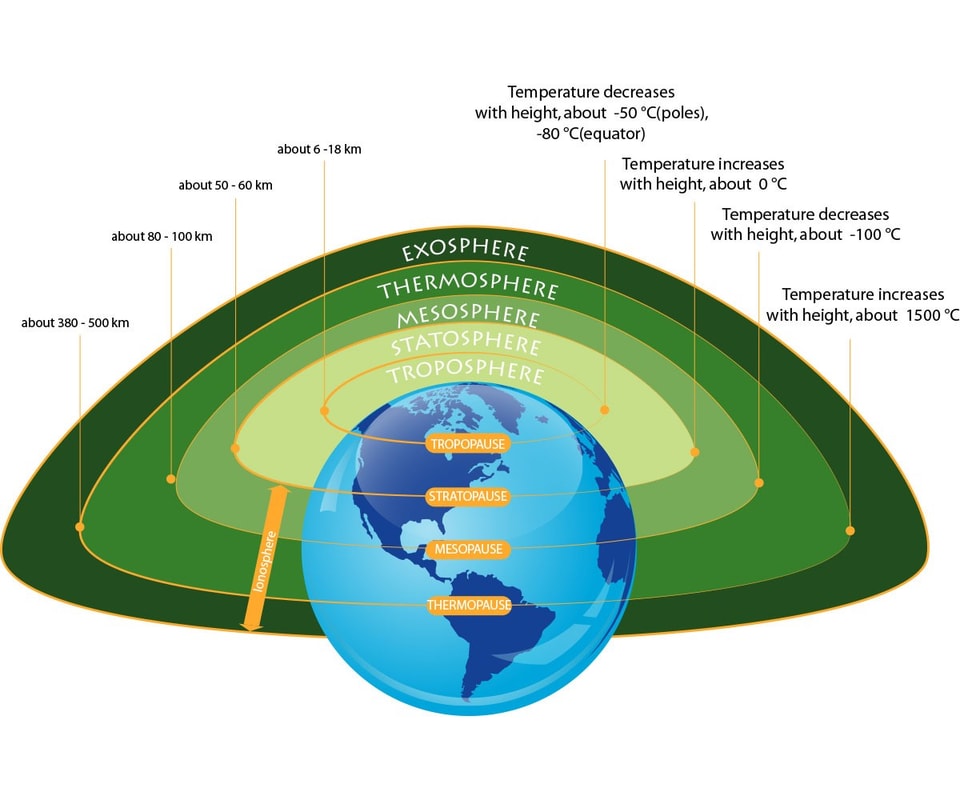
The atmosphere can be divided into individual spheres by various criteria. With regard to the chemical composition of the atmosphere, it can be divided into homosphere and heterosphere.
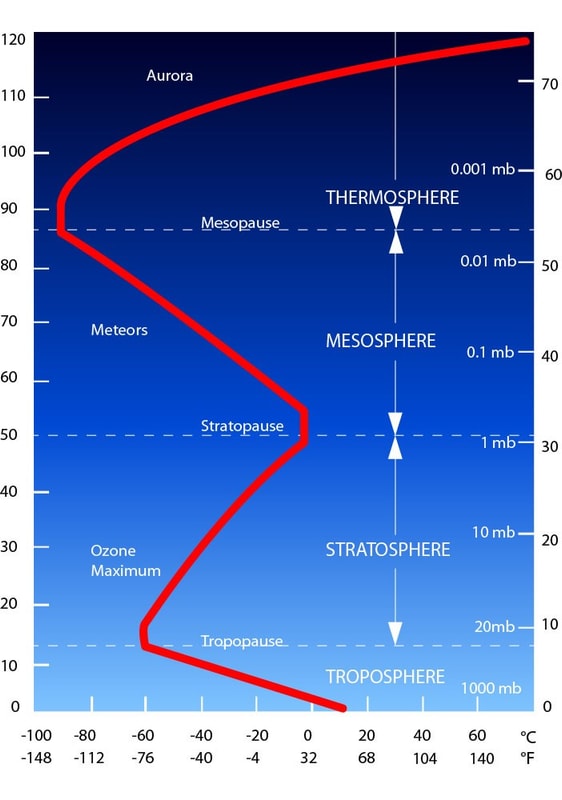
With respect to the temperature of the atmosphere, it can be divided into:
- The troposphere forms the lowest layer of the atmosphere. Also, it is the hottest and the densest part of Earth's atmosphere, whose height differs depending on whether it is measured at the Equator (16 - 18 km), over moderate widths (about 11 km) or at the Poles (8 - 10 km). Almost all water vapor is in the troposphere, so the clouds which provide precipitation are formed within the troposphere. The temperature decreases with height. All perceived weather changes happen in this sphere.
- The stratosphere is located above the troposphere. Between the troposphere and stratosphere is a transitional layer - tropopause (in it we do not have a change in temperature with height - isotherm, or the temperature rises very little). The layer which has the greatest ozone concentration is located at a height of 20-25 km. Ozone absorbs UV rays which make the air temperature rise. The air is diluted and has very few admixtures and water vapor, so the clouds causing precipitation are not formed within the stratosphere. In the stratosphere, there is no air lifting and lowering; only the horizontal wind blows. The stratosphere, together with troposphere, makes 99.9% of the total mass of the atmosphere. At the top of the stratosphere is stratopause, and the temperature does not change with height.
- The mesosphere comes after the stratosphere and is located at a height of 40 to 80 km. Here, the temperature reduces abruptly. It contains 99% of the remaining mass of the atmosphere. Extreme level clouds are located within the mesosphere - night clouds or noctilucent clouds (usually after a volcanic eruption - dust particles wrapped in ice).
- The thermosphere is located between 90 and 800 km of altitude. Here, the temperature during the day rises over 2000 ° C and falls to about 1000 ° C during the night. The thermosphere is composed of some very rare gases.