




Types of ships
Liners
Basic terms:
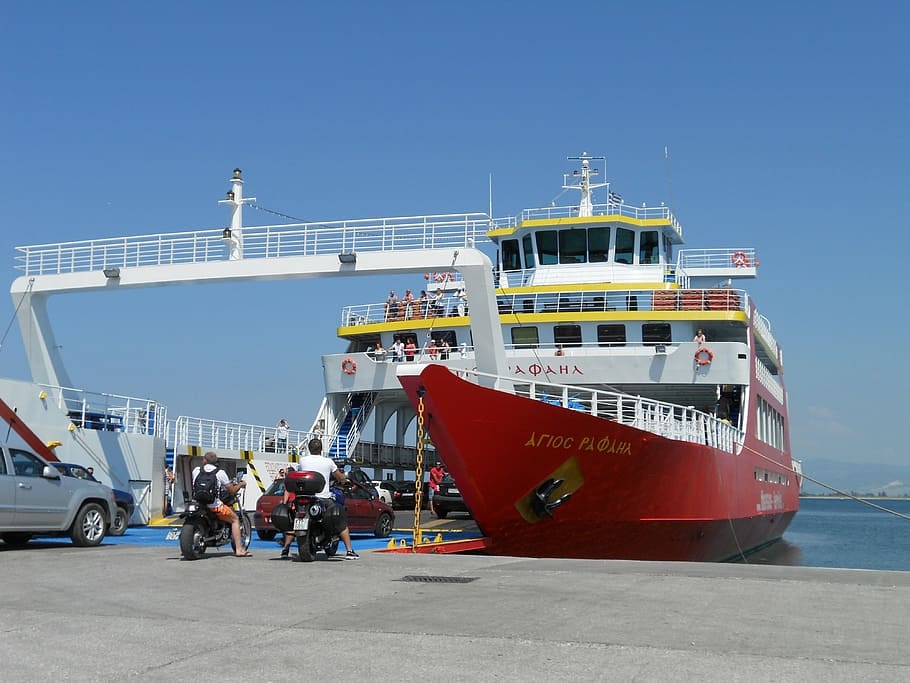
- liner - a vessel that operates on a regular scheduled service between groups of ports
- service - transporting goods by means of high-capacity, ocean-going ships that transit regular routes on fixed schedules (most providing weekly departures from all the ports that each service calls)
- accommodation - the act of providing with a room and food
- shipowner - a person who owns a ship or ships
- gear - implements, tools, or apparatus, especially as used for a particular occupation or activity
- general cargo - ordinary goods transported on a ship, aircraft, etc., rather than special goods like oil, food products, etc.
- fixed route - a form of transportation boat service without any regular deviation from schedules or course
- coastal trade - the transporting of goods or passengers by a ship registered in one country that takes place solely from port to port of another country
- deep-sea trade - the traffic routes of both cargo and passenger vessels which regularly operate on the high seas or on long voyages
- cargo handling - the activity of moving goods on and off ships, planes, trucks, etc.
- vehicle ferry - a boat that transports vehicles and passengers, usually across rivers or short stretches of sea
- sailing schedule - a list of ships that operate in a liner service, its voyage number for each call, the ETA and ETD dates and the ports of calls
Examples of use:
- Large liners from Liverpool, Southampton, London, Hamburg, Havre and Antwerp call regularly for passengers or cargo at Leixoes or Lisbon, or both ports, on their way to and from South America.
- These are vessels that operate on a regular scheduled service between groups of ports.
- A hotel, motel and inn are each an example of an accommodation for travellers.
- After an apprenticeship in a counting-house, he led a seafaring life for several years, and became a shipowner and merchant.
- The "Endeavour" struck heavily, and fell over so much that the guns, spare cables, and other heavy gear had at once to be thrown overboard to lighten the ship.
- Transporters are largely used for dealing with general cargo between vessels and warehouses, and also for coaling vessels; they have a great advantage in not interfering with the rigging of vessels.
- Such vessels operate on fixed routes, serving a group of ports and operate on fixed sailing schedules - the vessel departing whether she is full or not.
- In 1895 the quantity of rice exported in the foreign and coastal trade amounted to 1,419,173 tons.
- When it comes to dry bulk trades, some are short sea, meaning local, and others are deep sea, meaning international.
- Other services include general cargo handling, marine fuel product storage and wholesale electrical supplies.
Tramps
Basic terms:
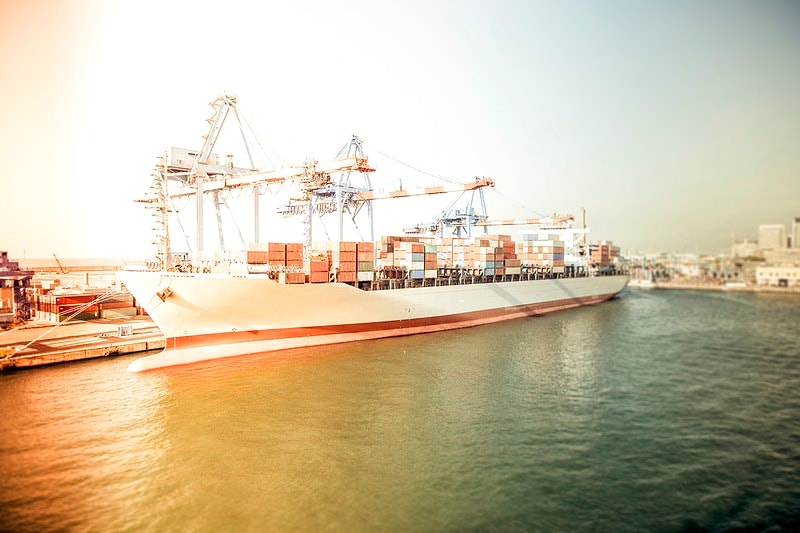
- tramp - or a general trader is a type of merchant vessel operating with no fixed route or published schedule
- bulk cargo - loose cargo (dry or liquid) that is loaded (shovelled, scooped, forked, mechanically conveyed or pumped) in volume directly into a ship';s hold (e.g., grain, coal and oil)
- shipload - as much cargo or as many people as a ship can carry
- conveyance - the action or process of transporting or carrying someone or something from one place to another
- charter party - a deed between a shipowner and a trader for the hire of a ship and the delivery of cargo
- draft - the depth of a loaded vessel in the water taken from the level of the waterline to the lowest point of the hull of the vessel; depth of water, or distance between the bottom of the ship and waterline
- beam - the overall width of the ship measured at the widest point of the nominal waterline
- deadweight tonnage - a measure of how much weight a ship can carry; the sum of the weights of cargo, fuel, fresh water, ballast water, provisions, passengers, and crew
Abbreviations:
- R.T. - gross register ton - a ship's total internal volume expressed in "register tons", each of which is equal to 100 cubic feet (2.83 m3)
- R.T. - net register ton - a ship's cargo volume capacity expressed in "register tons", one of which equals to a volume of 100 cubic feet (2.83 m3)
- Ft. - cubic feet (ft3)- an imperial and US customary (non-metric) unit of volume, used in the United States and the United Kingdom defined as the volume of a cube with sides of one foot (0.3048 m) in length
Examples of use:
- The collections comprise objects from all over Wales but there is a leaning toward Cardiff 's once-extensive tramp shipping industry.
- The first shipload of grain that came for the starving Irish was from India.
- Formerly of some importance, the harbour can no longer be entered by large vessels, and goods are transhipped into flat-bottomed lighters for conveyance
- A charter party often contains arbitration clauses which is usually incorporated into the bill of lading.
- Provided the ship is designed to float upright at the smallest draft with no load on board, the stability at any other draft of water can be arranged by the stowage of the weight, high or low.
- They conducted an experiment with a "Gull Wing" underwater shape for reduced waterline beam and low wetted area.
- Sailing ships of 200 tons register have given way to steamers up to 4000 tons register carrying a deadweight of nearly 8000 tons; and good order has succeeded chaos.
Liquid and dry bulk cargo ships
Basic terms:
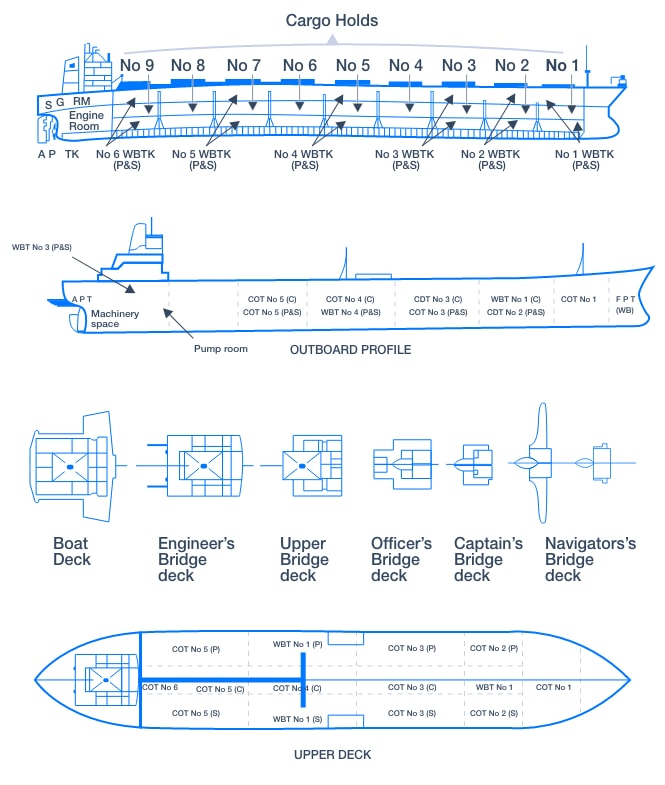
- tanker - a specialized cargo ship fitted with tanks for carrying liquid in bulk
- turn-round - time need to prepare a vessel or ship for a return trip
- return cargo - a cargo brought back in place of merchandise previously sent out
- chemical carrier - specialized vessels constructed to carry a cargo of noxious liquid substances in bulk
- product carrier - is an oil tanker engaged in the trade of oil other than crude oil
- dry bulk ships - ships used to carry solid dry goods that have a higher tolerance to heat and cold, such as metal ores, coal, steel products, forest products, and grains
- shipment - the action of shipping goods or a quantity of goods shipped; a consignment
- water ballast - fresh or salt water, sometimes containing sediments, held in tanks and cargo holds of ships to increase stability and manoeuvrability during transit
- cargo handling gear - equipment used for loading/discharging operations: e.g. cargo cranes, side-loading system with conveyors, side shifters, elevators, etc.
- barge carriers - a shoal-draft flat-bottomed boat, built mainly for river and canal transport of bulk goods.
Abbreviations:
LNG - liquefied natural gas - a natural gas that has been cooled down to liquid form for ease and safety of non-pressurized storage or transport
LPG - liquefied petroleum gas - a flammable mixture of hydrocarbon gases used as fuel in heating appliances, cooking equipment, and vehicles
F. - Fahrenheit - a temperature scale based on one proposed in 1724 by physicist Daniel used in the US, Cayman Islands and Liberia Gabriel Fahrenheit
OBO - oil bulk ore
d.w.t. - deadweight ton
Examples of use:
- Everyone can remember seeing photographs of oil covered birds following an oil tanker
- It is designed to deal with bulk liquid cargoes permitting quick loading and discharge, thereby ensuring the fast turn-rounds so essential to good utilization.
- Patent fuel is largely sent to South America, whence return cargoes of mineral ores and grain are obtained.
- A type 1 ship is a chemical tanker intended for the transportation of products considered to present the greatest overall hazard and type 2 and type 3 for products of progressively lesser hazards.
- As defined in MARPOL Annex II, chemical tanker means a ship constructed or adapted for carrying in bulk any liquid product listed in chapter 17 of the International Bulk Chemical Code.
- The average useful life of a dry cargo ship is between 20 and 25 years.
- The trimming system is operated by the flow of water ballast from tanks in either side of the ship.
- Cargo handling gear consisted of fourteen 5-ton cargo booms, plus two 30-ton booms at Nos. 3 and 4 hatches.
- Barge carriers vary in construction from LASH ships (lighter aboard ship), "Seabee", "bacat", etc.
Break bulk cargo ships
Basic terms:
- break bulk cargo - or general cargo are goods that must be loaded individually, and not in intermodal containers nor in bulk as with oil or grain
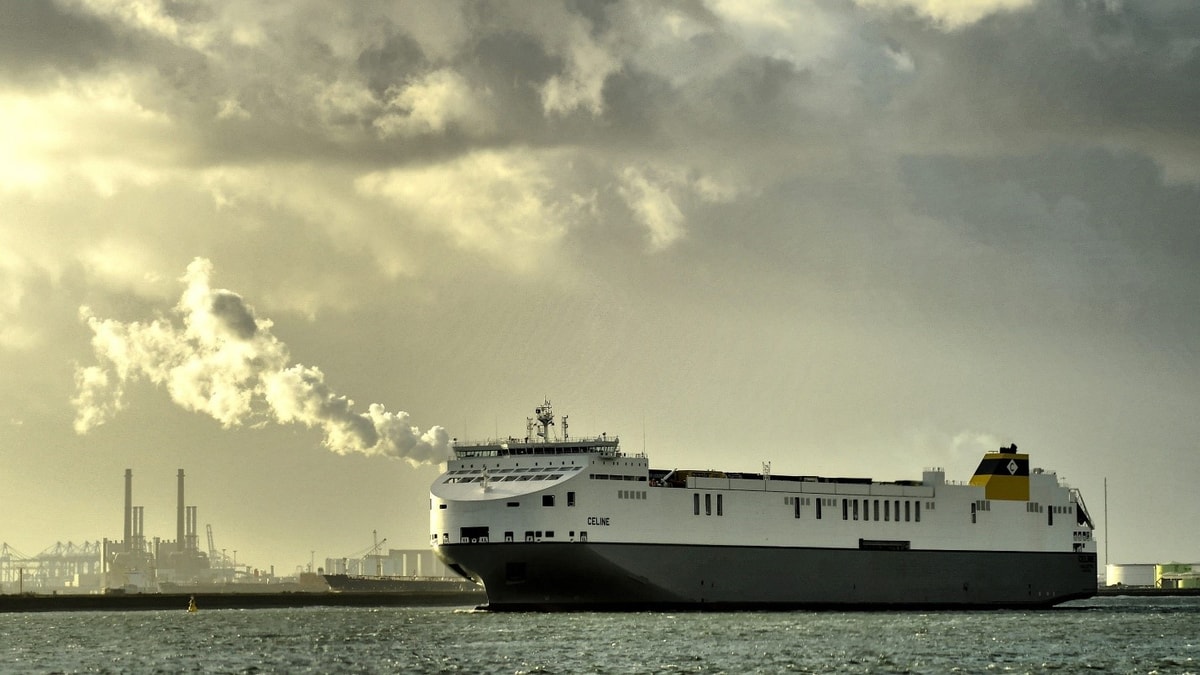
- roll-on/roll-off vessel - (RORO or ro-ro) cargo ships designed to carry wheeled cargo, such as cars, trucks, semi-trailer trucks, trailers, and railroad cars, that are driven on and off the ship on their own wheels or using a platform vehicle, such as a self-propelled modular transporter
- container vessel - cargo ships that carry all of their load in truck-size intermodal containers, in a technique called containerization
- fruit carrier - a refrigerated (reefer) ship equipped with a refrigerating system for carrying perishable goods (keeps them form over-ripening) such as apples, citrus fruits and bananas
- reefer ship - a refrigerated cargo ship, typically used to transport perishable commodities which require temperature-controlled transportation
- timber carrier - one-decked ships designed to carry logs and beams
- heavy lift ship - a vessel designed to move very large loads that cannot be handled by normal ships
Verb + noun collocations:
- to offer a service - an act of helpful activity or providing of utilities or commodities
- to eliminate cranage - eliminates the usage of a crane
- to reduce pilferage - diminishes theft
- to convey the cargo - transport goods
- to facilitate cargo handling - ease the processing of cargo
Examples of use:
- The volume of break bulk cargo has declined dramatically worldwide as containerization has grown.
- RORO ships have been increasing in size, and some ports have had trouble handling them because the harbours are not deep enough.
- Container ships are a common means of commercial intermodal freight transport and now carry most seagoing non-bulk cargo.
- The most noteworthy characteristic about the fruit carrier is the storage module devised to successfully transport the intended cargo.
- The future is more than uncertain for reefer vessels, as refrigeration now takes place in the containers.
- In the fifties, a large series of sea-going cotton/timber carriers was built on the basis of projects prepared by the Design Office. These ships operated at the Black, Mediterranean and Red seas.
- These heavy-lift ships differ in size and in the methods of handling the cargoes, but by using either roll-on/roll-off methods or special heavy-lift gear these vessels can handle unit loads weighing from 500 to 1,000 tons.
Specialized craft
Basic terms:
- tug - also known as a tugboat is a boat that manoeuvres vessels by pushing or towing them
- towing hook - a device created primarily to enable a quick connection to a tow, and secondly to reduce the heeling moment on the tug during ship handling
- towline - a line, hawser, or the like, by which anything is or may be towed
- fittings - pieces of equipment which are fixed to something but which can be removed if necessary
- towbeam - the transverse, curved steel hoops (also known as strongbacks) which are fitted so that the towline does not foul the after-deck fittings
- salvage tug - a specialized type of tugboat which is used to rescue ships which are in distress or in danger of sinking, or to salvage ships which have already sunk or run aground
- distress signal - also known as a distress call, is an internationally recognized means for obtaining help
- disabled ship - a damaged or impaired vessel not able proceed by its own
- controllable pitch propeller - a type of propeller with blades that can be rotated around their long axis to change the blade pitch
- Kort's nozzle - also known as a ducted propeller is a marine propeller fitted with a non-rotating nozzle
- oil rig supply vessel - or a platform supply vessel (PSV) is a ship specially designed to supply offshore oil and gas platforms
- offshore rig - an oil platform, offshore platform, or offshore drilling rig is a large structure with facilities for well drilling to explore, extract, store, and process petroleum and natural gas that lies in rock formations beneath the seabed
- icebreaker - a special-purpose ship or boat designed to move and navigate through ice-covered waters, and provide safe waterways for other boats and ships
- dredger - a vessel equipped for the removal of sand or sediment from the seabed
- grab/bucket dredger - a form of a pontoon with a slewing and hoisting crane capable of operating a double-chain grab
- pontoon - a flattish boat that relies on floats to remain buoyant
- slewing/hoisting crane - a crane that can lift its load, suspend it in mid-air, and then rotate it via a boom rotating mechanism
- hopper - dredgers that are generally used for maintenance dredging and in particular small-scale applications for port authorities
- barge - a shoal-draft flat-bottomed boat, built mainly for river and canal transport of bulk goods
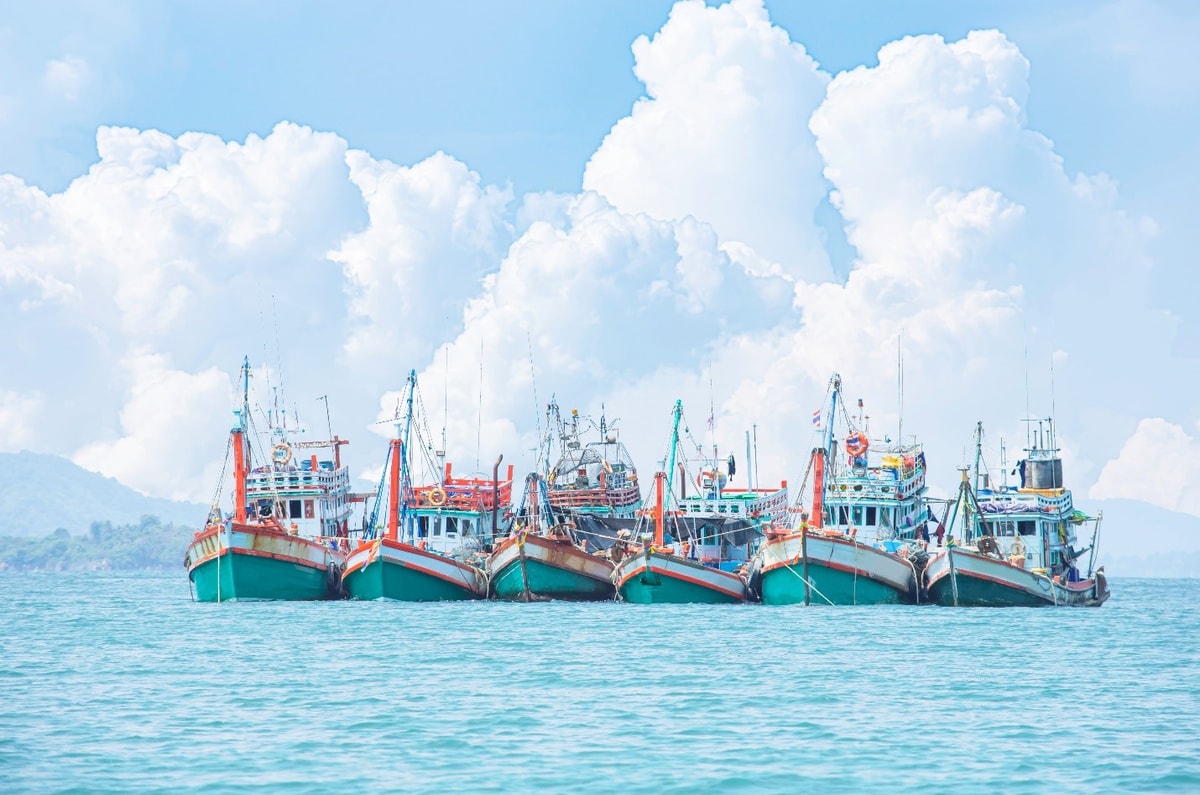
- trawler - a commercial fishing vessel designed to operate fishing trawls
- sturdy vessel - strong ship that is unlikely to be easily damaged
- the catch - the total number of fish caught
- fish factory ship - also known as a fish processing vessel, is a large ocean-going vessel with extensive on-board facilities for processing and freezing caught fish or whales
- seiner - a specialized vessel for seine-haul fishing (seine is a fishing net that hangs vertically in the water with its bottom edge held down by weights and its top edge buoyed by floats)
- craft - a boat of smaller size than a ship (mostly engaged in loading or unloading of other vessels, as lighters, hoys, and barges)
Examples of use:
- Five tugboats hauled the tanker off the rocks and into deeper water.
- The fixed or spring-loaded towing hook is at the after end of the superstructure.
- Captain Hiller quickly backed the ship, and the cable was paid out to reduce towline
- Towbeams are fitted so that the towline does not foul the after-deck fittings.
- Dreadnought's anchor had come up easily enough when the salvage tug came to dispose of her.
- Send out a distress signal; the ship is sinking!
- When a distress call is received, the tug and others who have heard the signal, race to the disabled ship to compete for the salvage work.
- The blade angle of controllable pitch propeller should be examined and adjusted.
- The grab dredger is in its simplest form a pontoon with a slewing and hoisting crane capable of operating a double-chain grab.
- The bucket ladder has no hopper space, so the spoil must be transferred to hopper barges
- The trawler had been fishing five miles off the coast in international waters but within the prohibited area.
- The trawler must be a strong, sturdy vessel to be able to work in the worst of weather.
- The catch included one fish over 18 pounds.
- The seine net is short, and hauled in, over the stern of the seiner.
- Hundreds of small craft accompany the liner into harbour.