




Ships and ship terms
Ship design and construction
Basic terms:
- hull - the watertight enclosure (the actual shell) of the ship, which protects the cargo, machinery, and accommodation spaces of the ship from the weather, flooding, and structural damage
- machinery - the engines required to drive the ship, as well as all the additional equipment serving the electrical installations, winches and refrigerating plant
- stern - also known as the after end, is the rear (back) portion of the ship
- bow - the forward part of the hull of a ship or boat, the point that is usually most forward when the vessel is underway
- amidships - in or toward the part of a ship midway between bow and stern
- beam - the overall width of the ship measured at the widest point of the nominal waterline
- engine room - the compartment where the machinery for marine propulsion is located
- propeller shaft - a shaft (long pole) that transmits power from an engine to a propeller
- bow thruster - an auxiliary propulsion device at the bow of a ship to aid in manoeuvring
- rudder - a device used for steering and manoeuvring a vessel
- bulbous bow - a protruding (sticking out) bulb at the bow (or front) of a ship just below the waterline
- hold - or cargo hold is a space for carrying cargo (load)
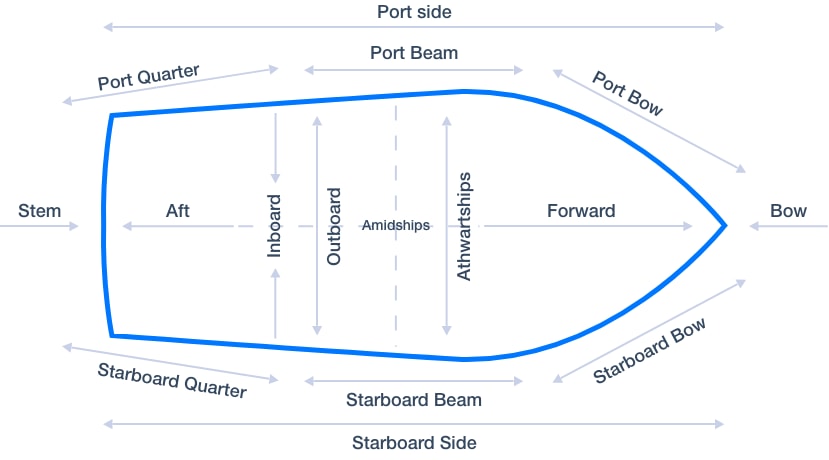
Examples of use:
- The trimaran hull form permits the ship to carry a large capacity of weapons packages with space to land two helicopters.
- An increasingly effective Union blockade reduced the availability of ships' machinery and even such items as nails and spikes.
- About 60m behind the keel at the stern end, the ship is completely severed in half.
- With his left hand, he gestures toward the stern of a ship at sea.
- Breakers suddenly loomed up on the starboard bow, and before the ship could turn she was ashore.
- Buoy line is attached at the point where the forward section of the ship has broken from the bow.
- The damage from hitting the iceberg head on was at the bow rather than Amidships section to the port side is a lone sanitary area.
- Themaximum beam(BMAX) is the distance between planes passing through the outer extremities of the ship.
- At the far end stood a fourth watertight bulkhead, separating the crew's quarters from the engine room.
- Each set consisted of one high-pressure and one low-pressure turbine driving one propeller shaft.
- They have a bow thruster for manoeuvring in crowded anchorages and channels.
- Rigging was certainly an important element and there are indications that stern rudders and the construction of the hull had an impact as well.
- The work included extensive model testing, which resulted in the adoption of a bulbous bow that alone increased the ships' service speed by 0.5 knots.
- It was found that water was leaking into the main cargo hold.
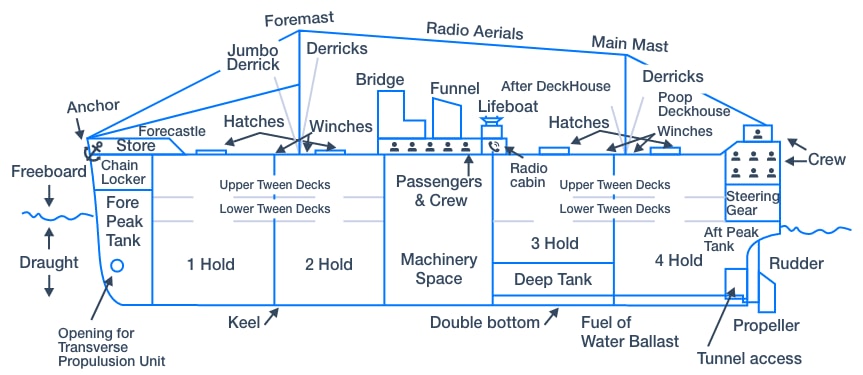
Structural members of a ship
Basic terms:
- shell plating - the outer-most structure on the hull of a steel or aluminium ship or boat
- strake - horizontal row of plating of the hull of a vessel
- keel - the bottom-most structural member around which the hull of a ship is built
- deck - a permanent covering over a compartment or a hull of a ship where the crew stand and walk on (the floor)
- tank top - the top of a ship's bilge tank, usually the lowest horizontal surface on board
- floor - the transverse stiffeners mounted vertically on the ship's bottom (unlike structures on land where a floor refers to something horizontal that you can stand on)
- stringer - a fore-and-aft girder running along the side of a ship at the shell and also to the outboard strake of plating on any deck
- buoyancy - the upward force of all the hydrostatic pressures on the hull
- strength - the quality or state of being strong, firmness
- stability - the ability of a ship to float in an upright position and, if inclined under action of an external force, to return to this position after the external force
- bulkhead - a structure used to protect against shifting cargo and/or to separate the load
- compartment - a portion of the space within a ship defined vertically between decks and horizontally between bulkheads
- stem - the most forward part of a boat or ship's bow and is an extension of the keel itself
- frame - in ships, frames are ribs that are transverse bolted or welded to the keel
- beam -; the ship's width at its widest point
- bracket - plates at the port and starboard ends, with struts that support the tank top with the bottom shell
- girder - a longitudinal member used in the construction of the bottom of a ship
- stern post - the upright structural member or post at the stern of a (generally wooden) ship or a boat
- stiffener - one of a series of angle-bars, Z-bars, or other shapes, riveted to plating, particularly to the plating of bulkheads, to give them the necessary stiffness or rigidity
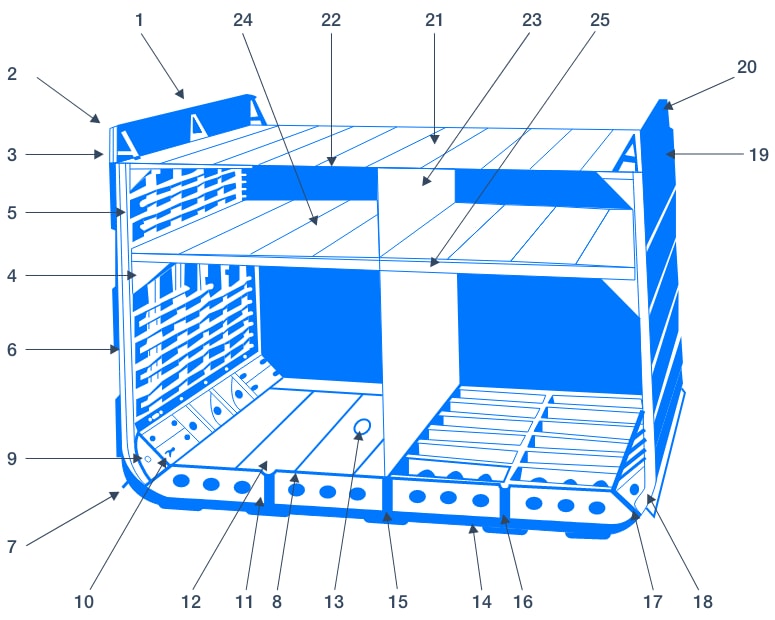
- 1. bulwark rail
- 2. bulwark stay
- 3. spur
- 4. beam knees
- 5. spar ceiling
- 6. frame
- 7. bilge keel
- 8. reverse frame
- 9. lightening hole in tank side bracket
- 10. limber boards
- 11. floor
- 12. tank top plating
- 13. manhole cover
- 14. garboard strake
- 15. keel plate
- 16. intercostal
- 17. margin plate
- 18. bilge strake
- 19. sheer strake
- 20 bulwark
- 21. upper deck plating
- 22. upper deck beam
- 23. centreline bulkhead
- 24. main deck plating
- 25. main deck beam
Examples of use:
- The strakes were enclosed by transverse bulkheads of the same thickness.
- A steel keel provides an added moment to maintain the vehicle in an upright pose.
- We sat on deck until it was dark.
- The water tanker version lacks the raised cargo expansion tank top amidships, and both can carry 600 tons of cargo.
- In smaller ships, the plate floors themselves act as the stiffening members of the bottom shell plating.
- One of the locations where stringer is mostly used is the forward part of the ship.
- Flotation suits are very popular now with boat anglers and have benefits of limited buoyancy and warmth.
- This suggests that I want a boat with a reserve of secondary stability and a low windage for longer trips.
- At the far end stood a fourth watertight bulkhead, separating the crew's quarters from the engine room.
- These might be detected by any other ships furnished with two plates dipping into the sea at stem and stern.
- A frame used to support a weight is often called a truss; the stresses on the various members of a truss can be computed for any given load with greater accuracy than the intensity of stress on the various parts of a continuous structure such as a tubular girder, or the rib of an arch.
- There are four cables, one on each side of the two main trusses or stiffening girders.
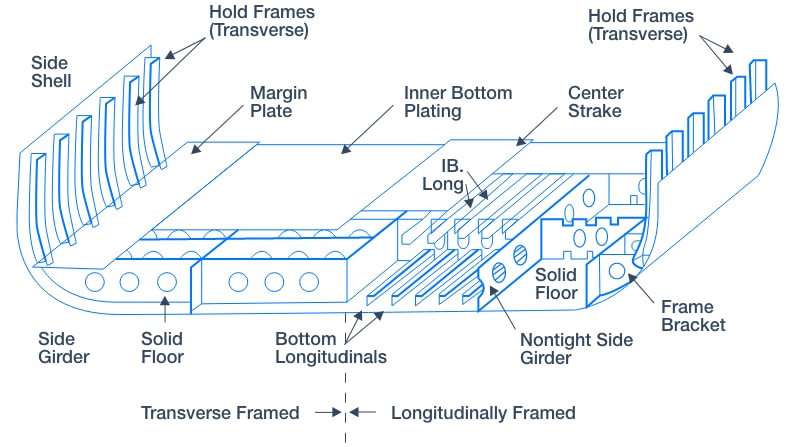
Ship’s equipment
Basic terms:
- cargo gear - equipment used for the handling of cargo
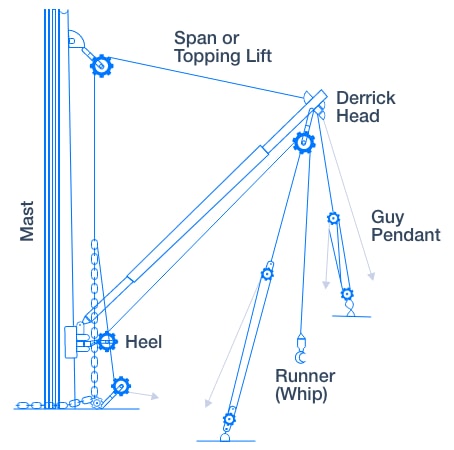
- derrick (ship's crane) - a lifting device composed at minimum of one guyed mast, as in a gin pole, which may be articulated over a load by adjusting its guys
- lifting capacity - the maximum weight that can be safely lifted or carried by a person or machine
- winch -; a mechanical device that is used to pull in (wind up) or let out (wind out) or otherwise adjust the tension of a rope or wire rope
- shore crane - a type of large dockside gantry crane found at container terminals for loading or unloading cargo
- mast - a tall spar, or arrangement of spars, erected more or less vertically on the centre-line of a ship or boat
- bridge - the room or platform from which the ship can be commanded
- crew accommodation - crew cabins usually located on deck 0, or below the sea level - deck A and B
- life-saving apparatus - appliances that protect human life at sea
- **draught - (**of a ship's hull) is the vertical distance between the waterline and the bottom of the hull (keel)
- waterline - the line where the hull of a ship meets the surface of the water
- freeboard - the distance from the waterline to the upper deck level, measured at the lowest point of sheer where water can enter the boat or ship
- samson post - a post resting on the keelson and supporting a deck beam of a ship
Examples of use:
- The handling of cargo is carried out either by the ship's own cargo gear or by shore cranes.
- Derrick cranes are made of all powers, from the timber I-ton hand derrick to the steel 150-ton derrick used in shipbuilding yards.
- The maximum lifting capacity is just over two tons.
- The line is hauled in by a steam or electric winch, and the sounding-tube containing a sample of the bottom deposit is rapidly brought on board.
- The lowest sail on a mast of a square-rigged ship.
- The bridge of a vessel is the navigating centre of the ship where her course is determined.
- At the head of an excellent harbour, a deep inlet about a mile long, available for ships of the deepest draught.
- Waterline length was more than 13 times the depth of the hull.
- Small vessels, with thin masts, light rigging & sailcloth, & a lower freeboard need less wind & smaller waves.
- In the old days when it was normal to cat anchors before they were let go or on weighing, a samson post was a post erected temporarily on deck to take a tackle with a sufficiently long lead for the whole crew to man the fall.