

7 Types of Ship Anchors and Their Uses Explained
An anchor is one of the most essential pieces of equipment on any vessel - yet most people don't know there are multiple types, each designed for different seabeds, vessel sizes, and purposes.
This guide covers the 7 main types of ship anchors used in maritime operations, how each one works, and the factors that determine which anchor to choose.
Why Anchor Type Matters
Not all seabeds are the same. Sand, mud, rock, and coral each behave differently when an anchor digs in. Using the wrong anchor type can mean the difference between holding position safely and dragging across the bottom in a strong current.
Anchors also vary by vessel size. A small recreational boat uses a different anchor than a supertanker. Getting the match right between anchor design, seabed type, and vessel weight is fundamental to safe seamanship.
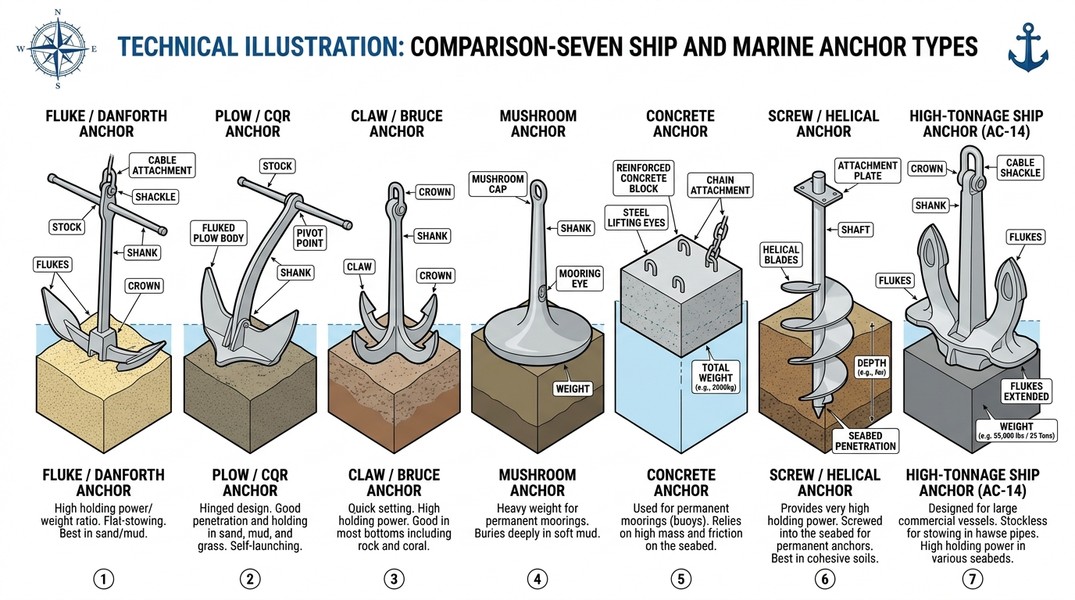
7 Types of Ship Anchors
1. Fluke Anchors (Danforth Anchors)
Fluke anchors - also called Danforth anchors - are lightweight anchors with two large, flat flukes attached to a central shank. When deployed, the flukes dig into soft seabeds and provide strong holding power relative to the anchor's weight.
How they work: As the anchor is pulled horizontally by the chain or rode, the flukes dig deeper into the seabed. The angle of the flukes is fixed to maximize penetration in sand or mud.
Best for: Small to medium recreational boats, sailing dinghies, and powerboats. Performs best in sandy or muddy seabeds. Not reliable in rocky or weedy bottoms.
Limitation: The rigid fluke design can fail to reset if the wind or current changes direction sharply.
2. Plow Anchors (CQR Anchors)
Plow anchors get their name from their curved, plow-like shape. A hinged joint between the shank and the plow head allows the anchor to rotate and reset if the vessel swings around - making it one of the most popular all-around anchors for cruising yachts.
How they work: When deployed, the plow digs into the seabed and pivots to align with the direction of pull. If the boat swings as wind direction changes, the plow resets itself rather than dragging.
Best for: Cruising yachts, medium-sized sailboats, and motor yachts. Works well in sand, mud, clay, and gravel.
Limitation: Heavier than a fluke anchor of equivalent holding power, which matters for storage on smaller boats.
3. Claw Anchors (Bruce Anchors)
Claw anchors, originally designed for North Sea oil platforms, feature three broad curved prongs that grip into almost any type of seabed. Their design provides reliable hold even on rocky or uneven bottoms where other anchors struggle.
How they work: The claw shape spreads the load across a wider area and grips seabeds that a single-point anchor would slip off. Like plow anchors, claw anchors also reset well when the boat's heading changes.
Best for: Larger recreational vessels, offshore powerboats, and situations where seabed type is uncertain or variable.
Limitation: Bulky and difficult to store on bow rollers designed for other anchor types.
4. Mushroom Anchors
Named for their distinctive shape, mushroom anchors consist of a heavy, rounded head on a short shank. Rather than digging in with flukes, a mushroom anchor works by sinking into soft seabeds - the weight and suction effect provide the hold.
How they work: Over time, a mushroom anchor settles deeper into soft mud or silt, creating significant suction resistance to dragging. This makes them extremely reliable for permanent installations, but slow to establish initial holding power.
Best for: Permanent moorings in marinas, lakes, and harbors with soft mud or silt bottoms. Also used for mooring buoys and floating docks.
Limitation: Not suitable for temporary anchorage - they take time to establish full holding power and are difficult to retrieve once well-set.
5. Concrete Anchors
Concrete anchors are purpose-built for permanent installation. Cast from reinforced concrete, they rely entirely on mass for their holding power rather than shape or penetration.
How they work: Pure weight. A concrete anchor does not dig into the seabed - it simply sits on the bottom and resists dragging through its sheer mass.
Best for: Permanent moorings, floating dock anchors, and harbor installations. Ideal where weight is no concern and removal is not planned.
Limitation: Heavy, not portable, and ineffective in strong currents where a grip-style anchor would hold better.
6. Screw Anchors (Helical Anchors)
Screw anchors look exactly like oversized screws or bolts. They are driven - literally screwed - into the seabed using hydraulic equipment, creating a grip that can withstand very high loads.
How they work: The helical shape of the anchor blade allows it to thread into the seabed. Once installed, it resists both vertical and horizontal forces - useful in tidal or current-heavy locations.
Best for: Offshore mooring systems, underwater construction, and offshore renewable energy installations. Also used in harbor and marina permanent mooring systems.
Limitation: Requires specialized installation equipment. Not a manually deployed anchor.
7. High-Tonnage Anchors
High-tonnage anchors are the heavy-duty anchors used on large commercial vessels: container ships, bulk carriers, tankers, and cruise ships. These anchors may weigh several tons and are designed to hold vessels of thousands of tonnes in open water.
How they work: Similar in principle to plow or claw designs, but engineered at a scale that allows them to hold enormous vessels in strong winds and currents. They are deployed by chain rather than rope rode, with chain weighing thousands of kilograms providing additional holding power through its own weight.
Best for: Large commercial ships, oil tankers, and ocean-going vessels operating in exposed anchorages.
Limitation: Not relevant for recreational use. Handling requires specialized ship equipment.
How to Choose the Right Anchor
Choosing the correct anchor depends on four factors:
1. Vessel size and weight Larger, heavier vessels need anchors with higher holding power ratings. Anchor manufacturers publish holding power ratings (in kilograms or pounds) for each model and size - match the anchor's rating to your vessel's displacement.
2. Seabed type Sandy and muddy seabeds suit fluke and plow anchors. Rocky or gravel seabeds require claw anchors. Soft mud and silt favor mushroom anchors for permanent installations. If you're anchoring in an area where the seabed type varies or is unknown, a claw or plow anchor is the safest choice.
3. Duration of anchorage For temporary stops - overnight or a few hours - any grip-style anchor (fluke, plow, claw) is appropriate. For permanent moorings, mushroom or concrete anchors are preferred.
4. Local wind and current conditions In high-current areas or exposed anchorages, choose an anchor with high holding power and good reset ability (plow or claw) rather than a lighter fluke anchor.
For anyone interested in tracking ships and understanding maritime operations, read our guide to key parts of a ship and our overview of types of ships.
Most Recent Posts
Discover more articles from our blog.