


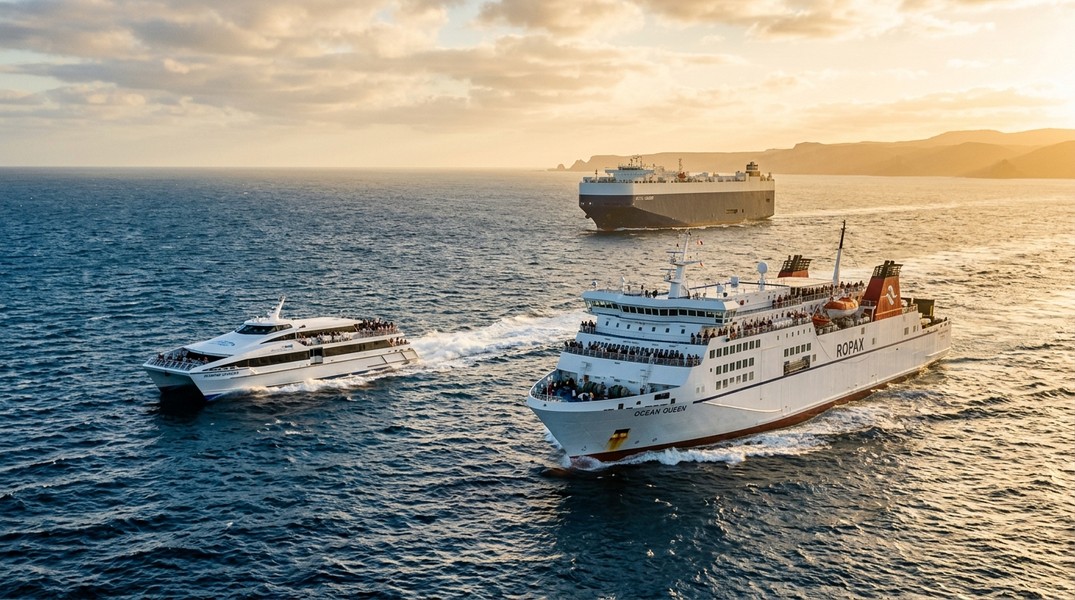
9 Types of Ferries: Ro-Ro, ROPAX, Catamaran and More
Ferries are the quiet workhorses of the maritime world. They don't command the headlines that supertankers or giant container ships do, but they move hundreds of millions of passengers and countless vehicles across rivers, straits, and open seas every single year. From the short hop across a Norwegian fjord to the overnight crossing of the Adriatic, ferries connect people and places in ways that bridges and tunnels simply cannot. There are more than 3,000 ferry vessels operating in Europe alone, and the global industry is undergoing one of its biggest transformations — driven by electrification, decarbonisation, and rapidly growing demand in Asia and the Pacific. But "ferry" is a broad term. Walk into any port and you might board a sleek catamaran, a drive-on/drive-off car carrier, or a double-ended vessel that looks the same from both ends. Each type has a different design, purpose, and set of capabilities. This guide breaks down every major type of ferry, how each one works, and where you're most likely to encounter them.
What Makes a Vessel a Ferry?
A ferry is a vessel that carries passengers, vehicles, or both on a scheduled service between two or more fixed points. Unlike cruise ships, which are about the journey itself, ferries exist to get people and cargo from A to B efficiently and reliably. What distinguishes ferries from other commercial vessels is their operating pattern: regular routes, defined terminals, and continuous turnaround. A ferry that crosses the Dover Strait might complete more than 20 round trips in a single day.
Types of Ferries
Ro-Ro Ferries
Ro-Ro stands for Roll-On/Roll-Off — a design principle that defines how cargo is loaded and unloaded. Rather than using cranes or lifting equipment, vehicles simply drive onto the ship via ramps and drive off again at the destination. This makes turnaround dramatically faster than conventional cargo handling. Ro-Ro ferries feature large hull doors (typically at the stern, bow, or both), internal ramp systems, and robust decking designed to handle the weight of trucks, trailers, and heavy machinery. Many vessels also use internal elevators or ramps to access multiple decks. The concept dates back to the 1950s, when vehicle export demand outgrew what bulk carriers could handle. The first bow door on a Ro-Ro vessel appeared on the Aniara in 1963, and the design has evolved ever since. Where you'll find them: Short-sea routes in the Baltic and North Sea, where frequent vehicle crossings demand rapid loading and unloading. A flagship example is the Scandlines hybrid ferry Copenhagen, which operates between Rostock, Germany, and Gedser, Denmark, and is fitted with rotor sails that reduce CO2 emissions through the Magnus effect.
ROPAX Ferries
ROPAX — Roll-On/Roll-Off Passenger — ferries combine Ro-Ro cargo capability with dedicated passenger accommodation. They are the dominant ferry type in European waters, accounting for around 26% of the global fleet, with more than 900 vessels in service on the continent alone. A ROPAX ferry has the same drive-on/drive-off vehicle decks as a Ro-Ro ship, but adds passenger lounges, restaurants, cabins, and deck space above and around the vehicle area. This makes them versatile — they serve short daily crossings as well as longer overnight routes. The trade-off is that many ROPAX vessels are ageing. The average age of the European ROPAX fleet is around 26 years, with roughly a quarter of vessels over 30 years old. Older designs tend to emit significantly more air pollutants than modern alternatives. That said, ROPAX is also at the forefront of clean propulsion development. Some operators have introduced LNG-powered and hybrid vessels, and analysts estimate that 52% of the ROPAX fleet could be electrified by 2035. A modern example: Incat Crowther's 80-metre high-speed ROPAX design built for Korea Express Ferry can carry 572 passengers and 60 vehicles at up to 45 knots — combining speed, passenger comfort, and vehicle capacity in a single vessel. Where you'll find them: Across the Mediterranean, the Baltic, the North Sea, the Adriatic, and the English Channel. The Dover–Calais crossing and Calais–Dover services are among the busiest ROPAX routes in the world.
Car Ferries (PCC and PCTC)
Car ferries are a specialised branch of the Ro-Ro family, purpose-built for transporting wheeled vehicles. They come in two main forms:
- PCC (Pure Car Carrier): Carries only cars, typically new vehicles destined for export markets. Japanese or Korean cars being shipped to Europe or North America travel on PCCs.
- PCTC (Pure Car and Truck Carrier): Carries any four-wheeled vehicle — cars, trucks, buses, agricultural machinery, military vehicles. These are among the largest Ro-Ro vessels afloat. Unlike ROPAX ferries, PCCs and PCTCs are built for vehicle volume above all else. They typically feature up to 12 or 13 decks, adjustable deck heights for different vehicle sizes, and stern ramps that slew to align with port facilities at any angle. The loading capacity is extraordinary — some of the largest PCTCs can carry over 7,000 cars in a single voyage. Where you'll find them: Long-haul international vehicle trade routes. Think Japan to Europe, South Korea to the US, or Germany to Australia. Some also operate on short-sea domestic routes where large volumes of vehicles need to move regularly.
ROPAX High-Speed Ferries
High-speed ferries push past the limitations of conventional hull forms to achieve 30–50+ knots. Most use either wave-piercing catamaran hulls or semi-planing monohulls, driven by powerful water-jet propulsion systems. At these speeds, hydrodynamics change significantly. Fuel consumption rises sharply, which is why high-speed ferries are typically used on routes where time savings justify the cost — tourist island services, time-sensitive passenger routes, or short crossings with high demand. The Incat Crowther ROPAX design mentioned above achieves 45 knots partly through its catamaran hull form, which generates hydrodynamic lift to reduce drag at high speeds. Where you'll find them: Mediterranean island routes (Greece, Croatia, Italy), the Baltic in summer, and Southeast Asia, where high-speed services connect coastal cities.
Catamaran Ferries
Catamarans use two parallel hulls connected by a deck structure. The twin-hull configuration provides greater stability than a monohull at speed, reduces resistance by lifting the vessel higher in the water, and allows for wider, more comfortable passenger decks. Catamaran ferries range from small passenger-only water taxis to large 80-metre ROPAX vessels capable of carrying both passengers and vehicles. The hulls can house vehicle ramps, cargo holds, and passenger accommodation depending on the design. Modern catamarans in ferry service are often powered by diesel waterjets, but the sector is moving toward battery-electric and hybrid systems for shorter routes. In Norway, several all-electric catamaran ferries are already in operation, with zero direct emissions. Where you'll find them: High-frequency island and coastal routes in Europe, Southeast Asia, and the Pacific. Catamaran ferries are common on the routes connecting the Greek islands, the Croatian Adriatic coast, and the coasts of Australia.
Double-Ended Ferries
A double-ended ferry is symmetrical — it has a bow and propulsion system at both ends. This means it can approach a pier, load, unload, and sail in the opposite direction without turning. The vessel never needs to spin around. Vehicles drive on from one end and off from the other, making loading and unloading simultaneous and extremely fast. Passenger access is typically from both ends as well. This design is particularly valuable on congested short routes where every minute of turnaround time matters. In tight fjords, harbours, or rivers where turning space is limited, double-ended ferries are a practical necessity. Many of Norway's electric ferry fleet uses double-ended designs. Norway has been a global pioneer in electric ferry technology, and the double-ended hull form is well-suited to battery-electric propulsion on short, predictable routes. Where you'll find them: Norwegian fjords, Scottish sea lochs, Scandinavian archipelagos, and urban harbour crossings. Double-ended ferries are also used in New Zealand, Canada, and parts of Asia.
Passenger-Only Ferries
Not every ferry needs to carry vehicles. Passenger-only ferries serve foot passengers across urban waterways, between islands, and on tourist routes where car access is impractical or unnecessary. These vessels range from small open launches to large multi-deck ships. Their design is uncomplicated compared to Ro-Ro variants — no need for ramps, vehicle decks, or the structural reinforcement required to handle heavy cargo. This simplicity means they are typically smaller, lighter, and cheaper to operate. Passenger-only ferries are also leading the sector's shift toward electrification. Several battery-electric passenger ferries now operate in Norway, Denmark, and the Netherlands, running emission-free on routes of up to 30 minutes. The smaller vessel size means battery capacity is more manageable, making full electrification viable even with current technology. Where you'll find them: Venice, Amsterdam, Stockholm, Istanbul, Sydney, Hong Kong, and hundreds of island communities worldwide that rely on boats for daily commuting and supply.
Cable Ferries and Chain Ferries
Cable and chain ferries are among the oldest and simplest ferry designs still in use. Rather than using free navigation, they travel along a fixed cable or chain stretched across the water. An onboard mechanism grips the cable and pulls the vessel across, using engine power or even the current of a river. Because they cannot deviate from their path, they are only suitable for short, predictable crossings — typically across a river, estuary, or narrow strait. Their major advantage is cost: no navigation equipment, no complex propulsion, and minimal infrastructure beyond the cable and simple pontoon piers. The Sandbanks Chain Ferry in Dorset, England, is one of the most famous examples. It carries vehicles and pedestrians across the entrance to Poole Harbour, a crossing of less than 200 metres. Despite its simplicity, it is one of the busiest ferry crossings in the UK. Where you'll find them: Rivers and narrow water crossings in the UK, Germany, Canada, and Australia where bridges are not economically viable.
Hydrofoils
Hydrofoils use underwater wing-like foils attached to the hull. As the vessel accelerates, the foils generate lift — the same principle as an aircraft wing, but through water — and raise the hull clear of the surface. This dramatically reduces drag and allows speeds of 40–50 knots with less power than a displacement hull would need. Hydrofoil ferries were popular in the 1960s through the 1980s, particularly in the Soviet Union, the Mediterranean, and Southeast Asia. The Meteor and Voskhod class hydrofoils built in the USSR operated on river and coastal routes across the Eastern Bloc. Modern hydrofoil technology is enjoying a revival in a new form: electric foiling ferries. Companies like Candela are developing electric hydrofoil vessels for urban commuter routes, combining the energy efficiency of foiling with zero-emission electric drives. Their vessels are already in service in Stockholm. Where you'll find them: Tourist routes in parts of Europe and Asia; urban commuter services in Scandinavia; historic routes in the former Soviet Union.
Ferries and the Future
The ferry industry is at an inflection point. Ageing fleets — particularly in Europe — face increasing regulatory pressure to cut emissions. Diesel propulsion, which remains dominant across almost all ferry types, is under scrutiny as ports and routes push toward zero-emission operation. The transition is happening fastest on short routes where battery technology is already viable: passenger-only ferries, double-ended vessels, and high-frequency urban services. For longer routes and larger ROPAX vessels, LNG and hydrogen are the main alternatives being explored. Despite the challenges, ferries remain irreplaceable. In island nations and coastal regions across Asia, Europe, and the Pacific, the ferry is not a convenience — it is the only reliable link between communities and the wider world.
The Bottom Line
Ferries come in more forms than most people realise. From the industrial efficiency of a Ro-Ro car carrier to the simplicity of a cable ferry crossing a river, each type has evolved to meet a specific operational challenge. What they all share is a fundamental purpose: connecting the places that water separates. Whether you drive your car on board in Calais or step onto an electric hydrofoil in Stockholm, you're part of a tradition that stretches back centuries — and a sector that is quietly reinventing itself for the decades ahead.
Most Recent Posts
Discover more articles from our blog.