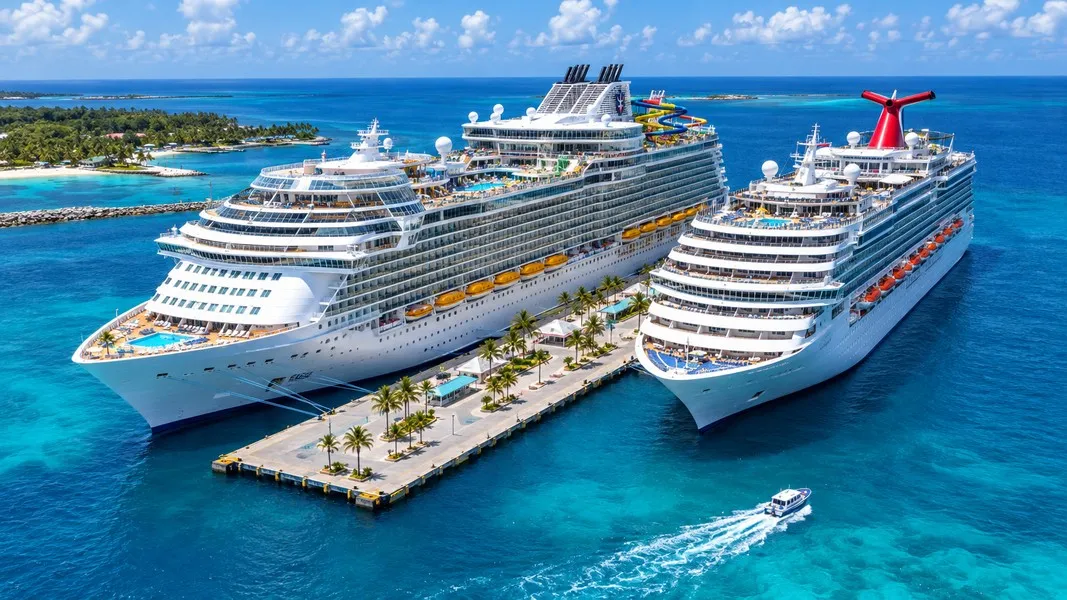
Carnival vs Royal Caribbean comes down to what you want from the ship itself. Royal Caribbean builds the biggest ships afloat and packs them with waterparks, ice skating and big production shows, while Carnival focuses on a relaxed, social "fun ship" atmosphere with a flat-rate drink package and a brand new private destination in The Bahamas.
Both lines sail the Caribbean, The Bahamas and Alaska, so the region alone rarely decides it for you. The differences sit in ship size, included dining, drink rules, private islands, kids programs and loyalty perks. This guide compares each one with current figures, then tells you which type of traveler each line suits best.
Carnival vs Royal Caribbean: The Quick Verdict
If you only have a minute, this table covers the main differences between the two cruise lines.
| Category | Carnival | Royal Caribbean |
|---|---|---|
| Best for | Relaxed, social cruises | Families who want big-ship thrills |
| Fleet | 29 ships | 30 ships |
| Largest ship today | Carnival Jubilee | Icon Class, 248,663 gross tons |
| Drink package | CHEERS!, flat daily rate | Deluxe Beverage Package, varies by ship |
| Private destination | Celebration Key, Grand Bahama | Perfect Day at CocoCay, Bahamas |
| Loyalty program | Carnival Rewards, since September 2026 | Crown & Anchor Society |
Royal Caribbean wins on scale and onboard attractions; Carnival wins on simplicity and a predictable drink package price. Neither line is the better choice for everyone, which is why the details below matter.
Overview of Carnival Cruise Line
Carnival markets its vessels as "fun ships", and the description fits. The atmosphere is casual and social rather than built around record-breaking attractions. Its guests are mostly Americans, though the line also sails in Alaska, Mexico and Australia.
According to Cruise.Blog, Carnival runs 29 ships ranging from about 70,000 to more than 184,000 gross registered tons. The largest is Carnival Jubilee and the smallest is Carnival Elation, so the experience on a short Bahamas run aboard an older ship can feel very different from a week on one of the newer Excel Class vessels.
Carnival is also growing. It cut steel for Carnival Destiny, the first of three Ace Class ships, in July 2026, and that ship is due in summer 2029.
Carnival's main strengths are an unpretentious atmosphere, one flat daily price for its CHEERS! drink package, and Celebration Key, a large new private destination with freshwater lagoons and an adults-only beach club.
The weaknesses are mostly about scale. Carnival's current ships have fewer headline attractions than Royal Caribbean's newest vessels, and the fleet spans a wide range of ages and sizes.
Overview of Royal Caribbean
Royal Caribbean is the line of record-breaking ships. Its Icon Class vessels, Icon of the Seas, Star of the Seas and Legend of the Seas, are the largest cruise ships in the world, and the rest of the fleet runs down to smaller legacy ships such as Grandeur, Rhapsody and Vision of the Seas. In total the line operates 30 ships in 2026.
The onboard offer is built around activity. Legend of the Seas, the newest ship, lists Category 6, the largest waterpark at sea, along with seven pools, a FlowRider surf simulator, ice skating, laser tag and five shows included in the fare, from an AquaTheater show to Roald Dahl's Charlie and the Chocolate Factory.
Royal Caribbean's main strengths are the biggest ships with the widest range of attractions, 17 complimentary eateries on its newest ship, and Perfect Day at CocoCay, home to the tallest waterslide in North America.
The trade-offs are crowds and cost creep. A ship this size means more people at the pool and the theater, and many of the best experiences, from the CocoCay waterpark to specialty dining, carry an extra charge.
Ship Size: Icon Class vs Carnival's Biggest Ships
Size shapes almost everything on a cruise: how many pools and restaurants there are, how many people you share them with, and which ports a ship can reach.
Royal Caribbean's Icon Class ships measure 248,663 gross tons and 1,196 feet long, with 20 decks, 18 of them open to passengers, according to the Royal Caribbean Blog. Legend of the Seas has 2,805 cabins and carries 5,610 guests at double occupancy, rising to about 7,600 when every berth is filled.
Carnival's current flagship, Carnival Jubilee, sits at a little over 184,000 gross tons. The gap will narrow when the Ace Class arrives. Each of those three ships is expected to measure about 230,000 gross tons, roughly 27% larger than the Excel Class, and carry around 8,000 guests in more than 3,000 cabins. That would make Carnival Destiny smaller than an Icon Class ship by tonnage but able to carry more people.
For now, if you want the biggest ship at sea, Royal Caribbean is the only answer. If you prefer a ship that feels less like a floating city, a mid-sized Carnival vessel may suit you better. Our cruise ship size ranking shows how both fleets compare with the rest of the industry.
Dining: Carnival vs Royal Caribbean Food
Food is one of the most searched parts of this comparison, and both lines include more than many first-time cruisers expect.
On Carnival Celebration, the cruise fare covers two main dining rooms with à la carte service and a free choice of dining time, a buffet with stations such as a salad bar and Carnival Deli, and casual favorites like Big Chicken. Venues such as Bonsai Sushi and Bonsai Teppanyaki charge extra. The Carnival style is hearty and casual, and its included quick-service spots are a big part of its reputation.
Royal Caribbean's newest ship lists 17 complimentary eateries on Legend of the Seas, a number that reflects how much more room an Icon Class ship has. Dinner in the main dining room comes with two nightly seatings, and on select ships you can choose My Time Dining for a flexible schedule.
The practical difference is variety rather than quality. A big Royal Caribbean ship offers more included places to eat, while Carnival's included options are fewer but well loved. On both lines, the steakhouses, sushi bars and chef's tables sit behind a surcharge.
Drink Packages Compared
Drink packages can add more to your final bill than any other extra, so it pays to know the rules before you sail.
Carnival's CHEERS! package costs $69.95 per person per day plus a 20% service charge when bought before the cruise, and $74.95 plus the service charge on board, according to Carnival's own terms. It covers up to 15 alcoholic drinks per 24 hours, must be bought for the whole voyage, and if one adult in a stateroom buys it, every adult in that stateroom has to buy it too. It does not apply ashore, including at Celebration Key and Half Moon Cay.
Royal Caribbean prices its Deluxe Beverage Package by ship and sailing. CruiseDirect lists it at between $60 and $100 per person per day, with a Refreshment Package at $29 a day for premium coffee, juice and non-alcoholic drinks, and a Classic Soda Package at $12.99 a day. Tap water, coffee, tea, milk, lemonade and iced tea are free.
If you drink moderately, skip both packages and pay as you go. If you plan to drink a lot, Carnival's flat rate is simpler to budget for, while Royal Caribbean's price depends on the ship you book.
Private Islands: Celebration Key vs Perfect Day at CocoCay
Each line now has a flagship private destination in The Bahamas, and for many families this is where the choice gets interesting.
Carnival opened Celebration Key on Grand Bahama in July 2025, a $600 million destination with one of the two largest freshwater lagoons in the Caribbean, over a mile of white sand beach and more than 30 food and drink venues. Pearl Cove Beach Club is the largest adults-only retreat at any cruise destination, with an 11,000-square-foot infinity pool. Carnival expects more than two million guests a year, growing to four million by 2028.
Royal Caribbean's Perfect Day at CocoCay is older and leans harder into thrills. Its Thrill Waterpark has 14 slides, the largest wave pool in the Caribbean and Daredevil's Peak, at 135 feet the tallest waterslide in North America, according to the cruise line's press center. Hideaway Beach is an adults-only area for guests 18 and over, and Coco Beach Club welcomes all ages.
Celebration Key is the better beach-and-lagoon day; CocoCay is the better adrenaline day. Royal Caribbean is also building Perfect Day Mexico, set to open in fall 2027.
Carnival vs Royal Caribbean for Families
Both lines take families seriously, but they approach kids differently.
Carnival's Camp Ocean runs supervised, age-based groups for children aged 2 to 11, starting with Penguins for ages 2 to 5 and Stingrays for ages 6 to 8. The program is built around play and activities on board, and it pairs well with Celebration Key's Starfish Lagoon, a 275,000-square-foot family area at the island.
Royal Caribbean's Adventure Ocean covers the same role, and its newest spaces let kids choose their own themed activities. Adventure Ocean stays open on board during a CocoCay call, which is useful because there is no daycare on the island itself. On the island, children under 14 need a ticketed companion aged 14 or older to enter the Thrill Waterpark.
The bigger difference is what the whole family can do together. A Royal Caribbean Icon Class ship has a waterpark, a surf simulator, ice skating and laser tag included in the fare, so teenagers and parents rarely run out of things to do. Carnival's current ships have fewer headline attractions of that kind. For families with active older kids, Royal Caribbean usually delivers more; for younger kids and a slower pace, Carnival holds its own.
Loyalty Programs After the 2026 Change
If you cruise more than once, loyalty perks can tip the balance.
Carnival replaced its VIFP Club with Carnival Rewards on September 1, 2026, according to Carnival Rewards. The new program adds points earned from cruise fare and onboard purchases, which you can redeem toward cruise fare on Carnival.com or for onboard purchases through the HubApp. Former VIFP members keep their red, gold, platinum or diamond level as a guaranteed minimum for the first two years, as long as they enrolled.
Royal Caribbean runs Crown & Anchor Society, its long-standing loyalty program, alongside Club Royale for casino players.
The Carnival change matters most to existing VIFP members, who now earn spendable points instead of status alone. If you are new to both lines, pick the ship and itinerary you like first and let the loyalty program follow.
Who Should Choose Carnival
Carnival is the better fit when the mood of the trip matters more than the attractions on the ship.
- Groups of friends and couples who want a social, easy-going atmosphere and no pressure to fill every hour
- Travelers who drink regularly and want one predictable daily price for alcohol
- Families with young children who want a beach and lagoon day at Celebration Key rather than a waterpark
It also suits short Bahamas getaways from Florida, Texas and other US homeports, where a relaxed three or four night cruise is the whole point.
Who Should Choose Royal Caribbean
Royal Caribbean earns its place when the ship itself is the destination.
- Families with teenagers who want waterslides, surf simulators, ice skating and big shows included in the fare
- Travelers who want to sail on the largest cruise ships in the world
- Thrill seekers who want CocoCay's waterpark and the tallest waterslide in North America
If you dislike crowds, choose one of Royal Caribbean's smaller ships, or compare it with a mid-sized Carnival vessel on the same route before you book.
Following Either Ship From Home
Whichever line you choose, someone at home will usually want to know where the ship is. Both cruise lines have apps, Carnival's HubApp and the Royal Caribbean app, but those are built for passengers on board and only cover their own fleets.
Primo Nautic tracks any vessel by name, MMSI or IMO number, so the same app works for a Carnival ship one year and a Royal Caribbean ship the next. With the Loved One on Cruise purpose selected, Primo Nautic turns raw position data into warm, plain-language updates about the journey's progress and the weather at the ship's location, with arrival and delay alerts when plans change. Our guides on the Royal Caribbean cruise tracker and on tracking Carnival ships explain how live cruise tracking works for each line.
Conclusion
Royal Caribbean is the stronger choice if you want the biggest ships, the most onboard attractions and a private island built around thrills. Carnival is the stronger choice if you want a relaxed, social atmosphere, a simpler flat-rate drink package and a lagoon-and-beach day at Celebration Key.
Both lines include more dining than most first-timers expect, both charge extra for their best restaurants and island experiences, and both now offer large private destinations in The Bahamas. Decide which kind of day at sea you want, then compare the specific ship and itinerary, because the ship you sail on shapes your cruise more than the name on the funnel.