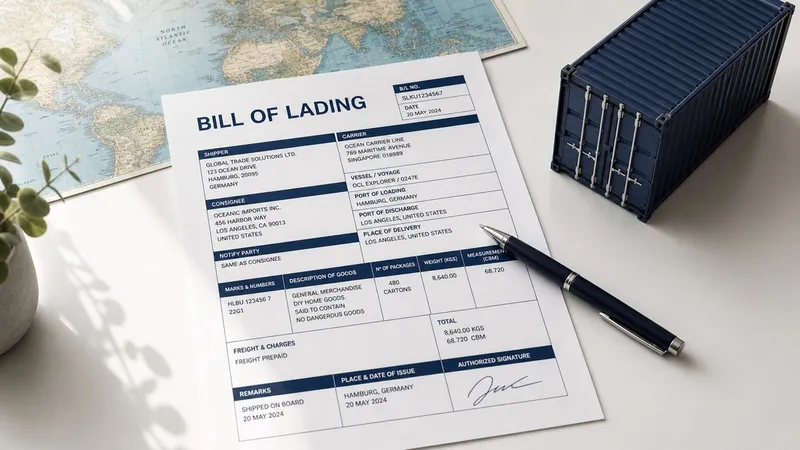

A bill of lading template is the fixed layout of boxes a carrier or forwarder fills in to issue a bill of lading: shipper, consignee, notify party, vessel and voyage, ports of loading and discharge, marks and packages, description of goods, weight and measurement, freight terms, number of originals, place and date of issue, and a signature. Every box on an ocean bill of lading answers to a rule, and a box filled in wrong can hold your cargo at the port or get a letter of credit rejected.
Most free templates you find online are built for US trucking, not for sea freight. This guide walks through the ocean version box by box, shows a sample entry for each one, and explains which rules decide what goes in, so you can check a draft before the carrier issues the original.
What Every Bill of Lading Template Has to Contain
Three sets of rules shape the ocean bill of lading, and a good template covers all three.
The oldest is the cargo convention known as the Hague Rules, later amended into the Hague-Visby Rules. Article III, rule 3 of the Hague Rules text says that once the carrier has received the goods, it must issue the shipper, on demand, a bill of lading showing the leading marks that identify the goods, the number of packages or pieces, or the quantity or weight, as the shipper furnished them in writing, and the apparent order and condition of the goods.
The second is banking practice. When the bill of lading is presented under a documentary credit, Article 20 of UCP 600 rules sets what the bank checks: the carrier's name and a signature by the carrier, the master or a named agent, shipment on board a named vessel at the port of loading, the ports stated in the credit, the full set of originals, terms of carriage or a reference to them, and no sign that the bill is subject to a charter party.
The third is the industry data standard. BIMCO published version 2.0 of its eBL data standard on 16 June 2026, defining each field, its format and whether it is mandatory, conditional or optional. Electronic or paper, the boxes are the same.
The Ocean Bill of Lading Template, Box by Box
The two tables below are the template itself, in the order most carrier forms print it. The example column uses an imaginary shipment of furniture from Shanghai to Rotterdam.
Boxes for Parties, Vessel and Ports
| Box | What goes in it | Example entry |
|---|---|---|
| Shipper | Full legal name, address and contact of the party contracting with the carrier | Ningbo Oak Works Co. Ltd, full address, contact, phone |
| Consignee | Named receiver, or "To order" or "To order of" a bank | To order of First Harbour Bank |
| Notify party | Who the carrier tells when the ship arrives | Delta Home BV, Rotterdam, contact and email |
| B/L number | The carrier's reference for this cargo | Carrier prefix plus number |
| Vessel and voyage | First sea-going vessel and the carrier's voyage number | Vessel name, voyage 245W |
| Place of receipt | Where the carrier takes charge, if before the port | Ningbo inland depot |
| Port of loading | Port where cargo goes onto the first sea-going vessel | Shanghai, CNSHA |
| Port of discharge | Port where cargo leaves the last sea-going vessel | Rotterdam, NLRTM |
| Place of delivery | Final point, if the carrier delivers beyond the port | Venlo, NL |
Boxes for Cargo, Freight and Signature
| Box | What goes in it | Example entry |
|---|---|---|
| Marks and numbers | Container, seal and package marks | Container and seal numbers, carton marks |
| Packages | Number and kind of packages | 412 cartons |
| Description of goods | Plain description that matches the invoice | Wooden dining chairs, flat packed |
| Gross weight | Total weight including packaging, with unit | 8,240 kg |
| Measurement | Total volume, with unit | 58.4 CBM |
| Freight terms | Prepaid or collect, and where payable | Freight prepaid |
| Number of originals | How many originals were issued | 3/3 |
| Place and date of issue | Where and when the original was issued | Shanghai, date |
| Shipped on board date | Date cargo was physically loaded | Date of loading |
| Signature | Carrier, master or named agent, with capacity | As agent for the carrier |
Shipper, Consignee and Notify Party
The shipper box names the party that concluded the contract of carriage, or on whose behalf the goods were handed to the carrier. BIMCO asks for company name, physical address, a contact person, email or fax, phone, and an LEI or tax ID.
The consignee box decides who can take delivery. A named consignee makes it a straight bill. "To order" or "to order of" a bank makes it negotiable, which is what most letters of credit ask for. The ICC's banking guidance is strict here: a bill that must be consigned to a named party should not also carry the words "to order".
The notify party is the company the carrier advises on arrival. It is often the buyer or the customs broker. BIMCO marks both consignee and notify party as conditional, because a to-order bill may name no consignee at all.
Vessel, Voyage and Ports
The vessel box holds the name of the first sea-going vessel the cargo is loaded on, and the voyage box holds the carrier's voyage number. BIMCO defines the port of loading as the place cargo goes onto that first sea-going vessel, and the port of discharge as the place it leaves the last one, both with a UN/LOCODE.
The vessel name on your bill of lading is also the fastest way to follow the cargo at sea. Search that name or the ship's IMO number in Primo Nautic, choose the Cargo Shipment purpose, and you get logistics-focused updates on position, speed and the ship's progress toward the port of discharge.
Marks, Packages and Description of Goods
Marks and numbers carry the container numbers, seal numbers and any shipping marks on the packages. Under the Hague Rules, these marks have to be stamped or shown clearly on the goods or their coverings, legible until the end of the voyage.
The package count and the description should match the commercial invoice and packing list word for word in substance. A carrier is not bound to state marks, numbers or weights it has reasonable grounds to suspect, or no reasonable means of checking, which is why sealed containers often carry protective wording, covered below.
Weight and Measurement
BIMCO requires gross weight, measurement, or both, each with its unit stated in metric or imperial terms. Gross weight includes packaging. Measurement is the packed volume in cubic meters or cubic feet.
If you measure your own cargo, use the same figures you gave the forwarder at booking. A weight on the bill that differs from the export declaration invites questions from customs and sends the draft back for correction.
Freight Terms, Originals and Signature
The freight box says whether freight is prepaid at origin or collect at destination. The originals box states how many originals were issued, usually written as 3/3 on paper. Under the ICC's banking practice, copies marked "First Original", "Duplicate" or "Triplicate" are all originals, and the bank expects the full set.
The signature block names who signed and in what capacity: carrier, master, or agent for a named carrier. BIMCO's standard also requires the date of issue to fall on or after the date loading was completed.
Shipped on Board vs Received for Shipment
A received for shipment bill is issued when the carrier takes charge of the goods, before they are loaded. A shipped on board bill confirms the goods are physically on the named vessel.
Article III, rule 7 of the Hague Rules lets the shipper demand a shipped bill once the goods are loaded. A received for shipment bill becomes a shipped bill when it is noted with the vessel's name and the date of shipment. Banks follow the same logic: UCP 600 wants the bill to show shipment on board a named vessel at the port of loading, either in pre-printed wording or through a dated on board notation.
If your credit or your buyer needs a shipped bill, make sure the template has a clear on board notation area with a date, the vessel name and the port. A missing notation is enough for a bank to call the presentation discrepant.
Clauses That Change What the Template Says
The blank boxes are only half of a bill of lading. A few short clauses change how the boxes are read, and they matter most when goods are packed in a sealed container the carrier never opened.
Clean vs Claused Bills
A clean bill records the goods in apparent good order and condition. A claused bill adds a remark about damage or shortage, such as torn cartons. Buyers usually ask for a clean bill, so a remark here usually means a conversation with the carrier before the original is issued.
Shipper's Load and Count, Said to Contain
Under UCP 600, clauses such as "shipper's load and count" and "said by shipper to contain" are acceptable on a bill presented to a bank. They tell the reader that the carrier is relying on the shipper's figures, because it could not check what was inside the box.
On Deck
UCP 600 says a transport document must not indicate that the goods are or will be loaded on deck. BIMCO's standard has an optional field for cargo shipped on deck at the shipper's risk. If you sell under a credit, leave that field empty unless the credit itself allows deck cargo.
Using a Bill of Lading Template With a Letter of Credit
Under a credit, the bank does not care what the cargo looks like. It compares the documents with the credit and with each other.
That makes the bill of lading template a checklist for the bank's own reading. Before you approve the draft, read it against the credit with these questions:
- Does the bill name the carrier and show who signed, and in what capacity?
- Are the port of loading and port of discharge exactly those stated in the credit, with no "intended" qualifier?
- Does it show shipment on board a named vessel, with a dated notation if the form is not pre-printed as shipped?
- Is the consignee box worded as the credit requires, to order or named?
- Is the full set of originals presented, and does the description match the invoice?
The ICC's guidance adds that a bill of lading need not be titled "marine" or "ocean" bill of lading for a bank to accept it, even when the credit uses those words. What counts is the content, not the heading.
The Straight Bill of Lading Template for Trucks Is a Different Form
Search for a bill of lading template and many of the results are forms for domestic road freight in the United States. They look similar and follow different rules.
For a for-hire motor carrier, federal regulations require only five items on the bill: names of consignor and consignee, origin and destination points, number of packages, description of freight, and weight, volume or measurement where it affects the rate.
The uniform straight bill of lading in the same federal rules is printed "Original, Not Negotiable". An order bill must be titled "Uniform Order Bill of Lading", marked "Negotiable" and consigned "to the order of" a party. Both may be issued on paper or electronically. When a domestic shipment moves between two ports by water, the form must state whether the weight is the carrier's or the shipper's.
If your cargo crosses an ocean, a trucking template is the wrong starting point. It has no vessel, voyage, port of loading or on board notation, which are exactly the boxes a buyer and a bank check first.
Word, Excel or PDF: Which Format Works
The format matters less than who issues the final document. On a full container load with a shipping line, the carrier issues the master bill of lading on its own form, filled from the shipping instructions you send. A forwarder or NVOCC issues a house bill on its own form. In both cases your template is the draft you check, not the document that gets signed.
A Word template is easiest to share as a draft with free text in each box. An Excel template suits shippers who send many similar loads and want to copy weights and package counts from a packing list. A PDF template is best for a fixed layout you print or send for approval.
Whatever the file type, keep the box order of the table above and the wording identical to the commercial invoice. If the original is later released electronically, a telex release or an eBL replaces the paper set, and the same data carries over.
Mistakes That Hold Cargo at the Port
Most bill of lading problems are small mismatches that only surface at destination.
A consignee written differently from the import declaration slows customs. A notify party with an old email means nobody hears about the arrival. A description that differs from the invoice, or a weight that differs from the packing list, triggers questions from customs, the bank or both. A port of loading marked "intended" without a later on board notation can fail a credit.
Timing is the other gap. The bill shows the vessel, but not when that vessel will actually berth. Primo Nautic compares the captain's reported ETA with an AI-calculated route ETA and sends delay and arrival notifications, so you know when to have the original or the release ready before the ship reaches the port of discharge. If you need a refresher on the document's role as receipt, contract and title, our guide on what a bill of lading is covers it.
From Paper Template to Electronic Bill of Lading
The paper template is on its way out. In February 2023 the nine ocean carriers that are members of DCSA committed to issue 50% of their original bills of lading electronically within five years and 100% by 2030, based on DCSA standards.
Adoption is still low. DCSA reported that around 11% of bills of lading were issued electronically as of 2025, and it attributes much of the gap to behavioural and organisational barriers rather than technical or legal ones.
For a shipper, the practical change is small. The eBL carries the same shipper, consignee, ports, goods and weights as the paper template, as structured data. BIMCO's standard even sets the number of originals to one as the eBL default, because a single electronic record replaces the paper set of three.
Conclusion
An ocean bill of lading template is a set of boxes, each tied to a rule. The parties decide who can claim the cargo, the vessel and ports decide where it travels, the marks, packages and weights must match the invoice, and the on board notation, originals and signature are what a bank checks first.
Use a sea freight layout, not a trucking form, and check every draft against the commercial invoice, the packing list and, where there is one, the letter of credit. Watch the clauses as closely as the boxes. Electronic bills will carry the same fields, so a draft that is right on paper today is right as data tomorrow.