




Present Tenses
A quick overview
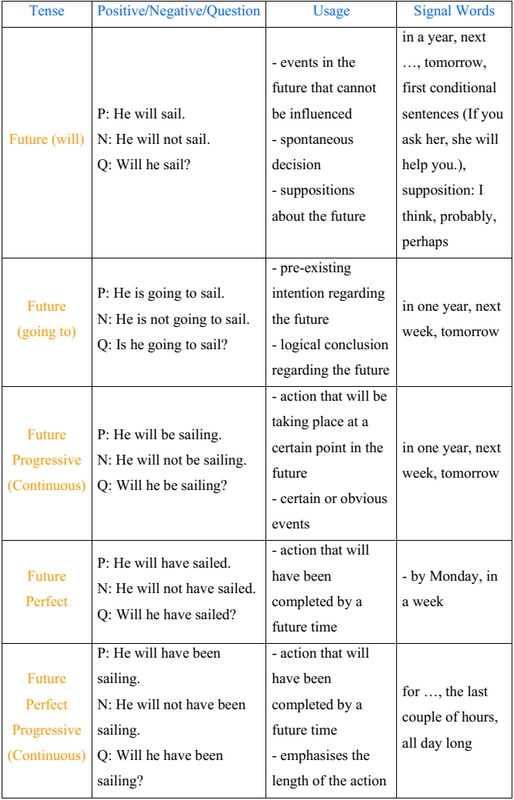
Present Simple
We use Present Simple to talk about present actions and events that take place repeatedly or one after the other, facts, and future actions that are determined by a timetable or schedule. It is one of the most commonly used tenses in the English language.
Examples
The 2nd Mate usually stands a navigational watch.
The Captain does not stand a watch.
Does the Chief Engineer usually work during the day?
Does the Bosun supervise all A/Bs? Yes, he does.
The quartermaster keeps a lookout for other vessels and steers the ship in and out of port.
The captain pays the crew.
I don’t usually go out on Saturday night.
I live in London.
The chief steward speaks German and Spanish.
Do you agree with the new anti-smoking regulations?
The fire drill starts at five o’clock.
Usage
We use the Present Simple tense:
- when we speak of habits and daily routines (what we do sometimes, often, …)
- when we speak about events that take place one after the other (e.g. first we work, then we eat and then go to sleep)
- when we speak about something permanent (where we live, what languages we speak, what we like, hate, know, …)
- to express facts
- for future actions that are planned and predetermined (e.g. by a timetable or programme)
Signal words for Present Simple
The following is a list of signal words that indicate the simple present tense:
- always, normally, usually
- often, sometimes, seldom
- never
- every day/week/month/…
Present Simple Conjugation
The conjugation of English verbs in the simple present is relatively simple. We add an -s/-es to verbs in the third person singular (he/she/it), otherwise the verb does not change. In positive sentences, we use the verb in its present form. In negative sentences and questions, we use the auxiliary verb do. The main verb is used in it the infinitive form.

Spelling Rules
To conjugate verbs in the third person singular in English grammar, we simply and an -s to the verb. However, there are a few exceptions to take note of:
1. When the verb ends with an -o, -ch, -sh, we add -es.
Example: do – he does_,_ wash – she washes
2. When the verb ends with a consonant + y, we change the y to ie before adding the -s. However, verbs that end in vowel + y simply take -s.
Example: worry – he worries, (but: play – he plays)
3. Modal verbs such as can, may, might, and must never take an -s. They remain the same in all forms.
Example: he can swim, she must go
Verb be
The verb be is irregular in all its forms. In negative sentences and questions, we do not use it with an auxiliary verb.
Verb have or have got
There are two version of the verb have in the simple present: have and have got. They are conjugated differently in positive, negative and interrogative sentences.
*Have got expresses possession/belonging in British English. This form is uncommon in American English.
Contractions
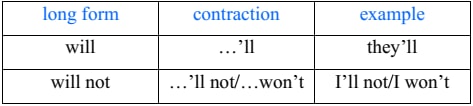
Contractions are a combination of certain pronouns, verbs and the word not. They are mostly used in spoken and informal written English. The table below provides an overview of contractions in the present simple using the verbs be, have and do.
Present Progressive
The Present Progressive, also known as the Present Continuous tense, is formed with the verb be and the present participle or -ing form of the main verb. We use this tense to talk about actions that are in progress at the time of speaking and temporary actions. We can also use the present progressive to talk about future arrangements and plans.
Examples
They are painting the hold.
What are you doing? Are you sleeping?
What is happening on deck? The crew members are having a drill preview meeting.
I’m meeting the crew manager tomorrow morning.
We’re repairing the ship in the dry-dock yard these days.
We are sailing around Australia.
The town is becoming more and more popular because of its beautiful beaches.
Usage
We use the Present Progressive tense for:
- actions happening at the present moment, e.i. now
- planned future events, predetermined events or appointments (usually in the near future, e.g. this evening, next week, …)
- actions or events happening around the present moment
- actions that are only happening temporarily
- situations that are changing
Signal words for Present Progressive
Signal words can help us decide which tense to use. The signal words for the present progressive are:
- at the moment
- now, just now, right now
- Listen!
- Look!
Conjugation
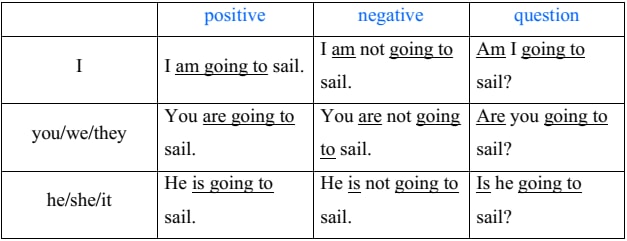
To conjugate verbs in the present progressive we use the conjugated form of the auxiliary verb be. Be is irregular (see the table below). The main verb is conjugated in the -ing form or present participle, it is the same for all people. The table provides and overview of the conjugation of verbs in positive, negative and interrogative sentences in the present progressive tense.

Spelling Rules
Generally, the present participle is formed by add -ing to the base infinitive form of a verb. However, there are a few exceptions:
1. An -e at the end of the word is removed, but -ee, -oe and -ye remain unchanged.
Example: come – coming (but: agree - agreeing)
2. The final consonant is doubled in words that have a short stressed vowel before the final consonant. However, -w, -x and -y are not doubled
Example: sit – sitting (but: fix –fixing)
3. An -l as the final consonant after a vowel is always doubled in British English but not in American English.
Example: travel – travelling (British), traveling (American)
4. An -ie at the end of the word is replaced by a -y.
Example: lie – lying
Contractions
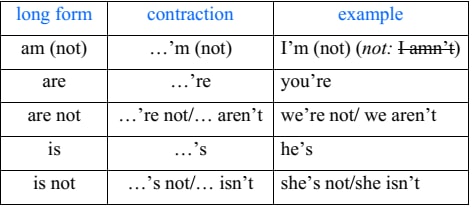
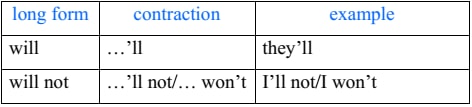
Contractions are a combination of certain pronouns, verbs and the word not. They are mostly used in spoken and informal written English. The table below provides an overview of contractions in the present progressive using the verb be.
Present Perfect Simple
The Present Perfect tense connects the past with the present. Use this tense to emphasise the result of a past action, especially when the exact time of this action is not important. The present perfect is formed using a present form of the verb have and the past participle of the main verb. Be aware that many languages have a tense that is similar to the present perfect, however, the usage is probably different.
Examples
We have secured all moorings.
Have you sounded the tanks? Yes, we have just finished sounding the tanks.
Have you connected the bunker hoses?
The Master hasn’t signed the Bunker Delivery Note (BND) yet.
He has never lost his wallet.
The other team has not completed their task on time.
Usage
We use the Present Perfect Simple tense to:
- describe recent actions
- express a completed action with influence on the present
- check completion of operation procedures
- give information about activities at different stages of completion
- express an action that has never happened, or has happened once or several times up to the time of speaking
Signal Words
Signal words can help us to recognise the tense in a sentence. The signal words for the present perfect are:
- already, just, not yet
- ever, never
- so far, till now, up to now
Most signal words follow the auxiliary (help verb), however there are others that come at the end of the phrase (yet, so far etc.)

* Some of the signal words for the Present perfect Simple are the same as those for the Past Perfect. The difference is that when used together with the Present Perfect the signal words refer to the present or the very recent past.
Conjugation
To conjugate the present perfect tense in English we use the present form of the auxiliary verb have and the past participle of the main verb. The table below provides and overview of the conjugation in positive, negative and interrogative sentences.
Spelling Rules
The past participle for regular verbs is formed by adding -ed to the base form of the verb. The past participle of irregular verbs is different and should be memorised. However, here are a few exceptions to take note of when conjugating the past participle of regular verbs:
1. When a verb ends with -e, we simply add a -d.
Example: love – loved (not: loveed)
2. The final consonant is doubled after short stressed vowels.
Example: admit – admitted
3. The final consonant -l is always doubled after a vowel in British English but not in American English.
Example: travel – travelled (British), traveled (American)
4. A -y at the end of the word is replaced by an -i.
Example: hurry – hurried
Contractions
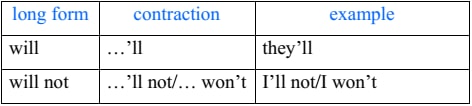
Contractions are a combination of certain pronouns, verbs and the word not. They are mostly used in spoken and informal written English. The table below provides an overview of contractions in the present perfect tense using the verb have.

1. In written English, we usually form contractions with a pronoun and an auxiliary (help verb), but not with a noun and an auxiliary.
Example: They’ve never played football (but not: The girls’ve never played football)
2. However, the contraction of has can be used after nouns as well as pronouns.
Example: He’s/The boy’s never played football. (’s = has)
3. Words that end in -s are an exception to this:
Example: James’s never played football. James has never played football.
Present Perfect Progressive
The Present Perfect Progressive Tense, also known as Present Perfect Continuous, expresses an action that begins in the past and lasts until a present or almost present moment. The timing of this action is not specified, instead, the result or process of the action is emphasised. The present perfect progressive is conjugated with the present form of have, the past participle of be and the present participle or -ing form of the main verb.
Examples
Mat has been sailing since he was eighteen years old.
I have been working on an oil tanker for ten years.
He has been straightening the hold ladder for quite some time.
The 3rd Mate has a stomach ache because he has been eating too much.
What have you been doing since I left?
I have been waiting for you for an hour and a half!
Lately, the Bosun has been coming late.
As Jack has been cleaning the tanks all morning, his overalls are dirty now.
Usage
The Present Perfect Progressive is similar to the Present Perfect, but we use it to express a continuing or unfinished action, or emphasise an action rather than a result.
Here are the three main uses of the Present Perfect Continuous:
- to express an action in the recent past with emphasis on the action itself and not the result
- to express a single continuing action that started in the past and is incomplete at the present moment
- to express repeated actions that started in the past and continue now.
Signal Words
Signal words can help us to recognise the tense in a sentence. The signal words for the present perfect progressive are:
- all day, the whole week
- for 4 years, since 1993, how long?
- lately
Conjugation
To conjugate the Present Perfect Progressive we follow the rule: have/has + been + verb in the -ing form. The table below provides an overview of conjugations of the present perfect progressive in positive, negative and interrogative sentences.
Spelling rules
The present participle is generally formed by adding -ing to the base form of a verb. However, there are a few exceptions to this rule:
1. An -e at the end of the word is removed, but -ee, -oe and -ye remain unchanged.
Example: come – coming (but: agree – agreeing)
2. The final consonant is doubled in words that have a short stressed vowel before the final consonant. However, -w, -x and -y are not doubled.
Example: sit – sitting (but: mix – mixing)
3. An -l as a final consonant after a vowel is always doubled in British English but not in American English.
Example: travel – travelling (British), traveling (American)
4. An -ie at the end of the word is replaced with a -y
Example: lie – lying
Contractions
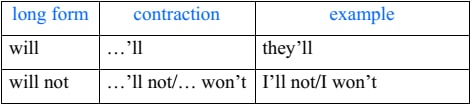
Contractions are a combination of certain pronouns, verbs and the word not. They are mostly used in spoken and informal written English. The table below provides an overview of contractions in the present perfect progressive tense using the verb have.
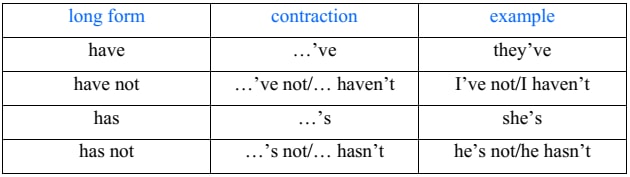
*The contracted form of have is generally only used after pronouns.
Example: They’ve been cleaning tanks in the morning (but not: The men’ve been cleaning tanks in the morning.)