




Cruise Ship Jobs: Roles, Pay and Life at Sea
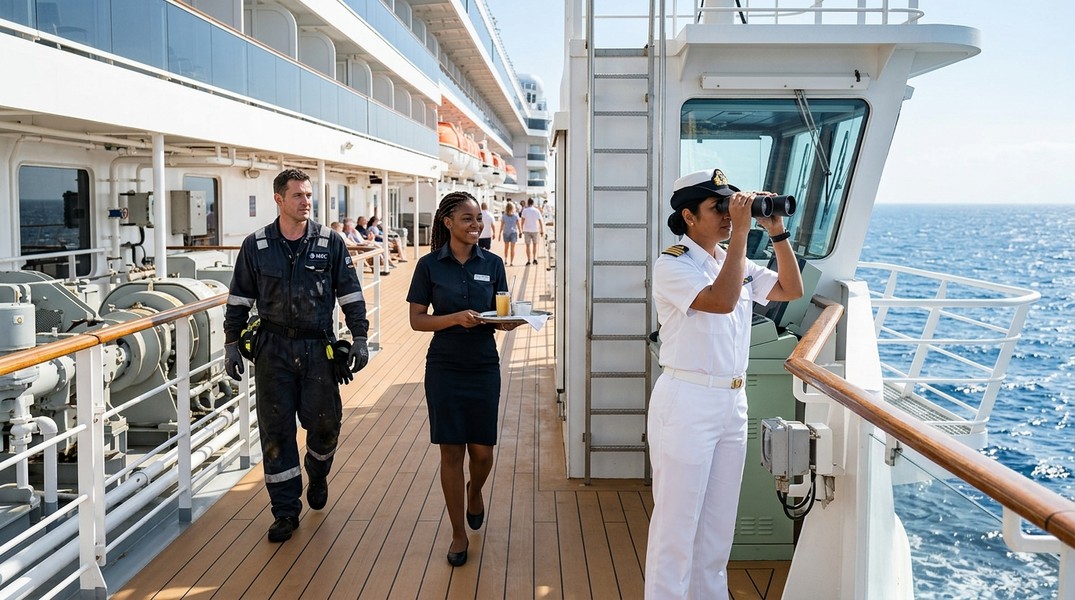
Cruise ship jobs span a wider range than most people expect. A large modern vessel operates like a floating city, requiring hundreds of specialists to keep it running: engineers managing multi-story engine rooms, chefs feeding thousands of guests, medical staff running fully equipped clinics, and performers filling theaters every night. Royal Caribbean's Icon of the Seas operates with over 7,600 crew members serving 5,610 passengers.
If you're exploring a career at sea, or someone you care about is already working onboard, this guide covers every major department, what each role pays, and what daily life looks like when the ship leaves port.
How Cruise Ships Are Staffed
Cruise ship jobs fall into five core departments. Hotel and hospitality accounts for 60-70% of the crew on most ships, but every department plays an essential role in keeping the vessel running and the guests happy:
- Deck and Navigation: Handles ship operations, safety, and course-plotting. Captains, deck officers, and able-bodied seamen all belong here.
- Engineering and Technical: Keeps propulsion, electrical systems, and HVAC running around the clock. Engineers, electricians, and motormen form this team.
- Hotel and Hospitality: The largest group by far. Cabin stewards, waitstaff, bartenders, chefs, and guest services all fall here.
- Entertainment and Wellness: Performers, fitness instructors, spa therapists, and youth counselors.
- Medical and Security: Doctors, nurses, and security officers who handle emergencies and day-to-day health needs.
A mid-sized ship carrying 3,000 passengers typically operates with 1,200-1,500 crew members. Each department has a clear hierarchy and its own qualifications structure.
Deck and Navigation Jobs
Deck officers are responsible for navigation, safety drills, and the ship's operational readiness. The captain sits at the top of this hierarchy, overseeing all decisions related to operations, routing, and crew safety. Below the captain, the chief officer manages deck crew, supervises safety drills, and coordinates mooring operations at port.
Officers stand watch in rotating four-hour shifts, plotting courses and monitoring weather throughout the voyage. Able-bodied seamen carry out physical maintenance on deck: painting, rigging, and mooring line handling. The bosun leads this team and coordinates daily repair tasks.
Most deck positions require STCW certification alongside either a maritime academy degree or documented sea time. Deck officers typically earn $5,000-$10,000 per month. Able-bodied seamen earn $2,500-$4,000, with the bosun reaching $3,500-$5,500. All packages include free accommodation and meals.
Engineering Jobs at Sea
The engine room runs 24 hours a day, every day of the contract. The chief engineer oversees all machinery, maintenance schedules, and regulatory compliance. Second and third engineers manage daily operations and stand watch over the engine room during their assigned shifts.
Electricians maintain the ship's electrical systems, HVAC, and automation controls. Motormen monitor fuel systems, pumps, and engines, reporting to the duty engineer. All marine engineering positions require recognized qualifications alongside an STCW certificate.
Pay in the engineering department reflects the technical expertise required. Chief engineers earn $8,000-$12,000 per month, with second and third engineers typically in the $5,000-$8,000 range. Electricians and motormen earn $3,500-$6,000, with accommodation, meals, and travel to the ship all covered.
Hotel and Hospitality Jobs on Cruise Ships
Hospitality positions make up the majority of cruise ship jobs, and most of them require no maritime qualification. Cabin stewards clean guest rooms and handle laundry and turndown service. Waitstaff and bartenders serve across multiple restaurants and bars throughout the ship, handling upselling responsibilities alongside regular table and counter service.
Chefs and cooks work in galleys preparing food for several restaurant concepts on larger ships, with specialized roles for pastry, sushi, and fine dining. Guest services agents manage check-ins, complaints, and onboard account queries. Casino staff deal cards and operate machines on the casino floor. Retail associates manage shops, often working on a commission structure tied to sales.
Base pay for hospitality roles runs $1,500-$3,000 per month, but gratuities add $1,000-$2,000 more each month for service-facing roles. Because accommodation, meals, and transport to the ship are all employer-provided, the savings potential is considerably higher than the base salary alone suggests.
Entertainment and Wellness Positions
Entertainment on a modern cruise ship ranges from production theater shows to comedy nights, deck parties, and trivia events. Singers, dancers, and comedians audition for contracts that are typically shorter than other departments, often running 3-6 months per stint. Cruise directors host daily events, coordinate the entertainment calendar, and make the ship-wide announcements guests hear each morning.
Fitness instructors lead classes from yoga to spin cycling to personal training sessions. Spa therapists offer massages, facials, and beauty treatments in dedicated wellness centers. Youth counselors run supervised programs for children and teenagers, and typically need a background in childcare or education alongside a first aid certificate.
These roles value personality and strong guest interaction as much as technical skill. Performing arts positions require auditions or recorded skill demonstrations as part of the application process.
Medical Jobs on Cruise Ships
Cruise ship medical teams operate fully equipped clinics that handle everything from seasickness to cardiac emergencies, hundreds of miles from the nearest shore-based hospital. The ship's doctor leads the team, managing the medical center and responding to emergencies around the clock.
Cruise ship jobs for nurses are among the more sought-after maritime roles for healthcare professionals. Nurses provide outpatient and inpatient care, run daily sick bay sessions, and cover on-call duties for emergencies. Requirements typically include a valid RN license, at least three years of clinical experience, and current certifications in ACLS, PALS, and BLS. Cruise lines conduct rigorous screening, and ITF safety standards set the baseline for medical staffing requirements at sea.
Registered nurses earn $3,500-$5,000 per month, with chief nurses reaching $6,000-$8,000. Because accommodation and meals are provided, the net value of these packages often compares favorably to equivalent land-based positions. Dental assistants and paramedics fill out the rest of the medical team on larger ships.
What Cruise Ship Jobs Pay
Pay varies significantly by department and seniority, but every package includes free accommodation and meals aboard the ship:
| Department | Typical Monthly Pay (USD) |
|---|---|
| Captain | $10,000-$15,000 |
| Deck / Navigation Officers | $5,000-$10,000 |
| Engineering | $5,000-$12,000 |
| Medical (Nurses) | $3,500-$8,000 |
| Entertainment / Wellness | $2,500-$5,000 |
| Hotel / Hospitality | $1,500-$3,000 + tips |
For many nationalities, cruise ship income is also tax-advantaged, since crew spend the duration of their contract offshore. Hospitality roles rely significantly on gratuities, which typically add $1,000-$2,000 per month on top of base salary. Combined with no living expenses, many crew members return home after six months having saved the majority of what they earned.
The captain's salary sits at the top of this range. For a detailed breakdown by rank and cruise line, the captain's salary guide covers how compensation changes with seniority and employer.
Contracts, Hours and Life at Sea
Cruise ship contracts typically run four to eight months, followed by a period of leave at home. A common rotation is six months on, six to eight weeks off. Deck officers often cycle through four months on, two months off. Exact contract lengths vary by cruise line and role.
Working hours are demanding across every department. Most crew members work 10-12 hours per day, seven days a week, for the duration of their contract: 70-84 hours per week with no traditional overtime. Port days provide brief breaks when crew can go ashore. Sea days are full operational days from start to finish.
Crew accommodation is functional but compact: shared cabins typically housing two to four people, located in the lower decks below the waterline. A bunk bed, small wardrobe, and shared bathroom make up the standard setup. Separate crew mess halls, bars, and a gym give crew their own space away from guest areas.
Family separation is one of the hardest realities of shipboard life. Crew members spend 10-34 weeks away from home without seeing their families. Wi-Fi is available on most ships but tends to be slow and comes at an additional cost.
For families at home, Primo Nautic makes it easier to stay close to the journey. Rather than trying to interpret raw AIS position data, the app translates vessel location, current sea conditions, and ETA into human-friendly updates calibrated to the "Loved One Working at Sea" context. Knowing the ship is steaming through calm conditions toward a scheduled port arrival is more meaningful than a set of coordinates and a speed readout.
How to Get a Cruise Ship Job
The application process differs by role. Deck and engineering positions require STCW certification before you can apply. The basic STCW safety package covers firefighting, first aid, personal sea survival, and personal safety. It typically costs around $1,000 at an accredited training center and is valid internationally.
For hospitality, entertainment, and wellness positions, no maritime qualification is needed. Cruise lines recruit directly through their own careers pages. Royal Caribbean, Carnival, Norwegian, MSC, and Disney all post vacancies on dedicated job boards as well as their own sites. Manning agencies list positions across multiple lines simultaneously.
The process is faster than many land-based applications but includes medical screening, background checks, and drug testing. Applications typically require a resume, a recent photograph, and sometimes a short video introduction. Expressing genuine enthusiasm for hospitality, travel, and working in a multicultural environment makes a measurable difference in selection outcomes.
If you want to track the ship your family member will be working on, Primo Nautic lets you do so before they even board. Search by vessel name or IMO number to see real-time position, route history, and current conditions at sea.
Conclusion
Cruise ship jobs cover an enormous range, from licensed deck officers navigating vast ocean routes to nurses running shipboard clinics to chefs producing thousands of meals each evening. The common thread is long contracts, demanding hours, and an extended period living at sea.
Pay varies widely across departments, but the full package, including free accommodation, meals, and travel to and from the ship, often makes these roles financially competitive with equivalent land-based work. The lifestyle suits those who thrive in multicultural, high-energy environments and can manage extended time away from home. For families following the journey from shore, staying connected to where the ship is and what conditions are like is easier than it used to be.
Most Recent Posts
Discover more articles from our blog.